Watch Guide · Published · Updated September 2026
Luxury Watch Brands Explained
We carry a range of luxury watch brands. Each one has its own idea of what a watch should do. Rolex and Cartier make watches for everyday wear. Audemars Piguet, Patek Philippe, Girard-Perregaux and MB&F make watches that are more rare. Collectors seek these out.
This guide is honest about that range. Here is one more fact: most watches listed here are pre-owned, and the listings change often. A watch listed today may sell next week. A different one takes its place. That is normal for a pre-owned dealer. It does not mean anything is wrong with the brand or the watch.
The brands below differ in two ways. First, think about why each watch was built. Rolex solves real problems. It keeps water out. It tracks a second time zone. Cartier and Patek Philippe’s Calatrava start from a beautiful design instead. Second, think about how rare each brand is. Rolex and Cartier make watches all the time, in large numbers. Audemars Piguet and Patek Philippe make far fewer watches than people want to buy. Girard-Perregaux and MB&F make so few watches that having none listed is normal. It is not a problem. Both of these facts shape how a watch feels to own. They matter more than the name on the dial.
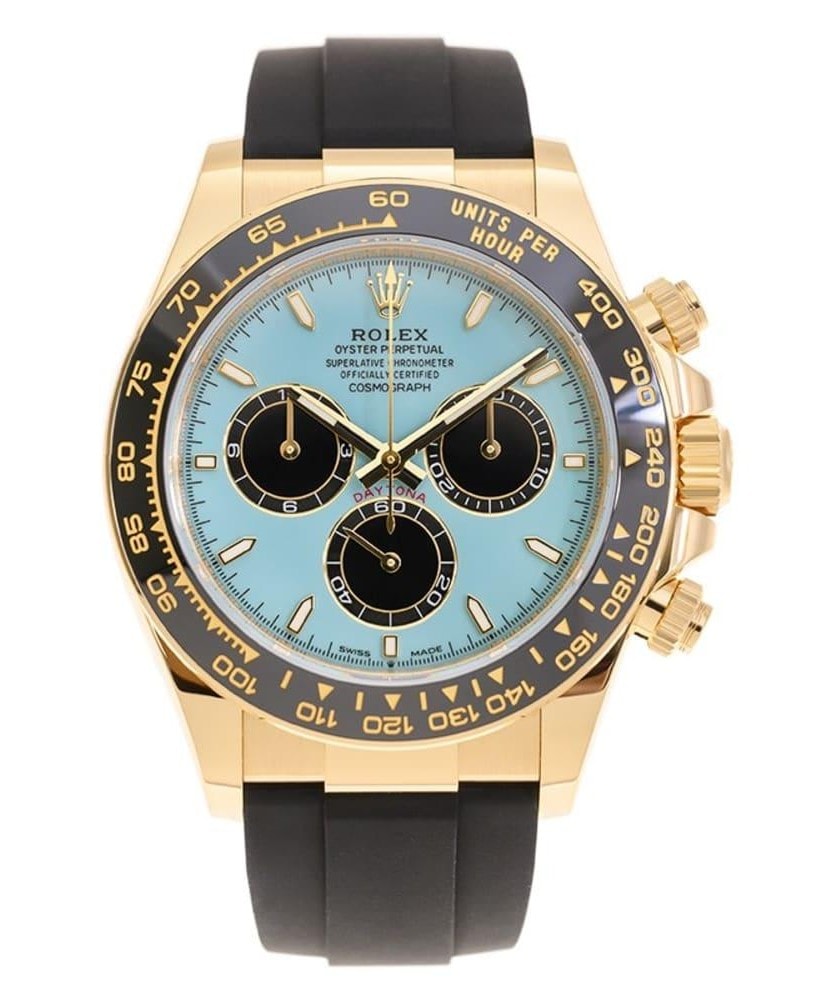
Rolex — the tool watch that became the benchmark
Rolex built its name by solving real problems, not by adding decoration. The big turning point came in 1926. That year, Rolex made the Oyster case. It was the first wristwatch case sealed tight enough to keep water out. Rolex’s own account of the watch’s history traces the whole modern catalog back to it. A few years later, Rolex added the self-winding Perpetual rotor. This part winds the watch as you move your wrist. Together, these two parts are why most current models are still called an Oyster Perpetual something.
After that, Rolex built specific watches for specific jobs:
- the Submariner, for diving
- the GMT-Master II, for pilots who track two time zones at once
- the Explorer, for mountain climbing
- the Daytona, for racing
This is also why the Datejust, Submariner and GMT-Master II are today’s most common used Rolex watches. Rolex barely changed these designs for decades. That means parts, service and buyers are all easy to find. That is what makes a used Rolex easy to sell again. It is not a gamble.
This is also why Rolex collectors use nicknames instead of model numbers. You may hear names like Pepsi, Kermit and Starbucks. Rolex designs barely change for decades. So the color of a bezel or dial becomes the easiest way to tell them apart. Our guide to those nicknames covers where each one came from.
Rolex also makes almost every part of its watches itself. This includes its own gold. It also includes its own hairsprings, the tiny coiled springs that help a watch keep accurate time. Few Swiss watchmakers make so much in-house. This is part of why Rolex quality stays steady, model after model, decade after decade. Current stock is on our Rolex watches in Atlanta page.
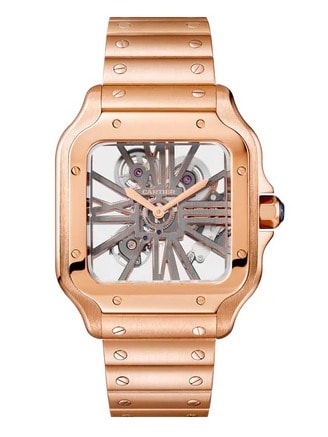
Cartier — a jewelry house that also builds watches
Rolex treats a watch like a tool. Cartier treats a watch like jewelry that also tells time. It has worked this way since 1847. The clearest example is the Santos, made in 1904 for the pilot Alberto Santos-Dumont. He needed to check the time while flying. He did not want to let go of the controls to reach for a pocket watch. Cartier still credits it as one of the first men’s wristwatches made for a real purpose. The Tank came next, in 1917. Its rectangular shape is said to come from an aerial view of a tank’s tracks in World War I. The newer Roadster brings that same Cartier look into a rounder, sportier case.
The shaped cases give Cartier away. A square Santos or a rectangular Tank sits on the wrist differently from a round Rolex. Even in plain steel, it looks dressier. Cartier also sells two kinds of movement. We carry both:
- Quartz — runs on a battery. It never needs winding, and keeps very tight time.
- Automatic — winds itself as you move your arm. It has no battery, and often carries more resale value.
Cartier also builds most of its watches to be worn every day, like jewelry. You do not take them off for tasks, the way you might a tool watch. Pieces like the Panthère have the bracelet built into the case. They feel just as at home at dinner as at work. That is a different goal from a dive watch’s water resistance rating. See what we currently have on our Cartier watches in Atlanta page.
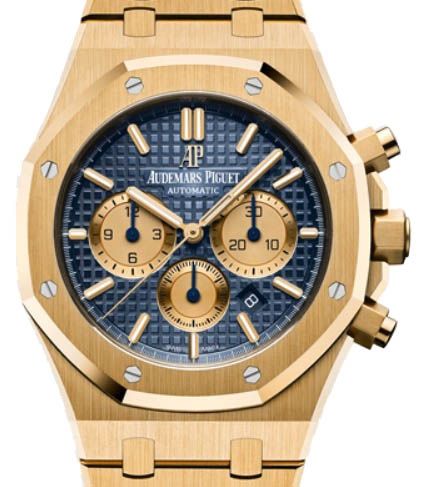
Audemars Piguet — the watch that invented luxury sports watches
Audemars Piguet has made watches in the Vallée de Joux since 1875. One 1972 design defines the house today: the Royal Oak. At that time, steel was only used for tool watches. It was never used for fine ones. AP priced a steel watch like a gold dress watch. The bet paid off. Two details make the Royal Oak easy to spot:
- an octagonal bezel, held by eight visible screws shaped like hexagons
- a bracelet built into the case, instead of hanging off separate lugs
That one design still carries most of AP’s current line. It is also why AP prices run high on the used-watch market. AP has never made watches at Rolex’s scale. So demand for the Royal Oak is higher than the small number AP makes each year.
AP was known for something else long before 1972. It made complications: extra features beyond simply telling time. Some watches had minute repeaters that chime the hour. Others had perpetual calendars that track the date for decades. This, not sport watches, was AP’s original reputation. The Royal Oak did not replace that skill. It just became most people’s first look at the brand. Browse current pieces on our Audemars Piguet watches in Atlanta page.

Patek Philippe — scarce by design, not by accident
The Stern family has run Patek Philippe since 1932. That makes it one of the few major watch houses never bought by a larger company. Patek has two main lines. They pull in opposite directions:
- Calatrava — from 1932, a plain, round dress watch. It set the template most dress watches still copy today. Its clean lines match the Art Deco style popular then.
- Nautilus — from 1976, it took the Royal Oak’s integrated-bracelet sports idea and gave it a porthole-shaped case
Both lines share one thing: they are scarce on purpose. Patek could make more watches, but chooses not to. This is a strategy, not a shortage waiting to be fixed. It is also why our own Patek selection is small. Just a few pieces are listed at a time.
This same restraint shows up in Patek’s complications, the extra features collectors know it for. Some track the phases of the moon. Some chime the hour. Nothing on the dial explains what they do. That is a quiet kind of showing off, different from a large logo or an oversized case. It is a big reason Patek pieces hold their value so well. See what we currently hold on our Patek Philippe watches in Atlanta page.

Girard-Perregaux — one of watchmaking's oldest manufactures
Girard-Perregaux has run without a break since 1791. That makes it one of the oldest Swiss watch companies still in business today. Watchmakers call a company like this a manufacture — it still builds its own parts. Its signature piece of engineering is the Three Gold Bridges tourbillon, patented in the 1860s. A tourbillon is a small rotating cage that helps a watch keep steadier time. Here, three arrow-shaped gold bridges hold this part in plain view, instead of hiding it under a dial. You can still see that same look on the house’s high-end pieces today.
The Laureato launched in 1975. It has the same style of bracelet-built-in sports case as the Royal Oak and the Nautilus. It arrived within a few years of both. But it never gained either rival’s fame. That has, over time, kept similar engineering at a lower price.
For a collector, that mix is often the appeal itself. Girard-Perregaux is a genuinely old manufacture. It invented its own signature complication, rather than licensing one. It also has a smaller following than Rolex, AP or Patek. You get similar engineering without competing for the same watches everyone else wants. Stock rotates quickly at this end of the range — check our Girard-Perregaux watches in Atlanta page for what we currently hold, or ask us to find one for you.
Which is right for you
A few quick situations cover most people who ask us this question:
- Daily wearer: Start with Rolex. It is tough. It is easy to service almost anywhere. It is easy to resell too. These are good qualities for a watch you wear all the time.
- First serious watch: Try a Cartier Tank or an entry-level Rolex. Both are easy to recognize and easy to resell later. Neither takes you into rare, hard-to-find territory yet.
- Collector chasing rarity: Look at Audemars Piguet, Patek Philippe or Girard-Perregaux. These brands are about scarcity itself, not everyday use.
None of these situations is a strict rule. Many people end up owning watches from more than one group over time. Owning a Rolex for daily wear and a Patek for special pieces is common. It is not a contradiction. Every brand here shares one thing. Our selection is pre-owned. Its condition is described honestly on every listing.
Frequently Asked Questions
Related guides & collections
- How to buy a pre-owned luxury watchCondition grades, box and papers, and how sourcing works.
- Rolex models explainedEvery current Rolex model line, compared.
- Rolex nicknames explainedPepsi, Starbucks, Kermit, and the rest of the nickname culture.
- Shop all pre-owned luxury watchesBrowse the full live inventory, faceted by brand and price.
Every house, one process
Ready to Talk Through Which Brand Fits?
Whichever house you land on, the process is the same: you call or message us, pay by wire transfer, and we buy the piece from our supplier. It ships to you, or you can collect it at our Snellville showroom. Tell us what you are looking for, and we will tell you honestly what we can find.
Prefer to talk? Call (704) 684-7530