Ear Piercing Guide · Published
Earrings for Sensitive Ears and New Piercings
Earrings for sensitive ears start with the metal in the post, because the post is the part that sits inside the skin. No metal is guaranteed to suit everyone, so this guide sticks to what the American Academy of Pediatrics, Sutter Health and the Association of Professional Piercers say, and to how we help you pick a first stud.
Where to start with sensitive ears
If an earring has ever left your ears red, sore or itchy, the first thing to look at is what the post is made of. We are jewelers, not doctors, so we will not diagnose a reaction, and the right person to ask about one is your doctor.
Several sources shape this guide, and we name each one where it matters. The American Academy of Pediatrics speaks to children and gold posts, Sutter Health lists the metals piercers recommend, and the Association of Professional Piercers covers aftercare. The American Academy of Dermatology and the Mayo Clinic explain nickel allergy, and the Federal Trade Commission defines what karat, gold filled and gold electroplate mean. Where they cannot tell us something, we say so instead of guessing.
The American Academy of Dermatology says earrings and earring backs are among the most common causes of nickel allergy, and the Mayo Clinic likewise links nickel allergy most often to earrings and piercing jewelry. Both name nickel, a metal found in alloys, as the cause, which is why it helps to know what an alloy contains.
This matters most for a new ear piercing, because the post stays in the lobe day after day while the piercing settles. Choosing the metal on purpose, rather than by color or by price tag, is the simplest thing you can do for a sensitive ear.
Metals piercers recommend
Sutter Health lists the metals that piercers recommend for body jewelry. They are implant-grade surgical steel, 14K or 18K gold, palladium white gold, niobium and titanium. That list is a good place to begin if your ears have ever reacted to an earring.
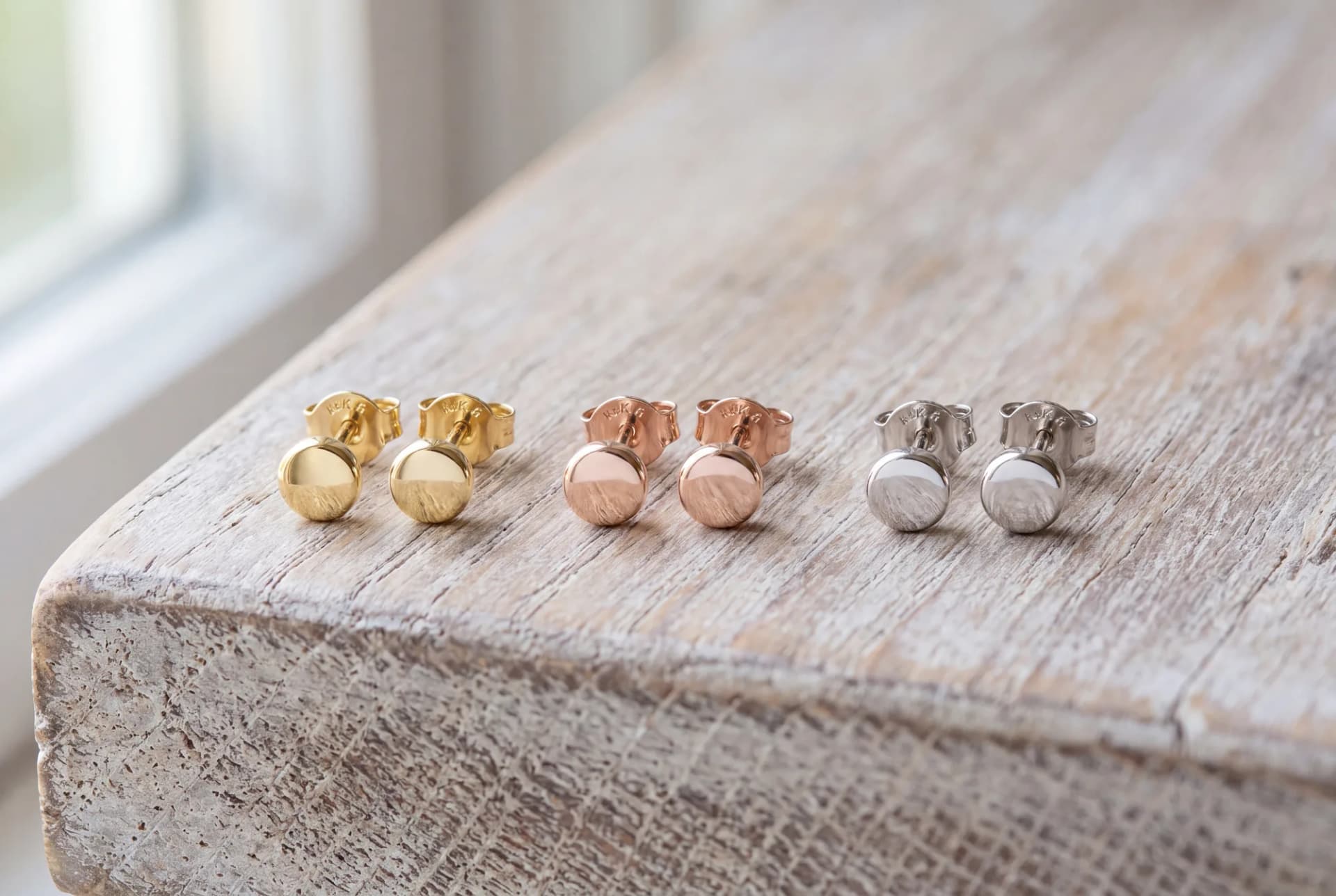
The studs we pierce with are chosen from our own case. Ask us what a particular stud is made of before you decide, and we will tell you what we know. Having the metal named in plain words is better than guessing from the color, and it gives you something specific to check against the list above or to show your doctor.
Reading the name of the metal
A description that only says gold tone or gold color does not tell you what the post is made of. A karat number such as 14K or 18K names a gold, and a word such as titanium or niobium names a metal outright. The more plainly a metal is named, the easier it is to compare with the list above.
The Federal Trade Commission's Jewelry Guides explain the karat number. Karat means parts of gold in 24, so 14K is 14 parts gold in 24, a little over half. The same guides separate three things that can all be described as gold. Plating, which the guides call gold electroplate, is a far thinner layer of gold over another metal, so a thin surface layer can wear through. Gold filled is a thicker layer of gold bonded to another metal, at least one twentieth of the piece's weight. Solid gold is a gold alloy all the way through.
When you shop for sensitive ears, look for the metal named in plain words and ask if it is not. The same habit helps when you talk to a doctor, because a specific name gives them something to work with.
Is 14K gold hypoallergenic?
The word hypoallergenic means less likely to cause an allergic reaction. It does not mean certain to avoid one, and no metal is guaranteed for everyone. So the honest answer to whether 14K gold is hypoallergenic is that it is not a promise.
What we can say is that Sutter Health includes 14K gold, along with 18K gold, on its list of metals piercers recommend. That is why 14K gold earrings for sensitive ears are a sensible place to start looking. The Mayo Clinic lists 18K and higher yellow gold instead, so the two sources differ on 14K, and that is one more reason to ask your doctor. If you have reacted to jewelry in the past, tell your doctor which pieces bothered you, and tell us when you come in.
White gold deserves a question rather than an assumption. The Mayo Clinic's list of better choices includes nickel-free white gold, which tells you white gold is not automatically nickel-free, so ask whether a piece is. If you are wondering whether you can wear white gold with a nickel allergy, the answer is for your doctor to give. Sutter Health lists palladium white gold among the metals piercers recommend, so ask for it by name and ask what is in any white gold piece you are considering.
What the pediatricians say about gold posts
For children, the American Academy of Pediatrics, as summarized by Johns Hopkins Medicine, makes its main recommendation plainly. It is to postpone piercing until a child is mature enough to care for the site herself.
If parents go ahead, the academy advises gold posts to reduce the chance of a reaction, and says the piercing should be done by a trained professional under sanitary conditions. Children come to us with a parent or guardian, and we are glad to talk it through with you before you book.
Caring for a new piercing with sensitive skin
The right metal is half of it, and care is the other half. The Association of Professional Piercers recommends a sterile saline wound wash in which sodium chloride at 0.9% is the only ingredient. Wash your hands first, and pat the area dry with disposable gauze.
The association says to avoid alcohol, hydrogen peroxide, harsh soaps, ointments and benzalkonium chloride ear care solutions. It also says not to twist or rotate the jewelry during healing and not to over-clean. Homemade salt mixes are no longer suggested.
Keeping it simple is part of the advice. The association cautions against over-cleaning, so more products and more rinses are not better. A sterile saline wash used as directed, clean hands and gauze are what it names, and everything else on its avoid list can wait for a conversation with your doctor.
You may remember older advice to turn the earring. That advice has changed, and the current association guidance is not to twist it. Follow the instructions you are given at your appointment, and your doctor's advice, if they differ from what you read online.
When to see a doctor
Sutter Health says to see a provider for pain that lasts beyond a day or two, for heat, for red lines spreading from the site, or for pus. The Association of Professional Piercers says that if you suspect an infection you should seek medical attention.
The same goes for any reaction you think might be to the earring itself. Take the concern to your doctor or pediatrician rather than waiting it out. It also helps to tell them exactly what the earring was made of, which is one more reason to have the metal named plainly when you buy.
Choosing a first stud
Choose the metal of the post first. Once that is settled, look for a small, smooth front that will not catch on hair or clothing, and a back that holds the earring firmly in place without pressing hard against the lobe.
If you would like to see gold options before you visit, our 14K gold earrings show a range of styles. A simple stud is the easiest place to start, and you can change to something more decorative once you are comfortable wearing earrings.
We pierce ear lobes by appointment, and you choose the stud from our case. We are glad to answer questions about the metals before you book, so call the showroom or ask when you come in.
Frequently Asked Questions
Related guides & collections
By appointment
Choose a Stud From Our Case
We pierce ear lobes by appointment. Book a time and pick your stud from our case, or call the showroom with any question first.
Prefer to talk? Call (704) 684-7530