What Is a Bezel Set Engagement Ring?
A bezel set engagement ring holds the center diamond inside a continuous rim of metal rather than between prongs — a full bezel surrounds the whole stone, a half bezel wraps only two side edges. The result reads architectural: clean, geometric, unmistakably modern.
- Most protective — the collar wraps the diamond’s girdle (its most vulnerable edge) and absorbs impacts that would chip a prong-set stone. The rational pick for nurses, surgeons, chefs, athletes, and parents of small children.
- Lowest profile — sits closest to the finger of any common setting style.
- Brilliance trade-off — a bezel stone gets ~90–95% of a four-prong’s light entry; imperceptible at 1ct+, slightly more noticeable under 0.5ct.
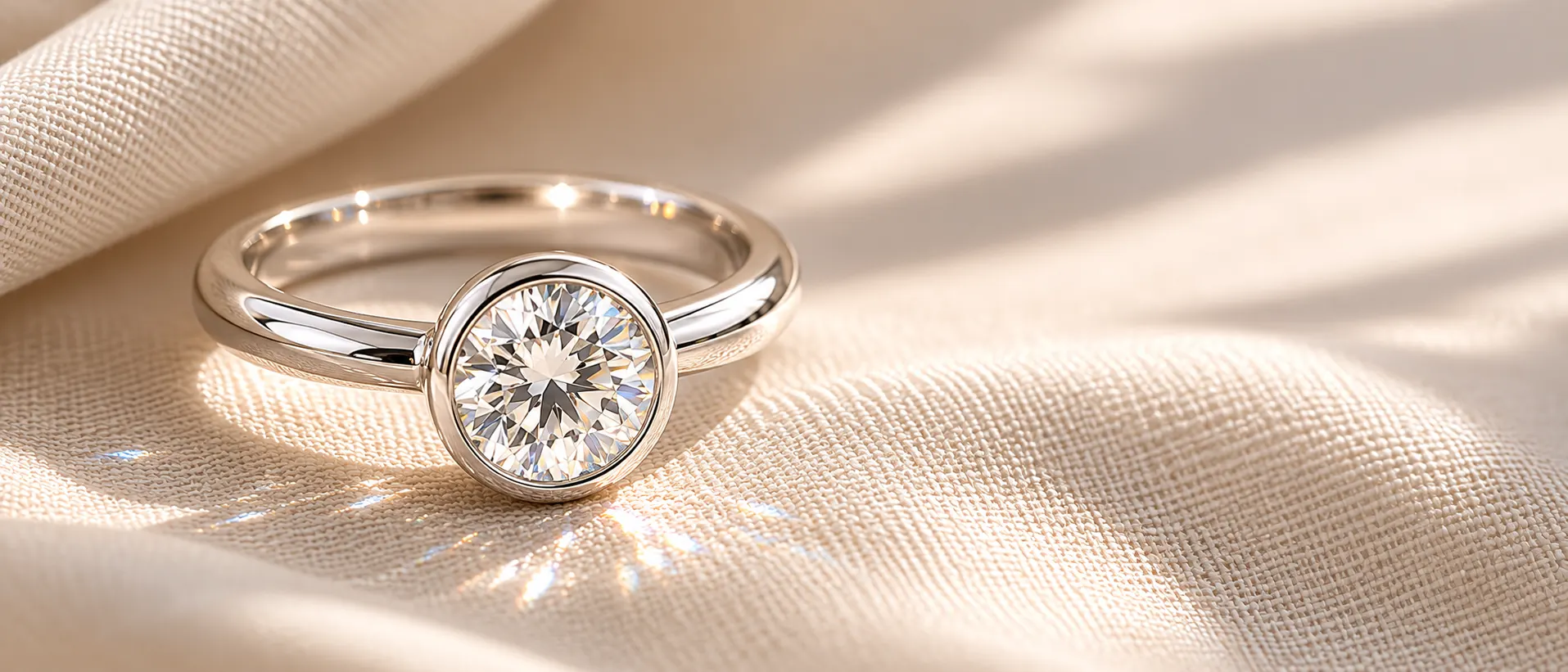
Full Bezel, Half Bezel & East-West Bezel Variants
Bezel variants offer different aesthetics within the same protective philosophy:
- Full bezel — continuous collar around the entire perimeter; maximum protection, cleanest modern look. The most-purchased config at our showroom.
- Half bezel — collar on only two sides (north-south or east-west), other two exposed; still protective but more light entry, reads more delicate and traditional.
- East-west bezel — an elongated stone (oval, emerald, marquise, pear) oriented HORIZONTALLY across the finger; distinctively modern, flattering on shorter fingers.
- Invisible / flush set — the diamond sits in a groove milled into the band, no visible collar; the cleanest minimalist look.
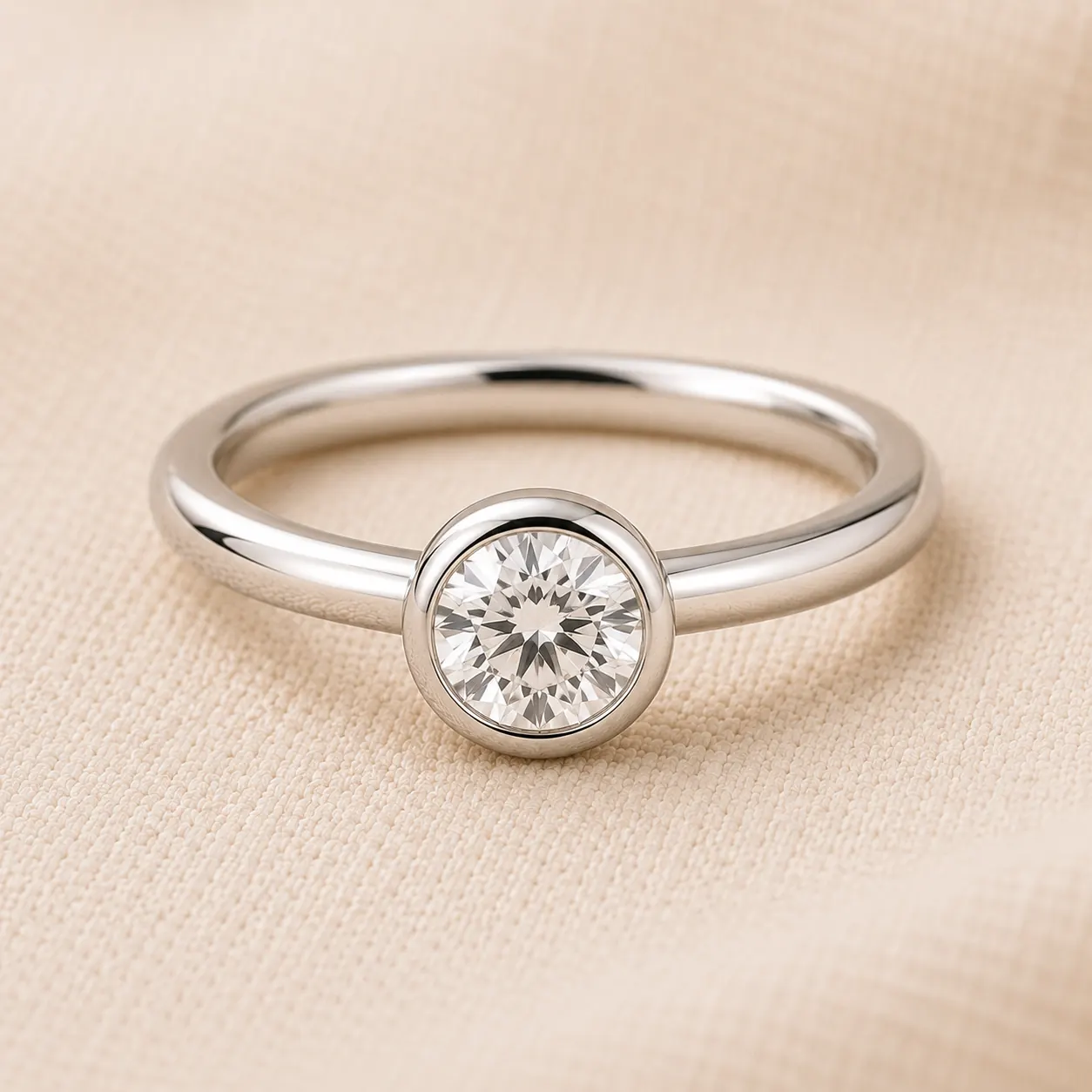
Bezel Set Engagement Rings for Women
Among the fastest-growing categories — popular with brides wanting modern minimalist aesthetics and durability, especially in healthcare, athletics, or hands-on professions where prongs catch on gloves or equipment. Most-purchased women’s configurations:
- Oval bezel — finger-flattering elongated silhouette in a clean modern setting.
- Round bezel — the classic minimalist statement.
- Emerald-cut bezel — geometric Art Deco precision.
- Half bezel + thin pavé band — balanced protection plus sparkle accent.
- East-west oval bezel — the contemporary distinctive choice. All in 14K white gold (most popular), platinum, yellow gold, and rose gold.
Low Profile & Minimalist Engagement Rings
Bezel-set rings dominate the low-profile and minimalist categories — the collar replaces tall prongs, letting the diamond sit nearly flush with the band:
- Low profile — sits closer to the finger; ideal for active lifestyles, for sitting flush with a wedding band, and for clients who find cathedral solitaires too elevated.
- Minimalist — the simplest setting and band: a single bezel-set diamond, no halo, side stones, or pavé. Reads architectural rather than ornate.
- Popular configs — 1.5mm thin plain band + full bezel (14K white gold or platinum); knife-edge band + half bezel for more interest; brushed-finish band + bezel for a warm matte look.
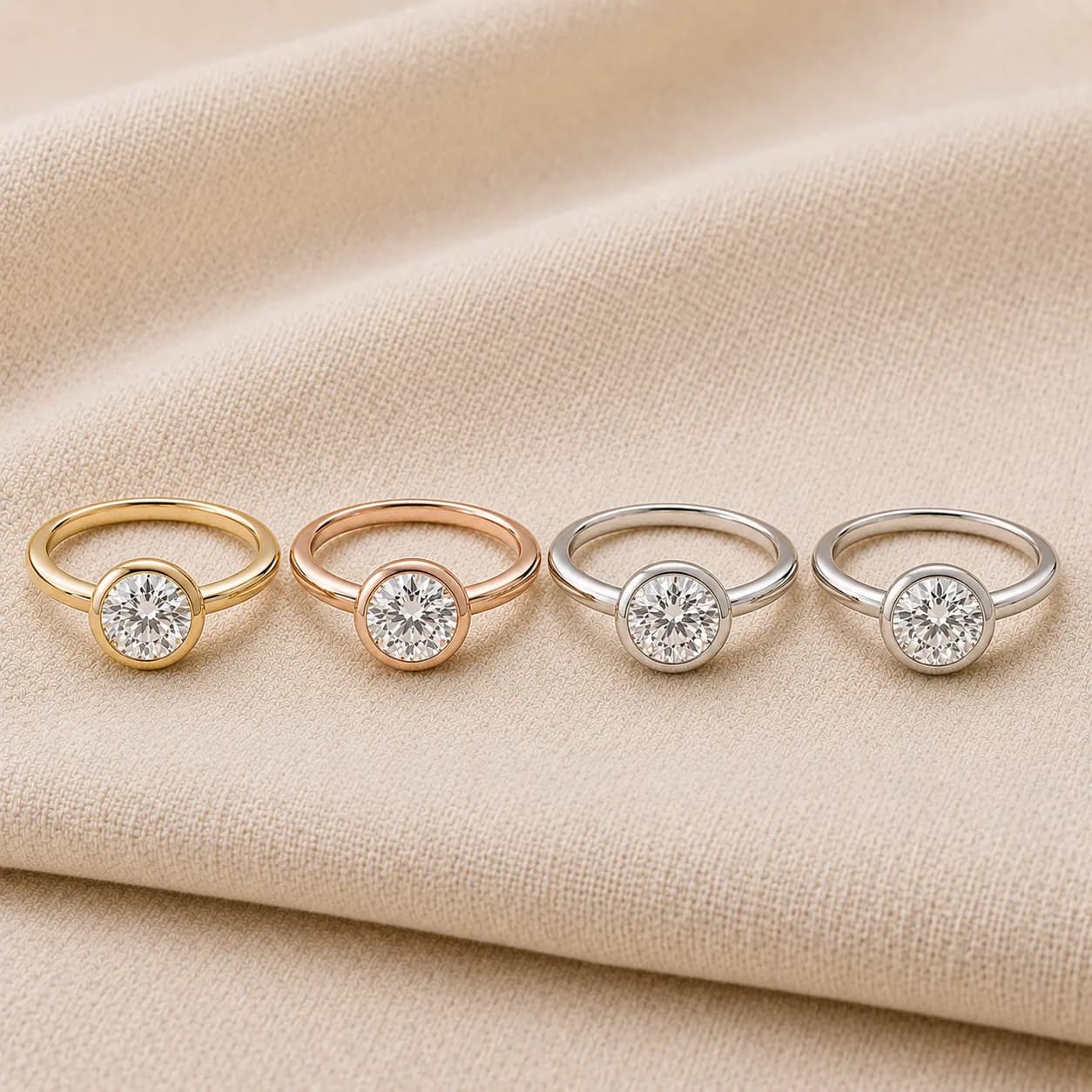
Bezel Engagement Rings by Metal
Bezel rings benefit from premium metals because the collar sees direct impact wear:
- Platinum — the premium choice; its rigidity holds the precision-cut collar over decades better than any gold alloy. See platinum bands.
- 14K / 18K white gold — reads like platinum at 30–50% the cost; our most-stocked bezel metal. Needs periodic rhodium re-plating.
- Yellow gold — warm-cool contrast (gold collar + white diamond), modern and graphic.
- Mixed-metal bezels — a gold bezel on a white gold band adds depth.
- Rose gold — the most contemporary romantic option. See gold and rose gold bands.
Pairing Your Bezel Ring with a Wedding Band & Why ATL
Bezel rings pair easily — the low-profile collar sits flush with a straight band:
- Plain or diamond half-eternity band — clean lines pair naturally; no curved enhancer needed since the bezel sits low. See diamond wedding bands.
- Thin minimalist band — a 1.5–2mm plain band in matching metal reinforces the minimalist aesthetic.
- East-west bezel — we sometimes recommend a slightly curved band following the stone’s horizontal line; ask about custom-matched bands.
Bezel work requires more precision than prong — the collar must be cut to the exact stone dimensions with zero tolerance. Our Snellville store specializes in bezel work; every ring is built around a center stone we measure ourselves, fabricated and burnished in-house. Includes lifetime cleaning, periodic collar burnishing, and 100% trade-up credit; bezel rings see the lowest service frequency of any style (collars never need tightening like prongs).
Related Collections
Solitaire Engagement Rings
Classic prong-set solitaires — the most timeless engagement silhouette.
Halo Engagement Rings
Bezel + halo combinations create the most dramatic protected setting.
Three-Stone Engagement Rings
Past, present, future — flanking stones in bezel-style mountings.
Men’s Engagement Rings
Bezel is the dominant setting style for men’s engagement rings.
Diamond Wedding Bands
Eternity and contoured bands that pair with bezel-set engagement rings.
Custom Design
Build a custom bezel design around the center stone you choose.
Frequently Asked Questions

Visit Our Atlanta Showroom
See Bezel-Set Engagement Rings in Person
Our Snellville showroom — minutes from Atlanta, Lawrenceville, and Stone Mountain — carries bezel-set engagement rings across every diamond shape and metal. Try them on, feel the difference in profile and protection against a prong setting, and design a custom build with us if you don’t find your match in stock.
1905 Scenic Hwy N Ste 230, Snellville, GA 30078 · (704) 684-7530