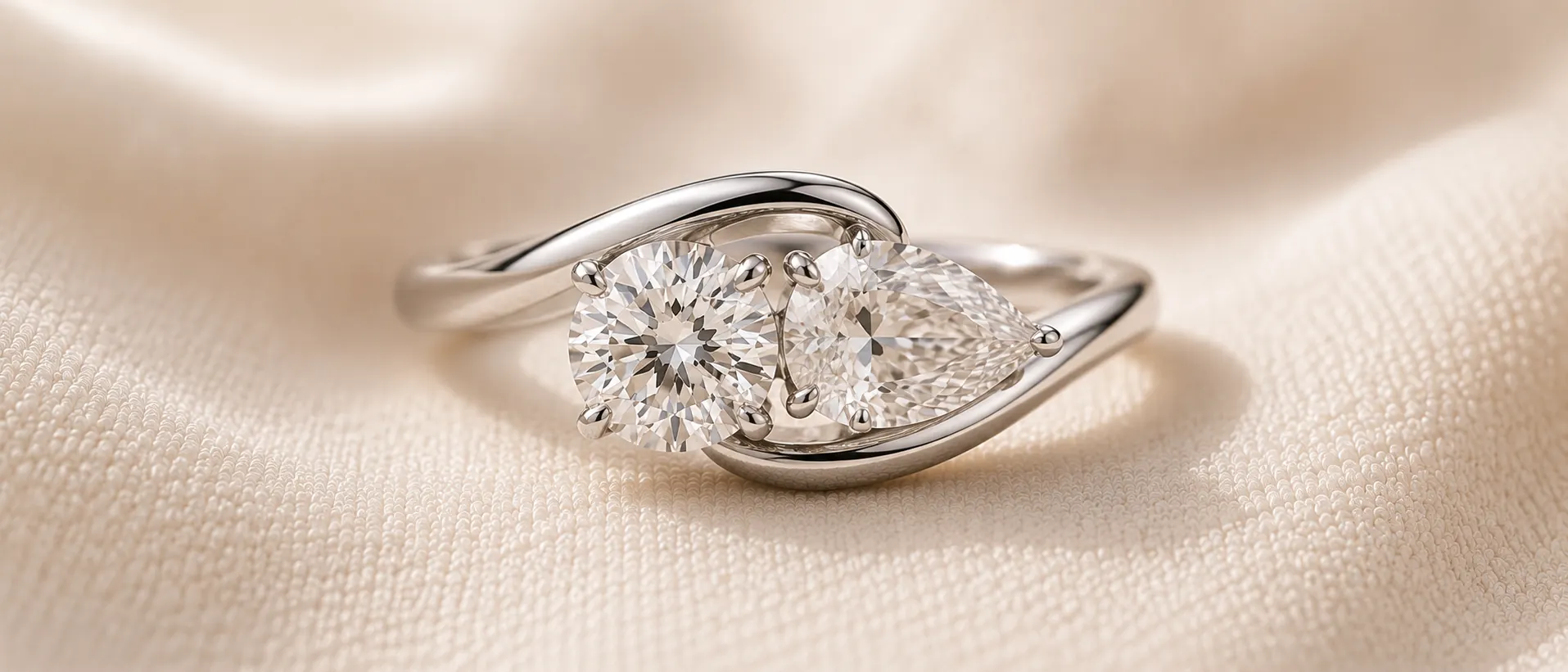
What Is a Two Stone (Toi-et-Moi) Engagement Ring?
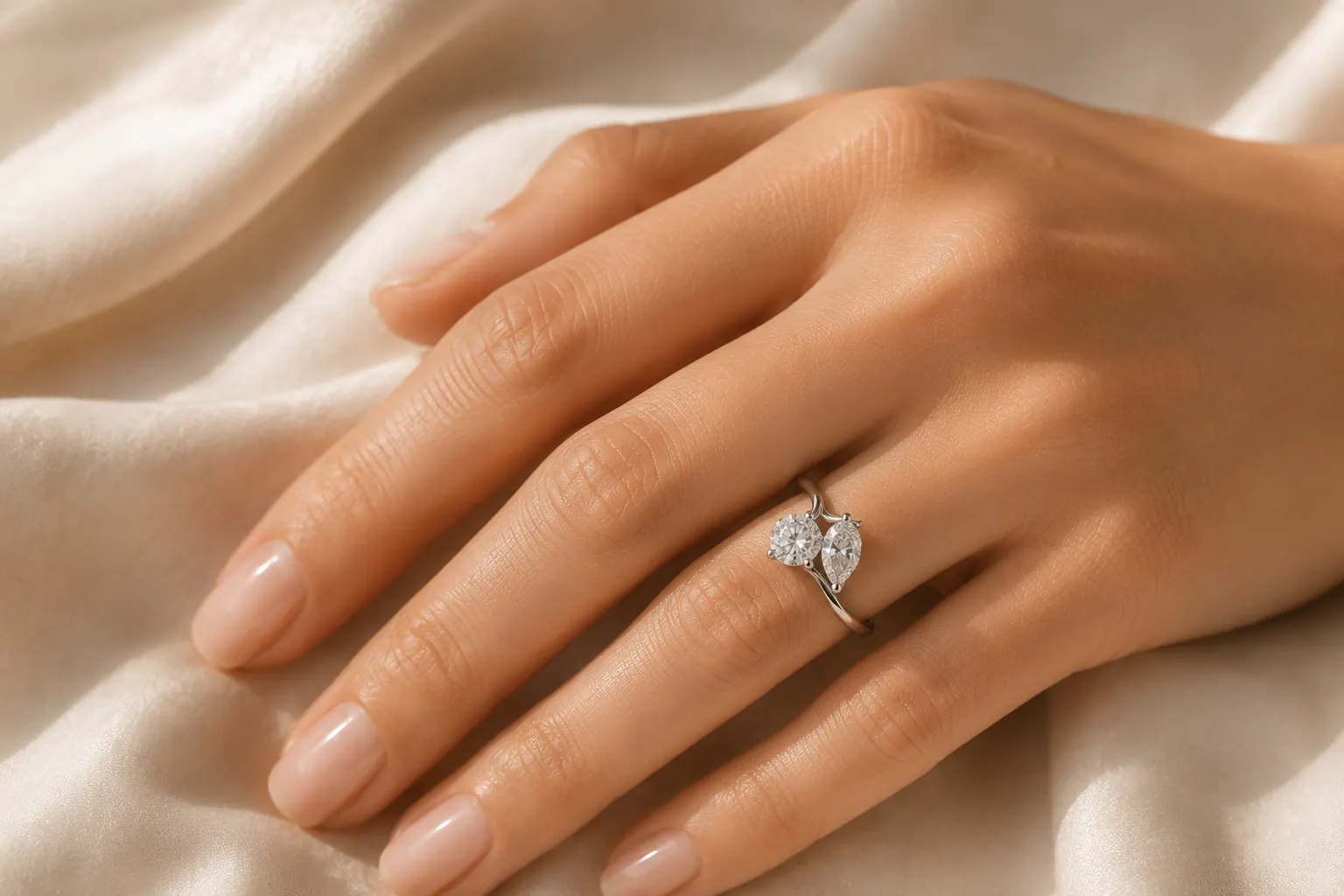
A two stone engagement ring — historically toi-et-moi, French for ‘you and me’ — sets two stones side by side with no central stone, representing the joining of two lives. Famously Napoleon’s 1796 sapphire-and-diamond proposal to Joséphine; revived in the 2010s–20s by celebrity rings like Megan Fox’s emerald-and-diamond design.
- Bypass — the band curves asymmetrically around the two stones; the most popular configuration.
- Parallel — both stones aligned in a single row on a straight band.
- Overlap — one stone set slightly above the other for dimensional depth.
Popular Two Stone Combinations
Round + Pear
The most-requested toi-et-moi pairing — circular brilliance meets teardrop elegance for shape contrast within a unified diamond pair.
Oval + Marquise
Two elongated cuts in flowing parallel — finger-flattering, with maximum visual length for a given carat weight.
Diamond + Sapphire
The historical Napoleon-Joséphine combination — pure brilliance paired with deep blue (or any sapphire color). The most durable diamond+gemstone pairing.
Diamond + Emerald
Megan Fox’s celebrated 2022 toi-et-moi pairing — striking color contrast. Emeralds are softer than diamonds, so we recommend a bezel setting for the emerald side.
Two Matched Diamonds
Two diamonds of the same shape and matched quality grades — for clients who want pure symmetry and maximum value retention.
Custom Birthstone
Diamond paired with the wearer’s birthstone — sapphire (September), tanzanite (December), ruby (July), or any of the twelve. Deeply personal symbolism.
Side Stone Engagement Rings — The Classical Accent Tradition
A side stone engagement ring features a dominant center diamond flanked by smaller accent stones along the band shoulders (typically 0.05–0.15ct each) — distinct from three-stone, where the flanking stones are large and visually equal. Side-stone accents are deliberately small, adding sparkle without competing with the center:
- Five stone — center + two flanking stones each side; symbolic in some traditions (five senses, five children, or five years).
- Seven stone — center + three each side; traditionally marks seven years.
- Diamond shoulder — small accents along the band shoulders, sometimes with milgrain edges or pavé detail.
- Where it sits — between solitaire (no accents) and three-stone (large flanking stones); for clients wanting more presence than a solitaire but lighter symbolic weight than three-stone.
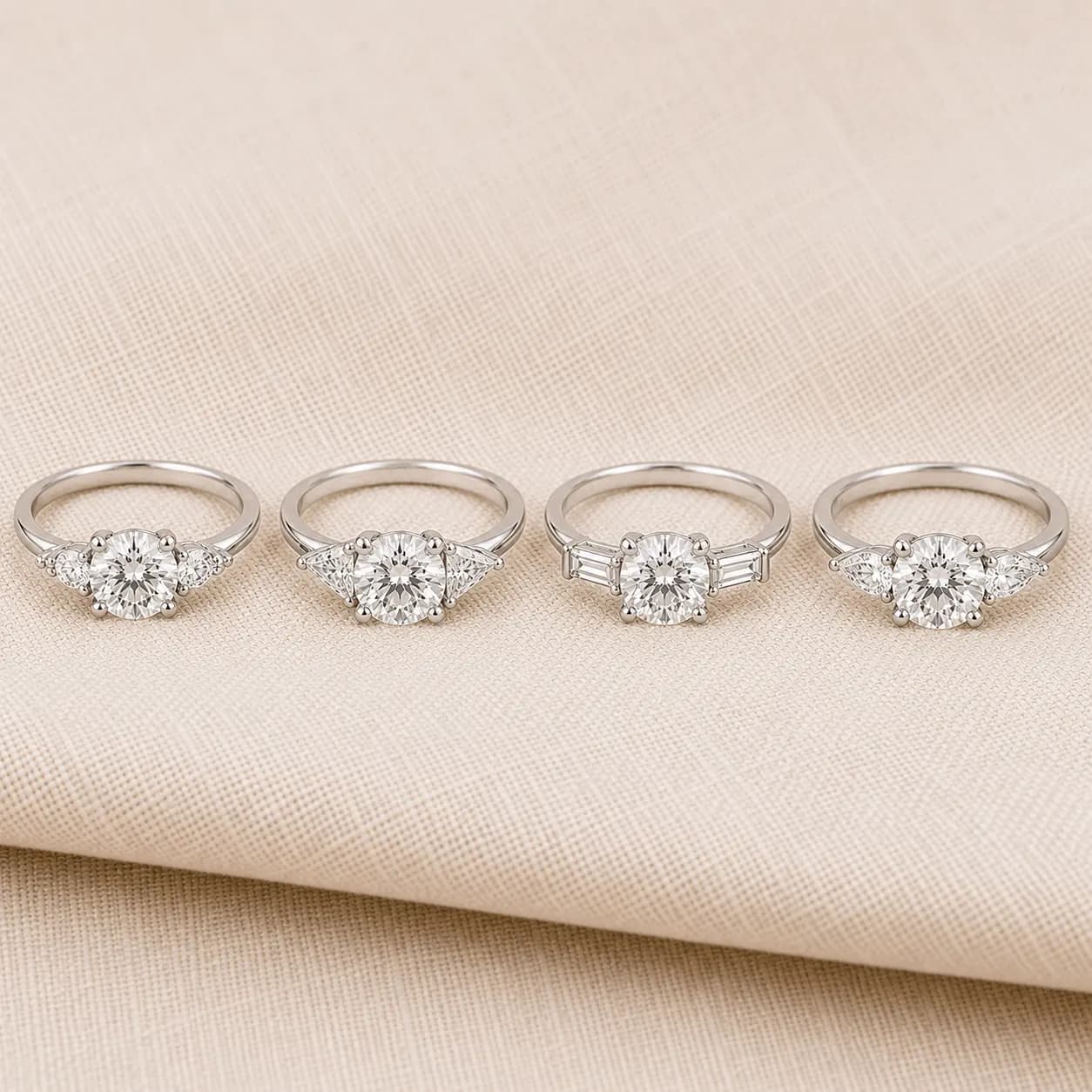
Side Stone Shapes — Trillion, Baguette, Pear, Round
Each side stone shape creates a different visual character:
- Round — the classic accent; maximum brilliance, works with any center, traditional. Most-purchased config at our showroom.
- Trillion — triangular cuts maximizing side-stone area per carat; striking flanking round or oval centers. The modern trendiest choice.
- Baguette / tapered baguette — rectangular step-cuts, Art Deco heritage; pair well with emerald-cut centers. See baguette wedding bands.
- Pear — teardrops pointed outward for dramatic movement, vintage feel.
- Marquise — pointed-ovals that elongate the line laterally, distinctive vintage-modern.
Engagement Rings with Sapphire, Emerald & Ruby Accents
Colored gemstone side stones are an increasingly popular custom choice (the Princess Diana ring shows the reverse arrangement, but the principle works either way):
- Sapphire accents — the most-purchased colored side stone; deep blue Ceylon sapphire flanking a white diamond reads classical and royal. Durable for daily wear (Mohs 9); best in platinum or 18K white gold.
- Emerald accents — vivid green contrast. Softer (Mohs 7.5–8), so use protected (bezel or partial-bezel) settings; best with yellow or rose gold.
- Ruby accents — bold red, the most romantic pairing. Durable (Mohs 9); works especially well with yellow gold and round or cushion centers.
Two Stone vs Side Stone vs Three Stone & Why ATL
Three multi-stone categories with very different design philosophies:
- Two stone (toi-et-moi) — two equal stones intertwined, no center; symbolic of two lives joining. Asymmetric bypass setting reads romantic and modern. Choose for modern romantic symbolism.
- Side stone — a dominant center with small accents on the shoulders; center clearly dominant, light symbolic weight, classical and timeless. Choose for classical sparkle accents.
- Three stone — center flanked by two LARGE comparable side stones, visually equal partners; past/present/future meaning. Choose for symbolic weight. See three stone rings.
Both toi-et-moi and side-stone are among our most-requested custom categories — their asymmetric bypass and accent configurations require hand-fitting handcrafted at our Snellville, GA showroom (since 2008). We guide shape, proportion, color balance, and setting; every ring includes lifetime cleaning and prong-tightening (especially important for colored-gem care). For pairing, see diamond wedding bands or curved ring enhancers (ideal for bypass toi-et-moi).
Related Collections
Three Stone Engagement Rings
A center diamond flanked by two side stones — symbolizing past, present, future.
Solitaire Engagement Rings
A single center diamond — the classic counterpoint to toi-et-moi.
Halo Engagement Rings
A frame of pavé diamonds amplifies the center stone’s presence.
Pear Engagement Rings
The shape Napoleon chose for the original toi-et-moi.
Diamond Wedding Bands
Curved bands designed to nestle against bypass toi-et-moi engagement rings.
Custom Design Process
Commission a one-of-a-kind toi-et-moi engagement ring in Atlanta.
Frequently Asked Questions
Visit Our Atlanta Showroom
See Two Stone Engagement Rings in Person
Our Snellville showroom — minutes from Atlanta, Lawrenceville, and Stone Mountain — carries a curated toi-et-moi selection. Two stone rings are one of our top custom-design categories, and we can model any stone combination in-store. Book a private consultation or call us.
1905 Scenic Hwy N Ste 230, Snellville, GA 30078 · (704) 684-7530