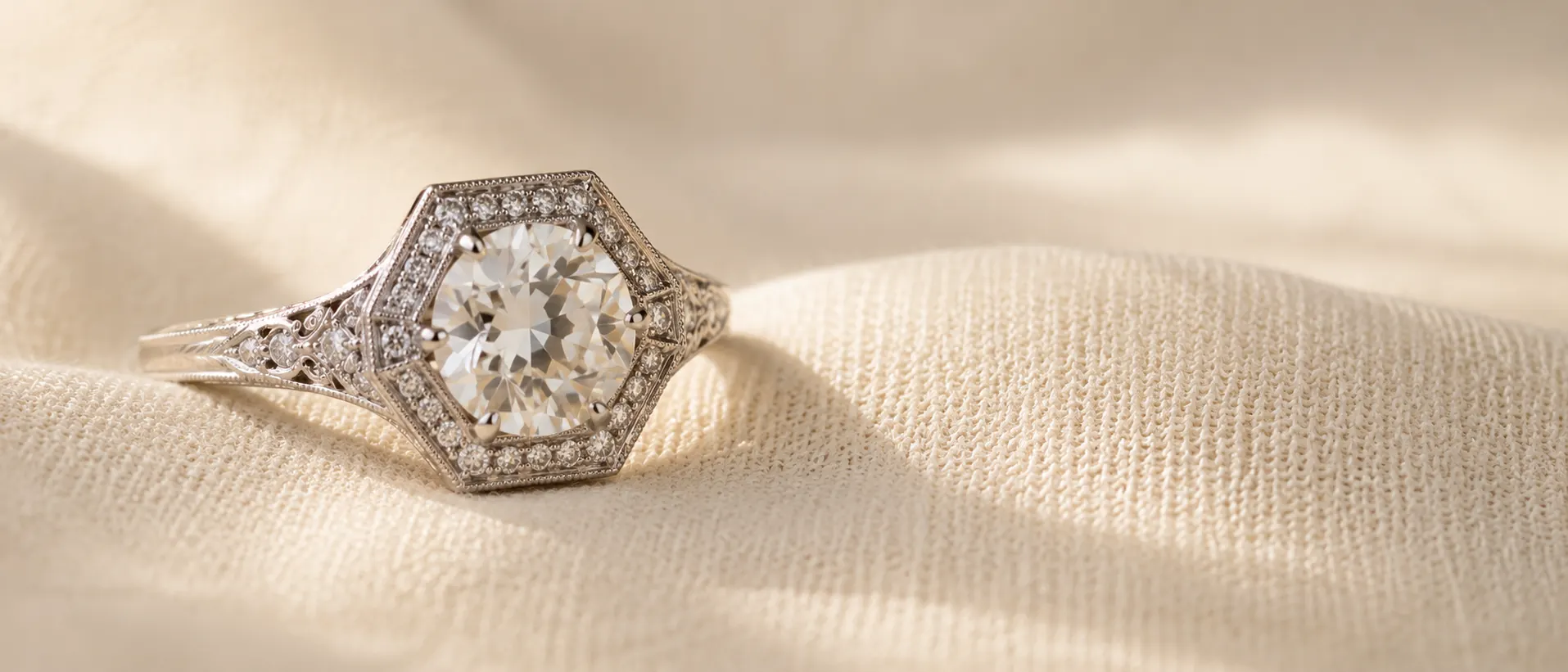
What Is a Vintage or Art Deco Engagement Ring?
A vintage engagement ring draws on the design language of a specific era — Edwardian (1900–1915), Art Deco (1920s–30s), Mid-Century (1940s–50s), or Victorian (1837–1901). The term covers three distinct categories that differ by provenance, age, and price:
- Antique — 100+ years old (Edwardian and earlier); rare, collector-tier, $8,000–$50,000+ for a quality 1ct example.
- Estate — 25–100 years old, previously owned, typically Art Deco through Mid-Century; excellent value at 30–50% below comparable new.
- Vintage-inspired — newly fabricated in historical design language. ~70% of our commissions; gives the aesthetic plus a fresh structure that lasts another century. We disclose age clearly on every piece.
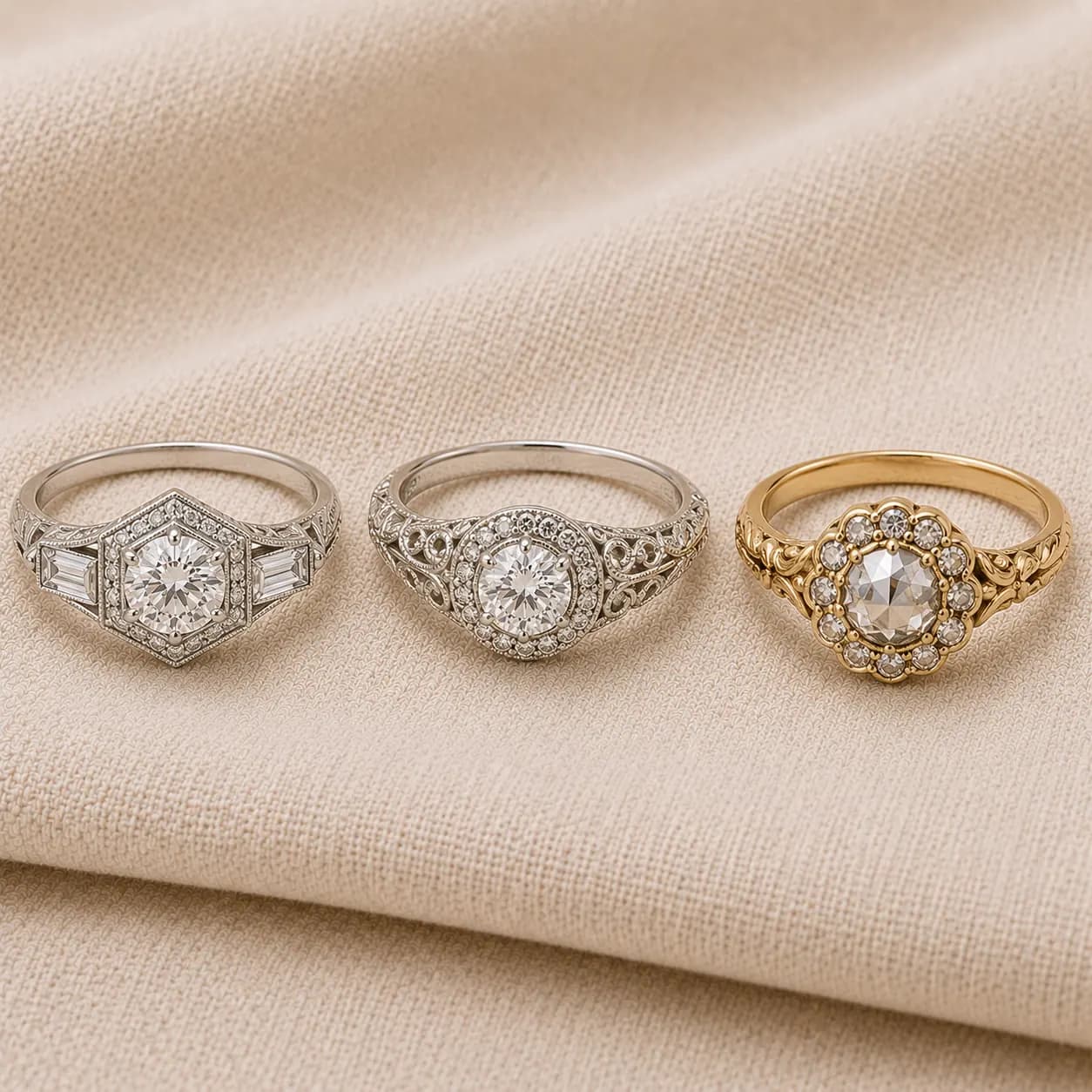
Engagement Rings by Era — Art Deco, Edwardian, Victorian, Mid-Century
Each historical era has a distinguishable visual language. We build vintage-inspired rings across all four:
- Art Deco (1920s–30s) — the most-requested at our showroom. Geometric symmetry, hexagonal/octagonal halos, baguette and tapered-baguette sides, calibré-cut sapphire or onyx accents, stepped milgrain, filigree shoulders. Platinum (the era invented platinum jewelry); Old European or step-cut Emerald/Asscher centers.
- Edwardian (1900–1915) — delicate lacy platinum filigree, garland and bow motifs, lattice pavé. The first era to use platinum extensively; more feminine and intricate than Art Deco, centers typically 0.5–1.5ct.
- Victorian (1837–1901) — sentimental and ornamental, often yellow or rose gold, cluster settings, rose-cut diamonds, symbolic motifs (hearts, knots, snakes, hands). 64 years of design evolution.
- Mid-Century / Retro (1940s–50s) — bolder, sculptural, often rose or yellow gold, statement geometric shapes, large centers with minimal side detail.
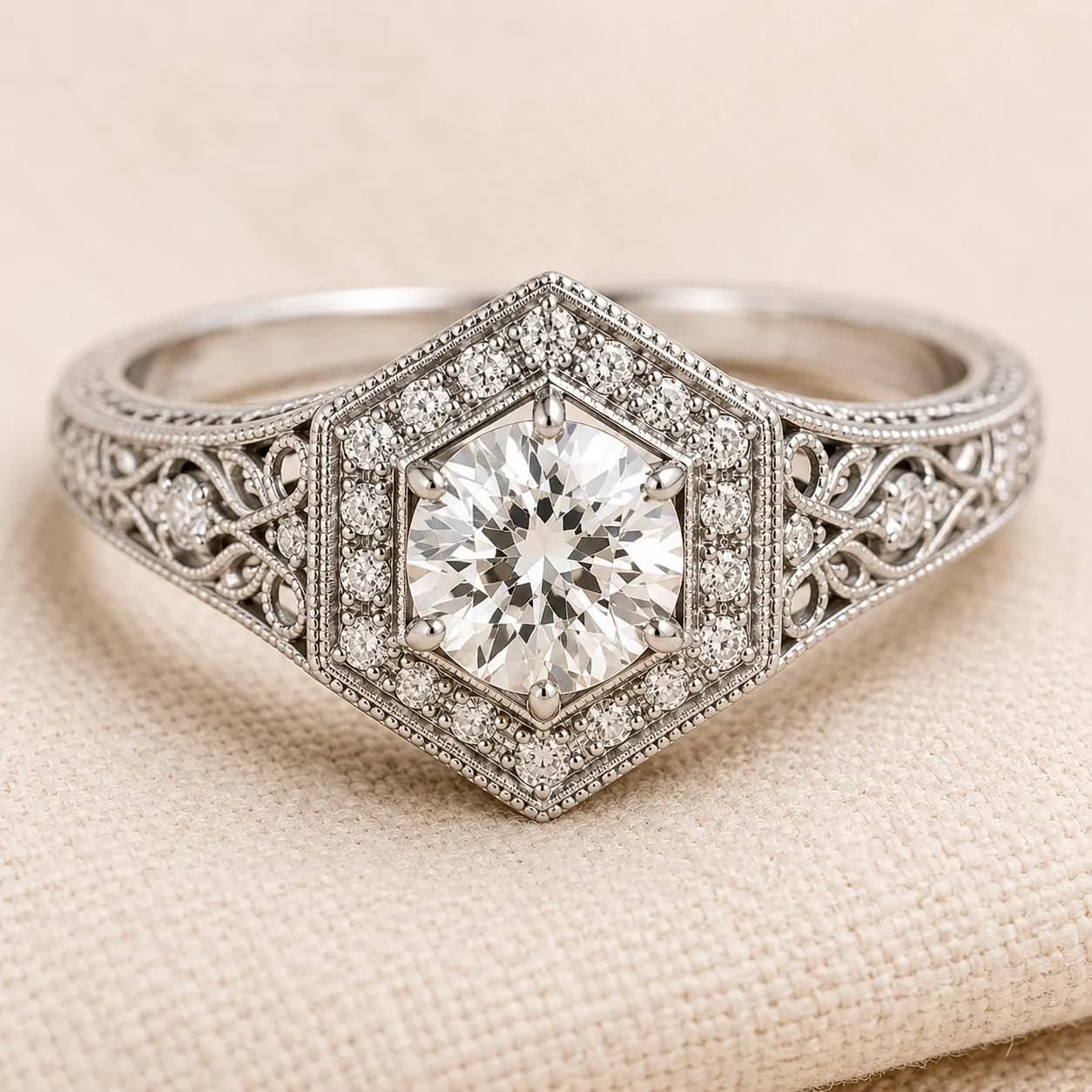
Milgrain, Filigree & Hand-Engraved Vintage Details
Three defining techniques of vintage jewelry, all still done by hand in our store:
- Milgrain — a fine row of tiny metal beads along the edges, like beaded trim. A defining Edwardian and Art Deco feature, revived over the past two decades. Hand-applied reads finer than machine; adds 1–2 weeks and $300–$800.
- Filigree — delicate openwork metal: scrollwork, lattice, or lacework cut into the ring. The defining technique of Edwardian jewelry; requires platinum or 18K white gold to hold detail. The most delicate, lacy detail work.
- Hand-engraving — patterns cut into the metal by hand (Greek key, scroll, floral, geometric). Adds 2–3 weeks; the most personalized detail work. Common Victorian/Edwardian, popular today for memorial or symbolic patterns.
Old European, Old Mine, and Rose Cut Diamonds for Vintage Rings
Authentic antique cuts give vintage rings their distinctive historical character:
- Old European cut (~1870–1930) — the predecessor to the round brilliant; smaller table, larger culet, shorter lower pavilion, chunky faceting. Fewer but larger flashes with more depth and warmth. The historically correct center for Edwardian and Art Deco.
- Old Mine cut (~1700–1890) — squarish/cushion silhouette with rounded corners, deep, very large culet, bold facets. The chunkiest, warmest look of any cut; the most-collected antique style.
- Rose cut — flat back, faceted dome top resembling a rose bud. Common in Victorian and earlier eras; flatter than brilliants, with a softer subtle sparkle rather than fire.
- Heirloom resets — we source authentic antique cuts and reset family-heirloom stones into new vintage-style settings.
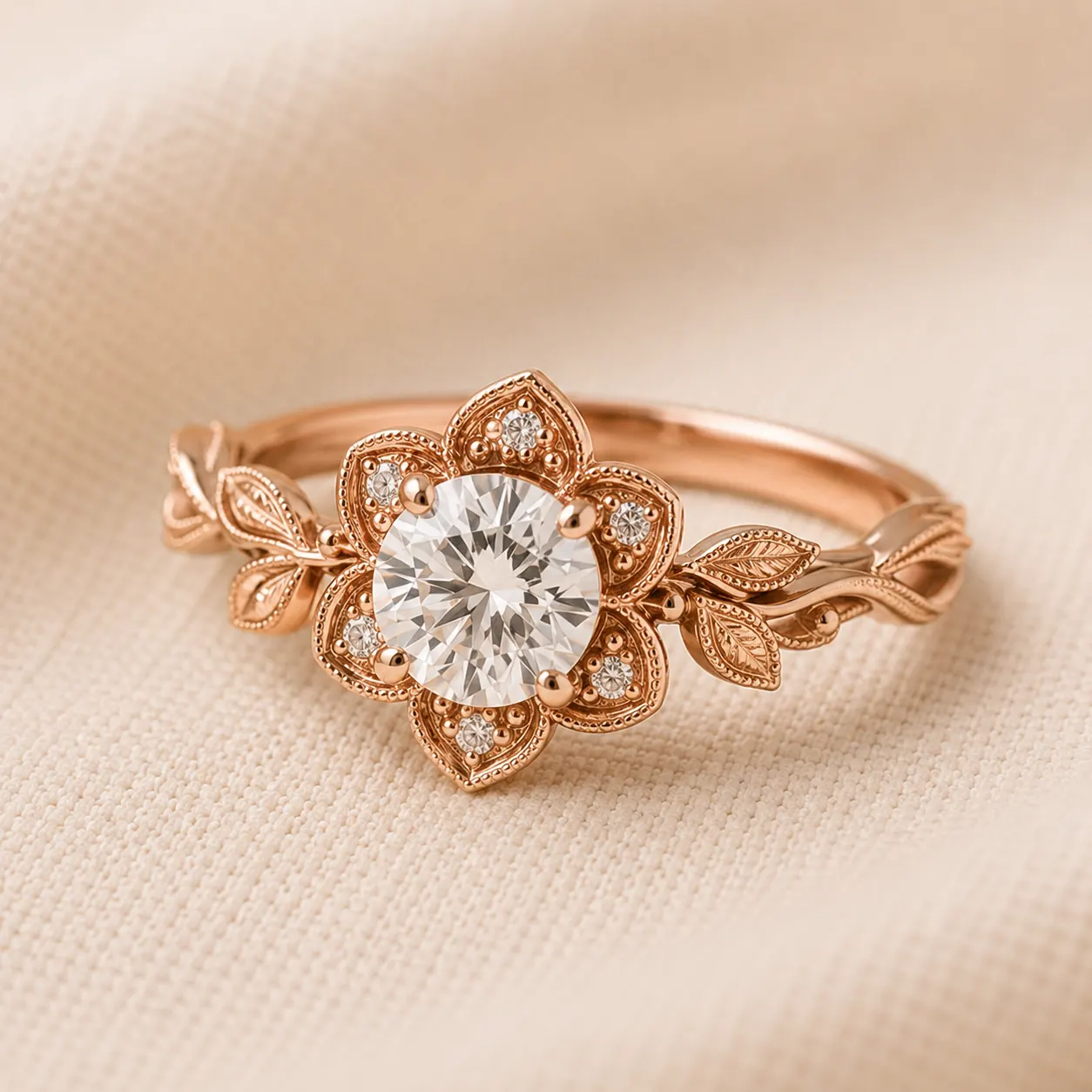
Floral & Nature-Inspired Vintage Engagement Rings
Floral and nature-inspired engagement rings use petal-shaped halos, leaf settings, vine-motif bands, and organic curving forms — often with milgrain or filigree detail. The aesthetic originated in Art Nouveau (1890–1910) and Victorian eras, with a strong Mid-Century revival.
- Who it suits — brides wanting romantic feminine forms rather than the geometric severity of Art Deco; typically vintage-inspired new fabrication.
- Common motifs — rose, lotus, leaf, branch, vine, magnolia, peony; often with cushion or round centers in 14K rose or white gold.
- Art Nouveau — a related sub-style of flowing organic curves and asymmetric forms; available as custom commission.
Vintage Engagement Rings by Metal
Metal should be era-appropriate for authenticity (or deliberately mixed for a modern interpretation):
- Platinum — historically authentic for Edwardian and Art Deco (both eras were almost universally platinum, which enables the fine filigree and milgrain). Holds small accent prongs over decades. See platinum bands.
- 18K white gold — reads like platinum at 30–50% lower cost; the most popular vintage-inspired metal at our showroom.
- Yellow gold — most authentic for Victorian and some Mid-Century pieces; warm and traditional. See gold bands.
- Rose gold — most accurately Mid-Century/Retro (surged from 1940 on); pairs with morganite, champagne diamond, or peach sapphire. See rose gold bands.
Why ATL Luxury Jewelry for Your Vintage Engagement Ring
We carry both new and authentic pieces, and disclose exactly what you’re buying:
- Custom vintage-inspired (~70%) — newly fabricated in historical design language, set with a modern certified or heirloom stone; a brand-new platinum or gold structure that lasts another century. Typical commission 5–7 weeks, $3,500–$25,000.
- Authentic estate (~30%) — sourced from the secondary market, evaluated and re-finished in-house; genuine patina at 30–50% below equivalent new. Trade-off: limited supply, exact sizing not always possible.
For wedding-band pairing, period-correct sets pair vintage engagement rings with matching vintage wedding bands (milgrain, filigree, Art Deco geometry) or baguette wedding bands — the step-cut baguette is the signature Art Deco diamond. Emerald-cut centers especially pair beautifully with baguette bands for unified step-cut aesthetic.
Related Collections
Halo Engagement Rings
Pavé halos in vintage-inspired hexagonal or scalloped designs.
Three-Stone
Edwardian and Art Deco favored three-stone designs.
Emerald Cut Diamonds
The step cut that defines Art Deco geometric symmetry.
Cushion Cut Diamonds
Pillowy soft-corner cut with strong vintage heritage.
Vintage Wedding Bands
Milgrain, filigree, and Art Deco wedding bands — period-correct pairing.
Baguette Wedding Bands
Step-cut baguette diamond bands — the signature Art Deco accent.
Custom Design
Build vintage-inspired from scratch or reset an heirloom.
Frequently Asked Questions
Visit Our Atlanta Showroom
See Vintage Rings Across Eras, in Person
Vintage detail doesn’t photograph well — milgrain, filigree, and Old European cut nuance are best understood in hand. Book a private consultation to compare Edwardian vs Art Deco vs Mid-Century pieces side-by-side at our Snellville showroom.
1905 Scenic Hwy N Ste 230, Snellville, GA 30078 · (704) 684-7530