Wedding Guide · Published · Updated September 2026
Wedding Band vs Engagement Ring
The wedding band vs engagement ring question has a short answer. The engagement ring is given at the proposal. The wedding band is given at the wedding.
This guide covers when each ring is given, how the two look, which one goes on first, and how to wear them together. It also covers whether you need both.
The difference in one minute
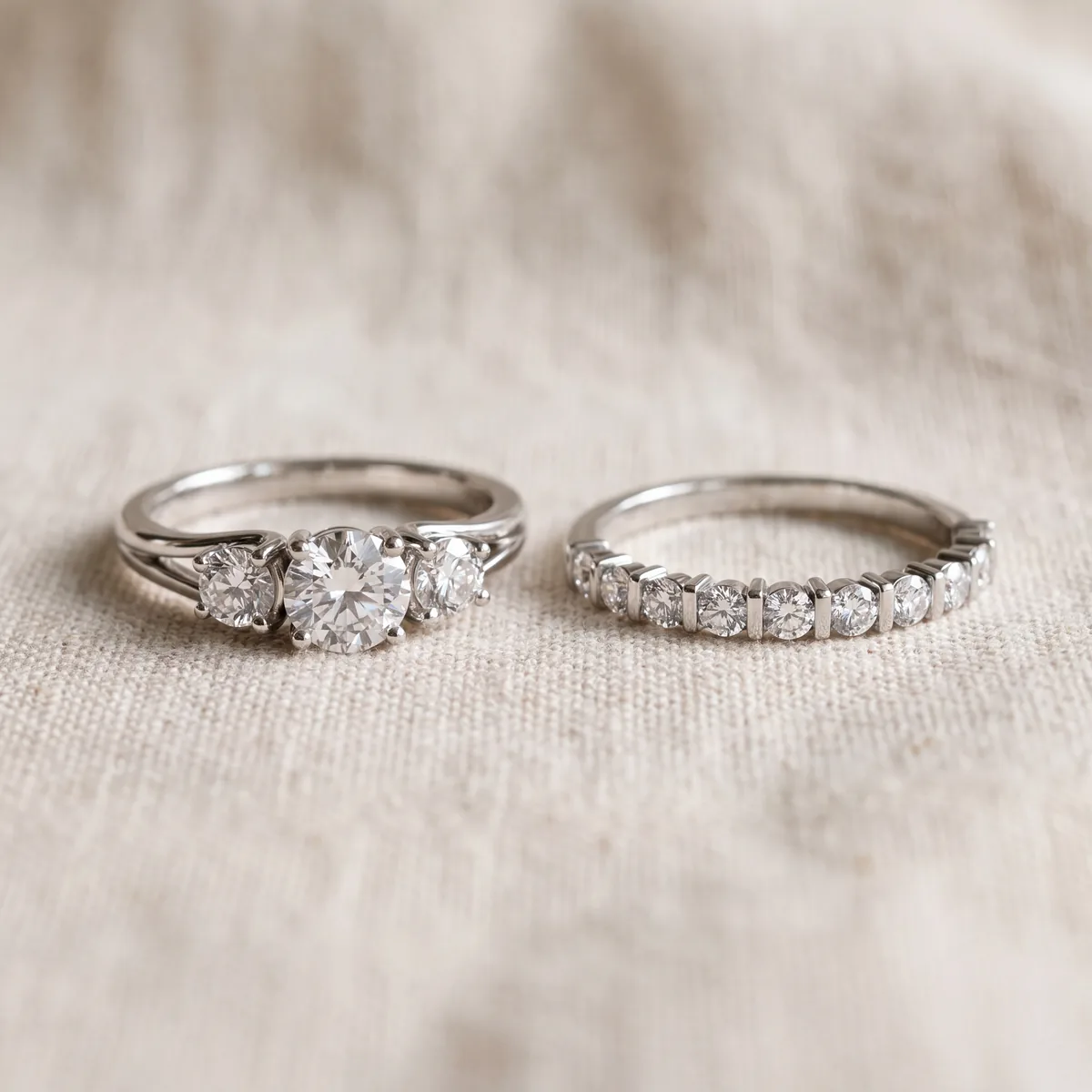
An engagement ring is given when one person asks another to marry them. A wedding band is given at the wedding, when the couple exchange rings as part of their vows. One is a promise. The other seals the marriage.
The two rings do different jobs. The engagement ring is built around a center stone. That stone is the main event, and the metal is there to hold it.
The wedding band has no center stone. It is one smooth ring, or a ring with a row of small diamonds, made to sit quietly on the finger every day.
- Engagement ring: given at the proposal, built around a center stone.
- Wedding band: given at the ceremony, with no center stone.
- Together: worn on the same finger after the wedding, in most cases.
People have given rings as a promise for a very long time. Britannica says the Romans are thought to have started the custom of betrothal rings, or engagement rings, as a sign of a promise to marry.
A band has no center stone to judge, so you choose it by its metal, its width and its fit. The engagement ring is different. Its center stone is the part people study most, and cut is a big reason. The Gemological Institute of America says cut quality is the factor that fuels a diamond’s fire, sparkle and brilliance.
How the two rings look
Put the rings side by side and you can tell them apart in a second. The engagement ring has height. The center stone sits up on the ring, held by small metal arms called prongs, so light can get in from the sides. The ring may also have smaller stones on the shoulders or a circle of tiny stones around the center.
The wedding band is lower and flatter. It is usually one width all the way around. Some bands are plain metal. Some have a row of small diamonds across the top.
Some have stones all the way around, and people call those eternity bands. Men’s bands are often plain metal. Many are made in comfort fit, which means the inside of the ring is gently rounded so it slides over the knuckle and feels smooth on the finger.
Engagement rings come in a few common styles. A solitaire has one stone. A halo has small stones in a circle around the center.
A three-stone has a center stone and one on each side. Bands have styles too. You can pick a plain band, a band with a few diamonds, or a band with diamonds across the whole top.
This is why the two rings do not always sit flat together. A straight band meets a raised center stone, and a gap can open. Some engagement rings are wide at the top.
Some sit high off the finger. A curved band follows the shape of the engagement ring, so the two touch with no gap. People also call it a contour band.
Some people want a wedding band that goes around the engagement ring. A wrap around wedding band does that, and a ring guard sits with the ring to hold it in place. You can see both on our page for ring enhancers and curved bands.
Not sure a straight band will fit? Try the two rings on together before you buy. Look for a gap.
Check that the rings do not press on each other. A straight band works with many engagement rings, so it is worth a look. If you already own an engagement ring, we can match a band to it.

Which ring goes on first
At the ceremony, the wedding band goes on first. The engagement ring goes on after it. Tradition says this keeps the band closest to the heart.
Many people wear the engagement ring on the other hand before the ceremony, or hand it to a friend for a few minutes. That leaves the ring finger free for the band. When the band is on, the engagement ring goes back on top of it.
Day to day, most people keep it that way. The band sits below and the engagement ring sits on top, both on the same finger. In the United States that is usually the left ring finger.
Some people switch the order, and some move the engagement ring to the other hand. Nothing here is a rule.
Here is a tip for the week before the wedding. Bring the engagement ring in for a check. The prongs should be snug, and the ring should look its best on the day. Cleaning, inspection and prong tightening are free on pieces bought from us.
Hands and fingers change from country to country. Read what hand an engagement ring goes on for where the tradition comes from and which countries use the right hand.
Wearing them together
Most people wear both rings on one finger. A few simple choices help the stack look right and feel good.
Metal. Two rings in the same metal look like one piece. Mixing metals is also fine.
Yellow gold beside white gold is a style choice, not a mistake. Pick the look you want to see every day.
Height. Look at the rings from the side. A band that is much thicker than the base of the engagement ring can crowd it. A band that is close in height looks calm and tidy.
Comfort. Two rings on one finger means more metal. If the finger feels tight at the end of a busy day, try a different width. Fingers can also swell in heat, so size for comfort.
More rings. You are not limited to two. Many people add thin rings above or below the pair for a birthday or an anniversary. Browse stackable rings to see how a small ring looks beside the pair.
Care. Rings that touch each other rub over time. Bring both rings in for a check every so often. Resizing, polishing and repairs are covered by our care plans on qualifying pieces; ask whether yours qualifies.
Buying both rings
You can buy the two rings together or apart. Both ways work. Here is what each one means.
Together. You choose the metal, the width and the style in one visit. You can see how the two rings sit side by side, and you only shop once. This suits couples who already know what they want.
Apart. Most couples buy the engagement ring first, because it is needed for the proposal. The band comes later, when the couple chooses wedding rings.
That gives you time to see how the engagement ring looks on the hand. Then you can pick a band that fits it.
Think about the budget for both rings before you shop. Many couples spend most on the engagement ring, because it holds the center stone. The band is simpler, so they spend less on it.
Others choose a richer band. There is no right split. Decide on a plan first, then shop.
Start with our engagement rings if you have not chosen one. When it is time for the band, see our wedding bands.
Wedding bands can be engraved inside with a date or a few words, and engraving is free at purchase. Catalog bands are made to order, so start early. If you want a band nobody else has, we design custom wedding bands with you in the showroom. You can book a design consultation.
Do you need both?
No. The two-ring plan is a tradition. It is not a rule.
Some people wear only a band. Some skip the engagement ring and buy wedding bands for both partners. Some wear one ring that does both jobs.
These questions can help you decide:
- Do you want a center stone? If yes, you want an engagement ring.
- Do you want a ring that is quiet and easy to wear all day? A band does that.
- Do you work with your hands? A low, smooth band may suit you best.
- Do you want one ring or two on your finger? Try both before you buy.
If one ring does both jobs, a low setting is easier to live with every day. If you wear two, plan them together so they sit well on the finger.
What matters is that the rings fit your style, your budget and your hands. Whatever you choose, we can match a band to an engagement ring you already own.
Frequently Asked Questions
Related guides & collections
- Wedding bandsGold, platinum, diamond and men's bands.
- Engagement ringsSolitaire, halo, three-stone and more.
- How to choose a wedding bandMetal, width, fit and style, one step at a time.
- What is a wedding band?What the ring is, who wears it and what it means.
- What hand does an engagement ring go on?Where each ring sits, and the order.
Visit the showroom
Try Both Rings On Together
Bring your engagement ring, or come and choose one. We can compare bands beside it and check how the two sit on your finger. Our showroom is in Snellville, near Atlanta.
Prefer to talk? Call (704) 684-7530