Wedding Guide · Published · Updated September 2026
How to Choose a Wedding Band
How to choose a wedding band comes down to four things: how it sits beside your engagement ring, its metal, its width, and how you live every day. Get those four right and the rest is a matter of taste.
This guide goes in that order. Each part explains one choice in plain words and points you to bands you can look at. If you are shopping for your partner, the same steps work for them too.
Start with your engagement ring
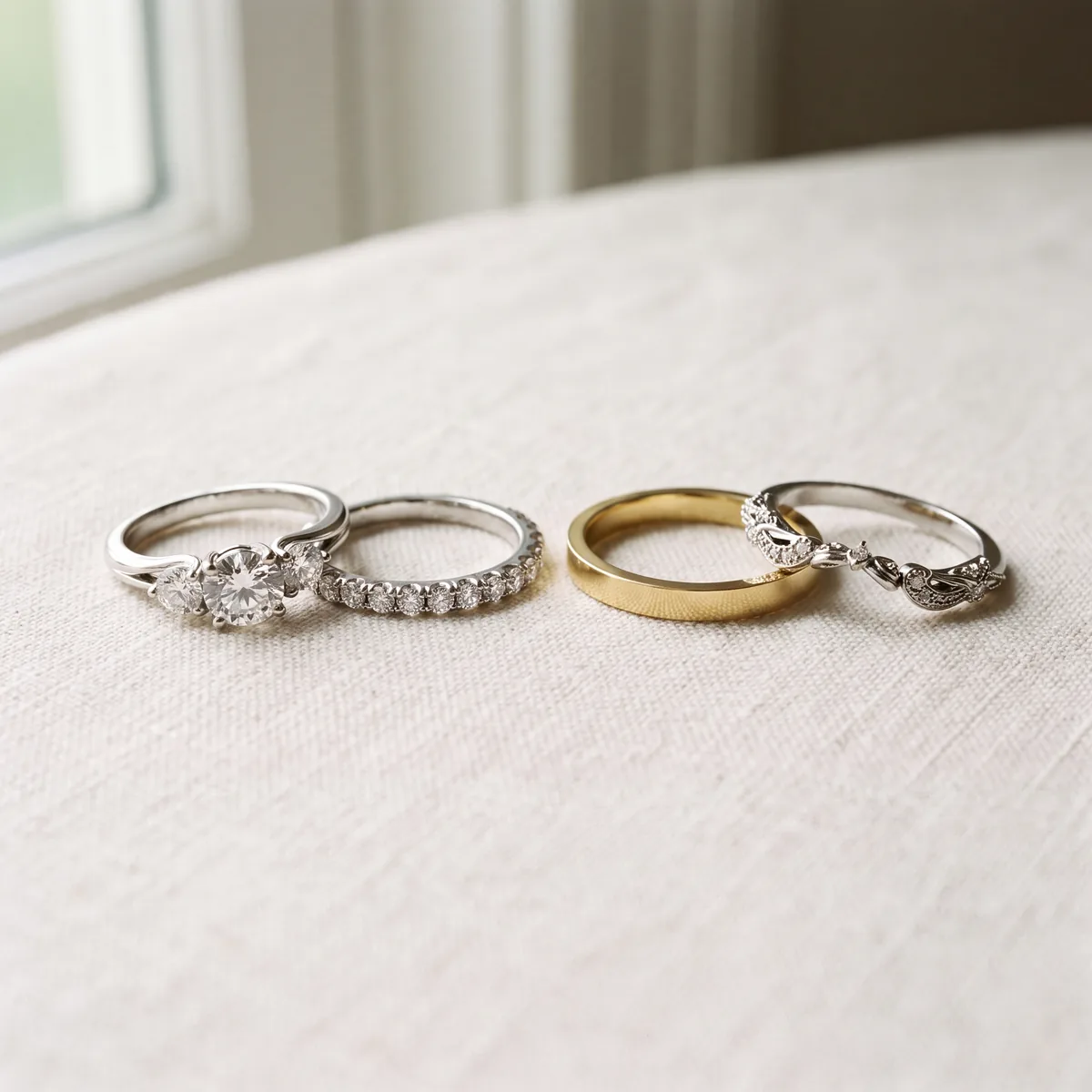
Your wedding band has to live next to your engagement ring, so begin there. Look at the bottom of the engagement ring. Is the base low and flat? Or does the stone sit high and wide?
A straight band works with a low, plain base. The two rings touch all the way along, and that looks clean. A curved band bends around the stone. It suits a big center stone, a halo or a three-stone top, where a straight band would tilt or leave a gap.
You can also choose between a flush fit and a gap. Flush means the two rings touch. A gap is a small space between them. Some people like the gap because each ring stands out on its own. Others want no space at all. Neither is wrong. Put your ring on and see which one you like.
If you are not sure, hold a straight band and a curved band against your ring in a mirror. The one that leaves no tilt and no odd gap is the better fit.
Some engagement rings sit so wide that no straight band lies flat beside them. A ring guard can help here. It is a band shaped to fill that space. See our ring guards and enhancer bands for the shapes we carry.
Pick a metal
Gold comes in yellow, white and rose. Platinum is a naturally white metal. Each one gives your band a different look.
Yellow gold is warm and classic. White gold and platinum look bright and silver-toned. Rose gold has a soft pink glow from the copper mixed into it. You can compare all three golds in our gold wedding bands, see rose gold wedding bands on their own, and look at platinum wedding bands if you want a white metal without the gold.
Karat tells you how much of a gold band is pure gold. The World Gold Council explains that 24 karat is pure gold, and lower karats are gold mixed with other metals. So a 14K band has less pure gold than an 18K band.
You can match your engagement ring’s metal, so the two look like a pair. Or you can mix on purpose, such as a yellow gold band beside a white gold ring. Mixing looks best when the difference is clear. Two golds that are almost the same shade can look like an accident.
It also helps to think about what you already wear. If your watch, earrings and other jewelry are all one color, a band in that color will fit right in.
Choose a width and fit
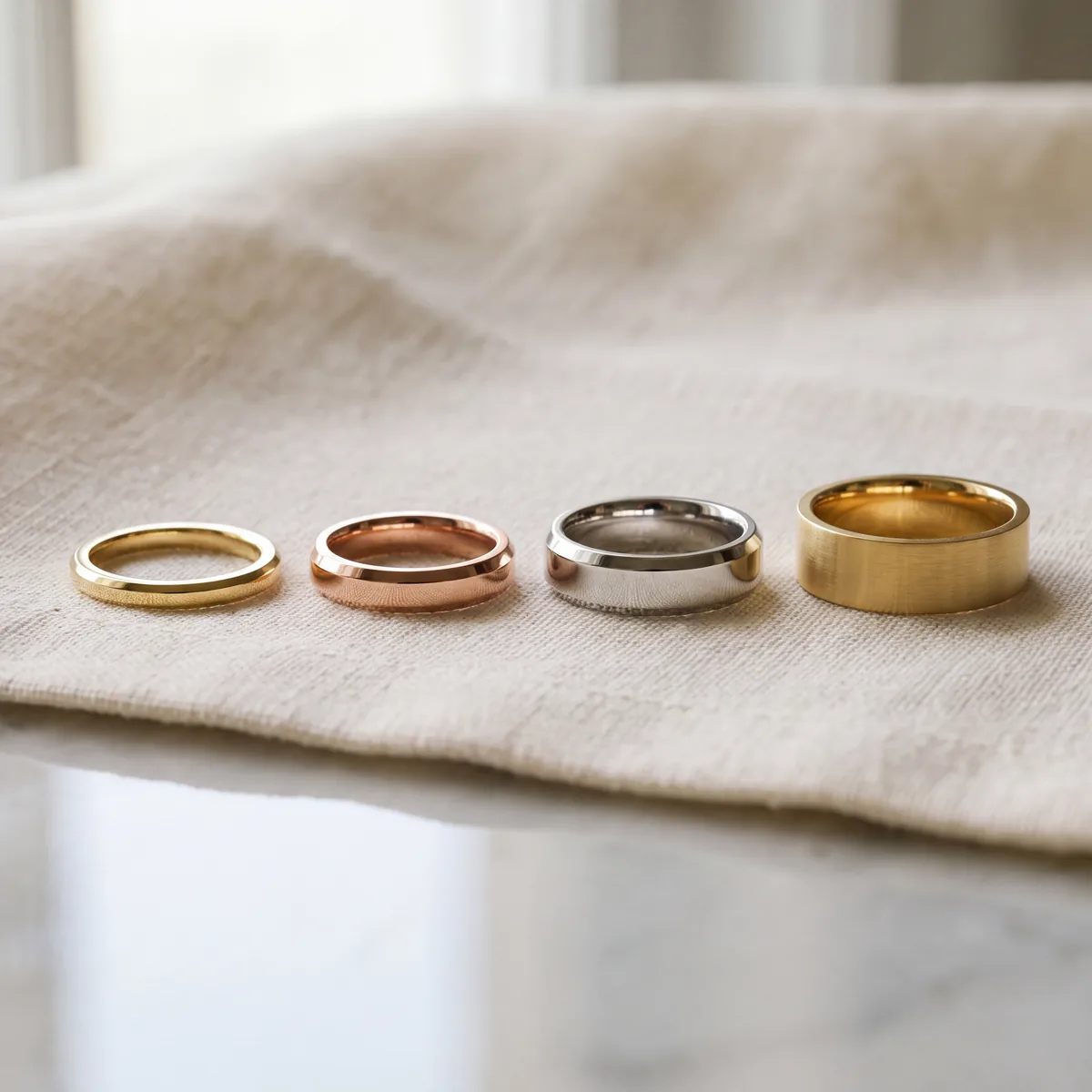
Width is how wide the band is across your finger. It is measured in millimeters, or mm. Slim bands are about 2 mm. Mid-width bands run 3 to 5 mm. Wide bands start near 6 mm and go up from there.
Width changes the look a lot. A slim band looks light and quiet. It sits well beside a ring with a large stone. A wide band looks bold. It gives a plain design more weight. Wider bands also cover more of the finger, so they can feel snugger than slim ones in the same size.
Fit is about the inside of the band. Comfort fit means the inside is rounded. It slides over your knuckle more easily and feels smooth all day. A flat inside is called standard fit. Comfort fit is easier to slide on and off, but try both.
Think about your hand too. A slim finger can carry a wide band, and a large hand can carry a slim one. There is no rule. Look at the ring on your own hand.
To see widths side by side, browse women’s wedding bands and men’s wedding bands.
Diamonds or plain metal
A plain band is simple, and it goes with almost any ring. A diamond band adds sparkle. We carry bands set with natural diamonds and with lab-grown diamonds. Here are the four common ways the stones are set:
- Pavé uses many tiny diamonds set close together, so the surface glitters.
- Channel holds diamonds in a groove between two walls of metal, so they sit flush with the band.
- Half eternity puts diamonds across the top of the band, with plain metal underneath.
- Full eternity puts diamonds all the way around.
Start with our diamond wedding bands, or look at eternity and anniversary bands for the half and full styles.
Sparkle comes from cut. In its guide to diamond cut, GIA says cut is what fuels a diamond’s fire, sparkle and brilliance. Ask to see any diamond band in the light before you choose it.
Think about resizing now. A plain band is the easiest to resize. A half eternity band can often be sized a little, because the plain metal underneath can be adjusted. A full eternity band usually cannot, because stones circle the whole finger. Get the size right before you buy.
Think about everyday wear
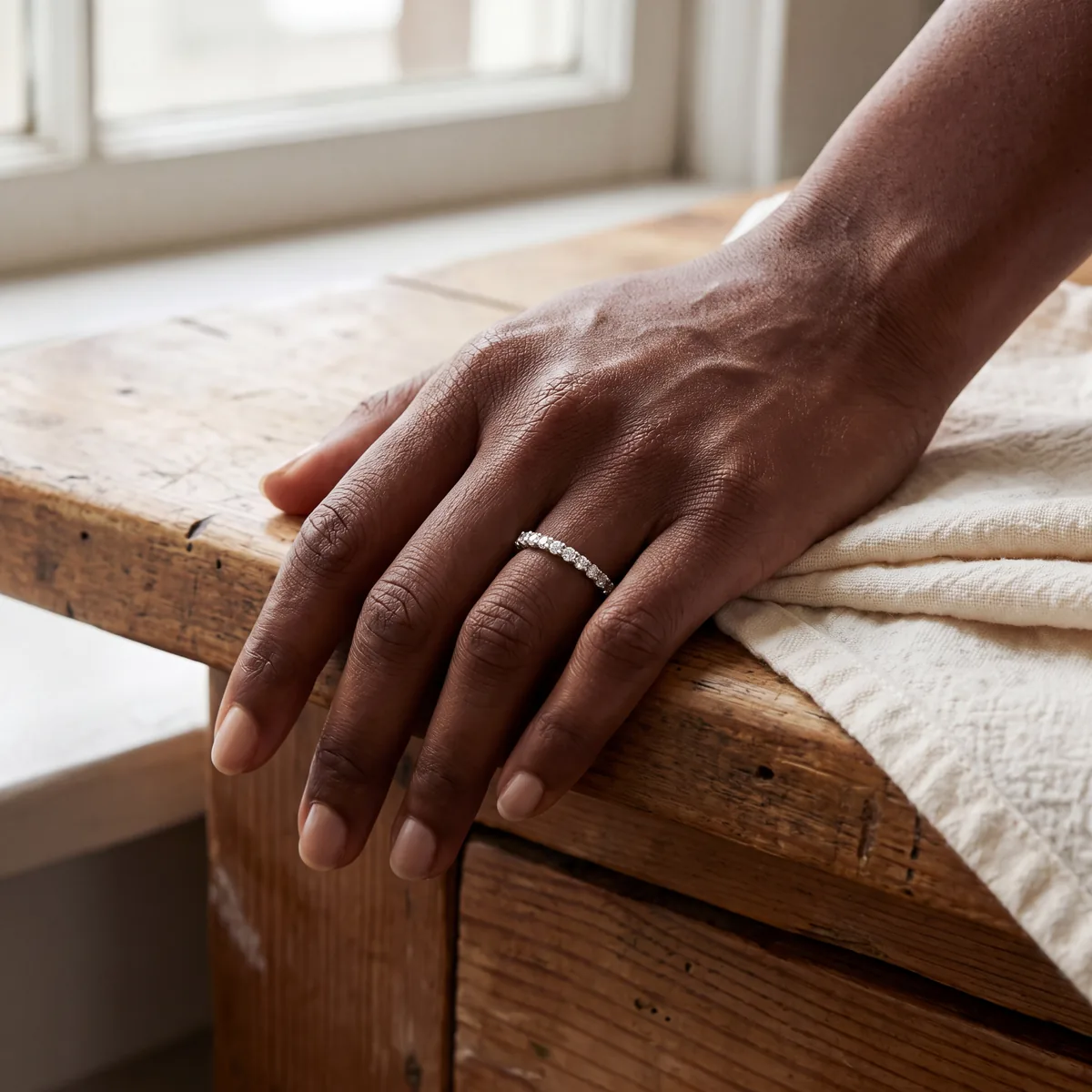
You will wear this ring for a long time, so think about your days. Do you work with your hands? Do you lift weights, garden, cook or wear gloves?
Rings take knocks. A low, smooth band gives stones less to catch on. Stones set into the metal sit lower than stones held up on prongs. A plain band has nothing to snag at all. If you use your hands all day, pick the lowest profile you like.
Slim rings you wear together are another good choice. You can start with one and add more later. Look at our stackable rings to see how they pair.
Every ring picks up scratches and loses some shine over time, and some need resizing when life changes. Resizing, polishing and repairs are covered by our care plans. Cleaning, inspection and prong tightening are free in our showroom.
Set a budget
Three things move the price of a band: the metal, the width and the stones. A wider band uses more metal. More diamonds add more cost. A plain band with a slim width is usually the easiest place to start. It also helps to set the top of your budget before you look, so you are not drawn to bands you would not buy.
Here is what our bands cost today.
- Across our whole collection, bands cost about $37 to about $7,440.
- Diamond bands cost about $726 to about $5,098.
- Men’s bands cost about $136 to about $7,440.
These ranges come from the bands we list right now, so they change with our stock.
Decide which part matters most to you, whether that is the metal, the width or the stones. Spend on that part first, and keep the rest simple.
Try bands on before you decide
A photo cannot show how a band sits next to your ring. Bring your engagement ring to our showroom in Snellville, near Atlanta. You can set each band beside it and look at the gap, the color and the width. Try a few widths, because even 1 mm changes how a band feels.
Wear each band for a few minutes. Make a fist, reach into a pocket and move your hand around. A good band feels easy on the finger.
If you are choosing rings as a pair, look at our wedding bands for couples. They make it simple to match metals and finish across two rings.
Engraving is free at purchase. You can add a date, initials or a short line inside the band. If you do not see the band you picture, we design custom wedding bands with you in the showroom.
How to narrow it down
Four questions get most people to a short list:
- Does the band need to sit flush? A low, plain ring base points to a straight band. A high or wide stone points to a curved band or a ring guard.
- Match the metal or mix it? Pick the same metal for a matched pair, or a clear contrast for a planned mix.
- How wide feels right? Slim looks light and wide looks bold. Try both on.
- What will the band go through? If your hands are busy, choose a low profile with stones set into the metal.
Once you have your answers, pick three bands and try them on with your engagement ring. Keep the one you keep looking at.
Frequently Asked Questions
Related guides & collections
- Types of wedding ringsPlain, diamond, eternity, stackable and more, explained.
- What is a wedding bandWhat the ring is, and how it differs from other rings.
- Wedding band vs engagement ringHow the two rings differ and how they wear together.
- Engagement ring metalsPlatinum, white gold, yellow gold and rose gold compared.
- Wedding bandsShop every style, metal and width in one place.
Visit the showroom
Try Bands Beside Your Ring
Bring your engagement ring to our showroom in Snellville, near Atlanta. We will help you compare metals, widths and settings side by side.
Prefer to talk? Call (704) 684-7530