Wedding Guide · Published · Updated September 2026
Types of Wedding Rings
The main types of wedding rings are plain, pavé, channel-set, eternity, baguette, vintage-style, stackable, curved and men’s bands. They differ in three ways: how much sparkle they carry, how they wear day to day, and how they sit next to an engagement ring.
This guide takes each type in turn. It says who each one suits and what to watch for.
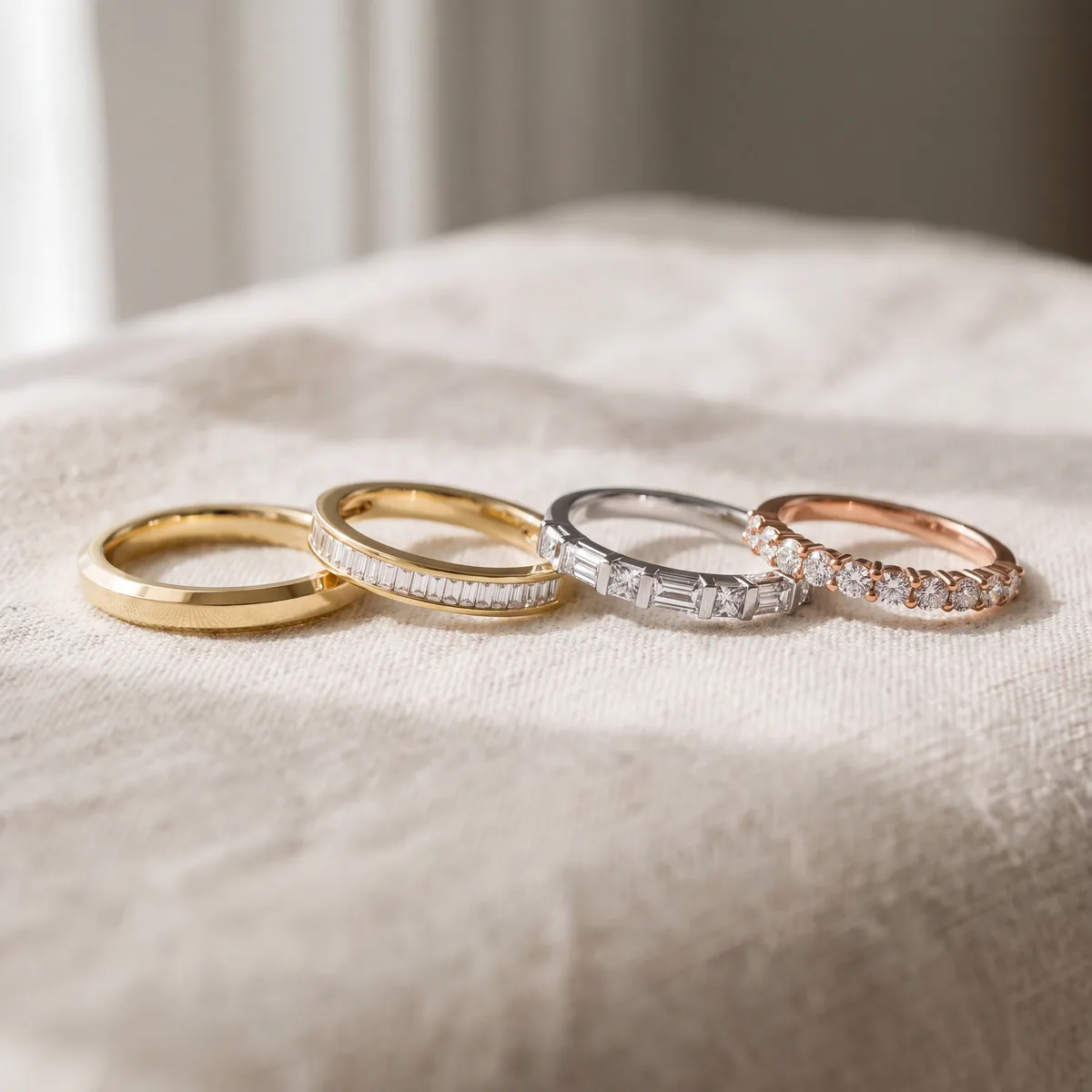
Plain bands
A plain band is a smooth ring of metal with no stones. It is the simplest wedding ring, and it is the one most people picture first. To see plain and stone-set styles side by side, browse all wedding bands.
Two things change how a plain band looks. The first is the profile. A comfort-fit band is rounded on the inside, so it slides over the knuckle with less rubbing. A flat band has a squarer look. The second is the finish. High polish is shiny. Satin and matte finishes are softer and hide small scratches.
Metal changes the look too. Yellow gold is warm. White gold is bright and cool. Rose gold is soft and pink. Platinum is naturally white. Many people pick the metal of their engagement ring, so the two match. Palladium and sterling silver are also options in some styles.
A plain band suits anyone who wants a quiet ring for daily wear. It also has room for a message inside. Engraving is free at purchase. Resizing, polishing and repairs are covered by our care plans. If you are new to all this, read what a wedding band is.
Pavé and channel-set bands
Pavé and channel-set bands both carry small diamonds. They hold the stones in different ways.
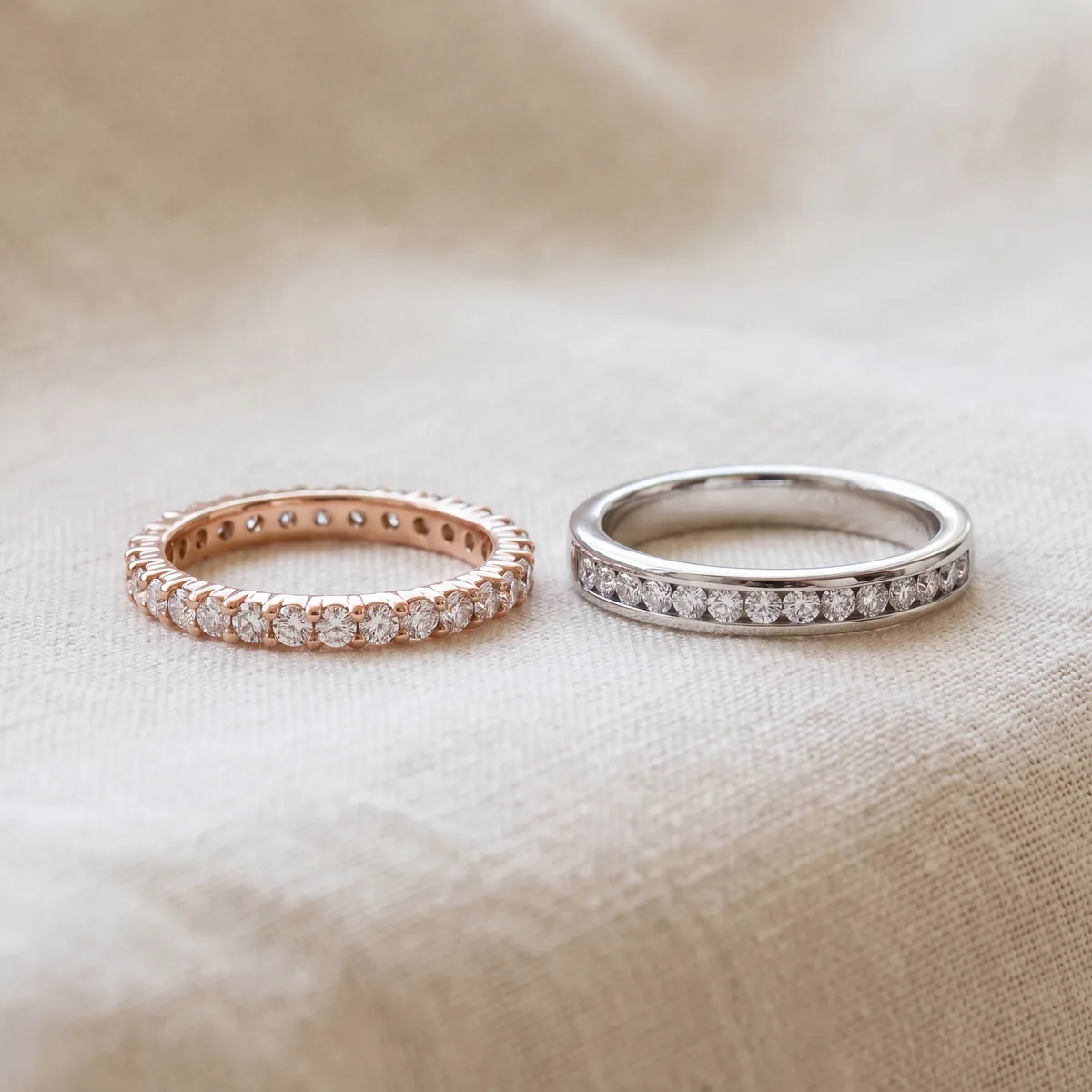
In a pavé band, tiny diamonds sit close together across the surface of the metal. Small beads or prongs hold each one. The word comes from the French for paved, like a stone road. The band looks like it is covered in sparkle.
In a channel-set band, the diamonds sit in a groove between two walls of metal. The walls protect the stones from knocks. The surface stays smooth, so the band does not catch on a sweater or a glove.
Both styles come in many widths. A thin pavé band looks delicate. A wide channel band looks bold. If you want the ring to sparkle from every angle, pick pavé. If you want a smooth feel and a tougher build, pick channel. Either one pairs well with a diamond engagement ring.
Pavé gives the most shine. Channel is the tougher choice for busy hands. Cleaning, inspection and prong tightening are free in our store, so bring a stone-set band in for a check now and then. To compare the two styles, browse our diamond wedding bands.
Sparkle comes from cut. For any diamond, GIA explains that cut quality fuels fire, sparkle and brilliance. Small stones follow the same rule.
Eternity and half eternity bands
An eternity band has diamonds all the way around. A half eternity band has diamonds across the top half only. The rest is plain metal.
The big difference is resizing. Stones sit all the way around a full eternity band, so the band cannot be stretched or cut without disturbing them. A half eternity band has a plain section at the back, and a jeweler can work there. Get your finger size right before you order a full eternity band.
There is a middle choice. A three-quarter band has diamonds around most of the ring and plain metal at the back. It keeps more sparkle than a half band and leaves a small section for sizing. Look at all three lengths side by side before you decide.
Half eternity bands also feel smoother, because the plain back sits flat against the finger. Many people give an eternity band as an anniversary gift. To see the styles, browse our half eternity bands.
Baguette bands
A baguette is a long, narrow diamond with straight edges. It is cut in flat steps instead of round facets. Its name comes from the French word for a long loaf of bread.
Set end to end in a row, baguettes make a clean, glassy line. They look sharp and modern. Rounds flash. Baguettes gleam. Some baguette bands sit in a channel, like the second ring in the picture above. Others place baguettes beside round or square diamonds.
The corners are the weak spot on a baguette, so a channel or bar setting is common. It guards the corners from knocks. Baguette bands suit people who like straight lines and a simple shape. They also pair well with a rectangular or emerald-cut engagement stone, because the straight lines echo each other. See our baguette wedding bands.
Vintage-style bands
Vintage-style bands borrow details from older jewelry. Look for milgrain, which is a row of tiny beads along the edge of the band. Look for filigree, which is thin, lacy metalwork. Other bands copy the sharp lines of Art Deco, a style that took hold in Europe in the 1920s.
A vintage-style band is a new ring made in an older style. It suits an engagement ring with the same look. The trade-off is the detail. Fine metalwork collects dirt and can wear soft over the years, so it needs cleaning more often. Cleaning is free in our store. Browse our vintage wedding bands.
Stackable bands
Stackable bands are thin rings made to be worn together. You wear two, three or more on one finger, beside an engagement ring or on their own.
Each ring can be different. You can mix metals, such as yellow gold beside white gold or platinum. You can mix textures, such as a smooth band beside a twisted one. Some carry small diamonds. Some carry colored gemstones, such as emerald or peridot.
Here is a simple way to build a stack. Start with a base ring you love, such as a plain band. Add a second ring with stones. Add a third with a different texture. Keep the height about the same, so the rings sit flat together.
You can add one ring at a time. Many people start with one and add another for a birthday or an anniversary. Try the stack on before you buy. Rings of different metals rub together and can scratch each other. See our stackable rings.
Curved bands and ring guards
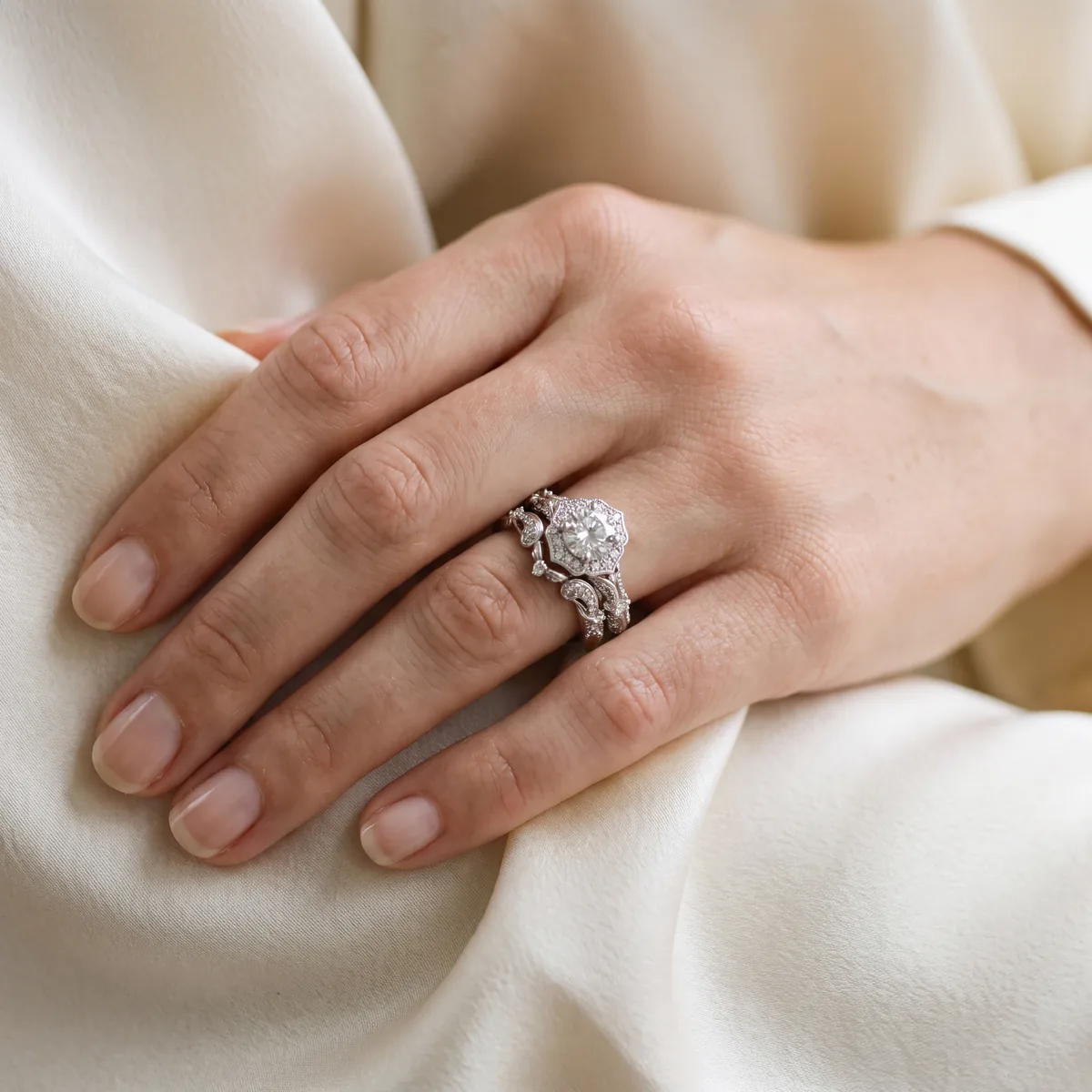
Some engagement rings do not sit flat against a straight band. A halo or a wide setting can leave a gap or press on the band. A curved band solves that. It bends around the engagement ring, so the two sit flush. You may also hear it called a contour band. A solitaire with a low setting can often take a straight band. A tall or wide head usually needs a curve. See our curved wedding bands.
A ring guard sits beside the engagement ring. It can keep a top-heavy ring from spinning. A ring enhancer wraps around the engagement ring to add sparkle. Both are worn with the engagement ring. Browse our ring guards to compare them.
If nothing fits your ring, we design custom wedding bands with you in the showroom.
Men’s wedding bands
Men’s wedding bands are usually wider than women’s bands. Widths from 3 mm to 8 mm are common. Most are plain, so the shape does the work.
A flat band has a straight profile. A knife-edge band rises to a soft ridge. A square band has flat sides. A beveled band has slanted edges. Some men’s bands carry a row of small diamonds. Gold, platinum and palladium are all common metals.
Width affects fit. A wide band fits tighter than a thin band of the same size, so it may need to be a little bigger. Try one on before you decide. Browse our men’s wedding bands.
Matching bands and bridal sets
A matching band is made to go with one engagement ring. It shares the same stones or details, so the two look like a pair. A bridal set, also called a wedding ring set, is an engagement ring and a wedding band made to match. On our site you choose each ring on its own.
Couples can match their bands with each other too. Two bands in the same metal, or with the same edge or finish, read as a pair. Some people match everything. Others match only the metal. There is no rule. Metal color matters when you match, so try to keep the metals close and the colors will agree on your hand. See our wedding bands for couples.
How to narrow it down
Four questions get most people to a short list.
- How do you spend your day? If your hands are busy, pick a plain band or a channel-set band with a smooth top. Rings with raised stones can snag.
- What is your engagement ring like? A halo or a wide setting may need a curved band or a ring guard. A simple solitaire takes almost any band. Our guide to engagement ring styles shows the common shapes.
- Do you want sparkle or calm? Sparkle points to pavé, eternity and baguette bands. Calm points to plain and vintage-style bands.
- What is your budget? Bands with more stones cost more than plain metal bands. Bands in our collection range from $37 to $7,440.
Once you know the type, the rest follows: width, metal and size. Our guide on how to choose a wedding band covers those steps.
Frequently Asked Questions
Related guides & collections
- How to choose a wedding bandWidth, metal and fit, one step at a time.
- What is a wedding bandWhat a wedding band is and how it is worn.
- Wedding band vs engagement ringHow the two rings differ and how they work together.
- Engagement ring stylesThe seven ring settings, compared.
- Wedding bandsBrowse the whole wedding band collection.
Visit the showroom
Try Wedding Bands On in Person
A ring looks different on your hand than on a screen. Book a design consultation at our Snellville showroom near Atlanta, and bring your engagement ring with you.
Prefer to talk? Call (704) 684-7530