Engagement Guide · Published · Updated August 2026
Engagement Ring Metals: Platinum vs. White Gold, Yellow Gold and Rose Gold
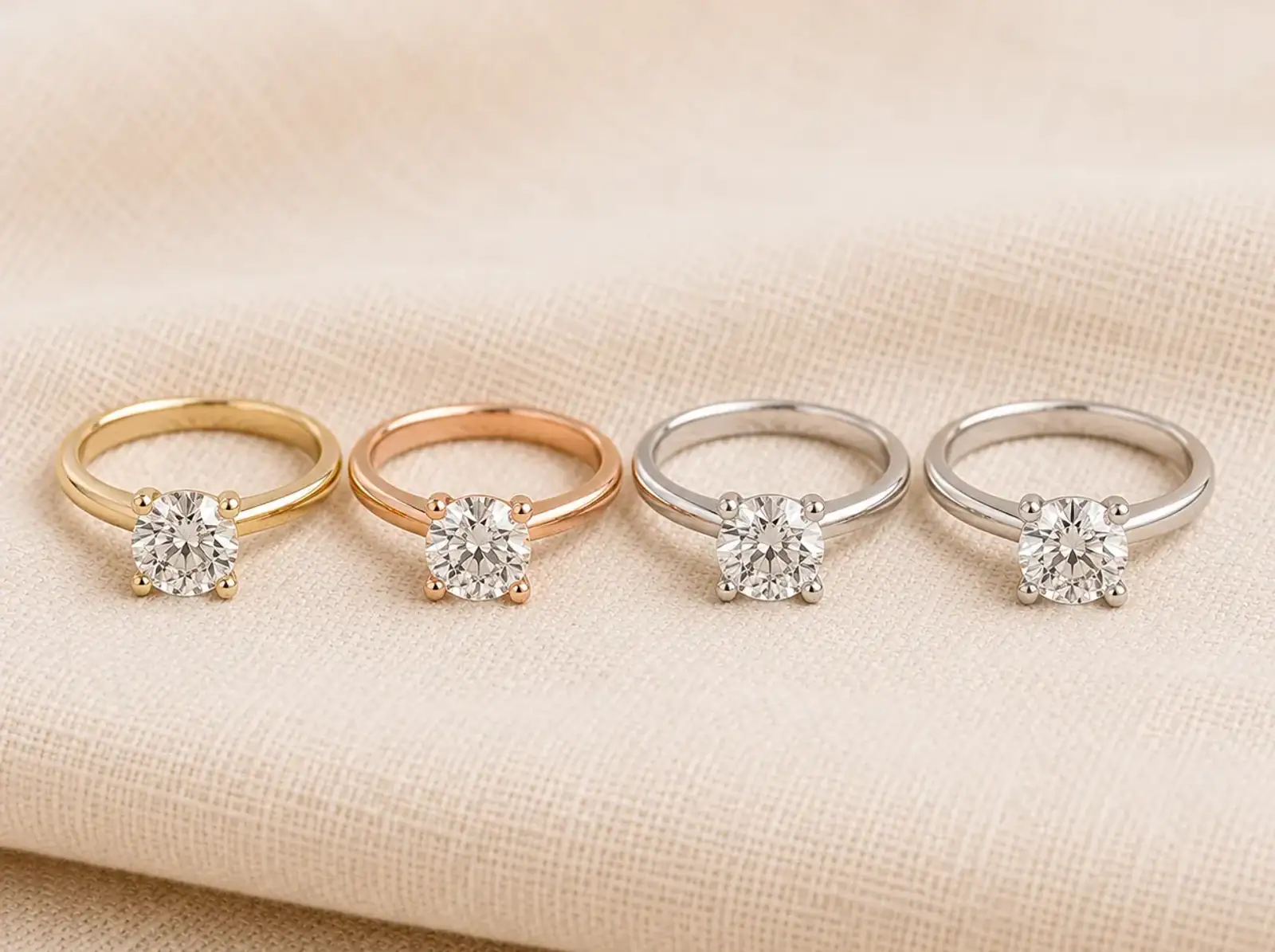
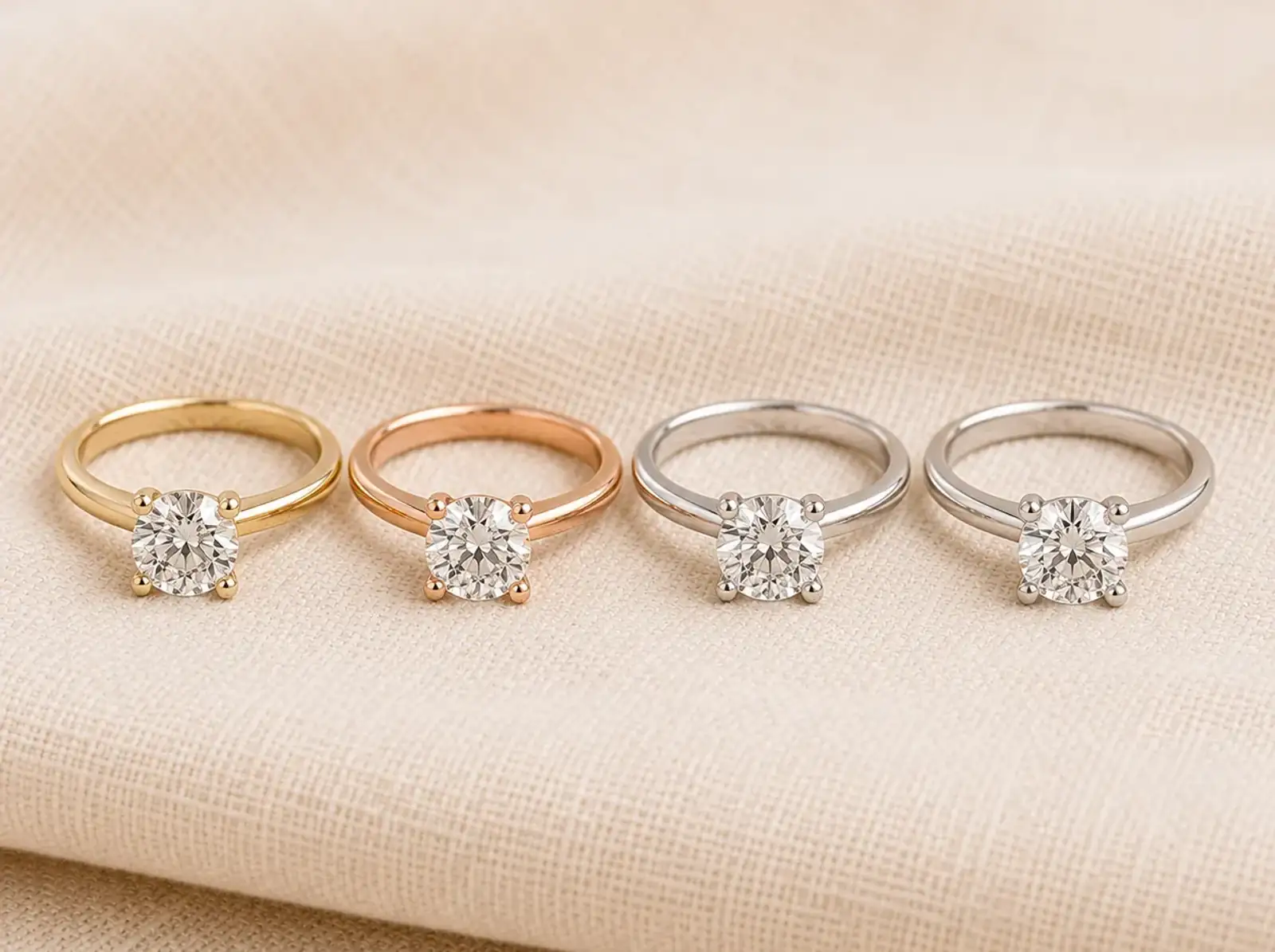
Platinum and white gold look near enough identical on the hand; the difference is what happens over the next ten years. White gold’s colour is a plating on the surface and it wears through. Platinum, yellow gold and rose gold all carry their colour the whole way through, so there is nothing to renew. That one distinction explains almost everything below. To see each metal on a finished ring, browse engagement rings.
A note on words: once white gold exists, “gold” on its own stops meaning anything, so this guide says yellow gold whenever it means the warm metal.
Seven sections: platinum vs. white gold, white gold, platinum, yellow gold, rose gold, what upkeep actually costs, and mixing metals. For each metal you get what it is, who it suits, the honest trade-off, and the average price in our collection. The stone is a separate decision, and so is the setting — our diamond shape guide and ring style guide cover those.
Platinum vs. white gold — what actually differs
Held next to each other in good light, a rhodium-plated white gold ring and a platinum ring are the same colour. Nobody at the wedding will know which one you chose. Every real difference between them is about what the ring does after you stop looking at it.
The one distinction that explains the rest: white gold’s colour is a surface, and platinum’s is not. Gold is yellow; you make it white by alloying it pale and then plating it with rhodium, a hard white metal from the platinum family. That plating is thinner than a human hair, it sits between your skin and the ring, and it wears through — underside first. Platinum is simply white metal all the way down.
- Weight. Platinum is markedly denser. The same mounting is noticeably heavier, which most people either love immediately or notice for a fortnight and then forget.
- Wear. Gold loses a little metal every time it is scratched or polished, so a gold ring gets very slowly thinner over decades. Platinum displaces instead — the metal moves to the side of the scratch rather than off the ring — so it keeps its weight and gains a patina.
- Prongs. Platinum is actually softer than 14K gold on a hardness scale, and still holds a large stone more securely, because it bends rather than fractures. It is a density argument, not a hardness one, and it is why we set high-value stones in it.
- Upkeep. White gold needs re-plating; platinum needs nothing, unless you want the patina polished off.
- Cost. Platinum costs more for the same mounting. Rather than quote a percentage, the price lines under white gold and platinum below are read live from what we actually stock, so you can see the gap instead of taking it on faith.
The trade-off in one line: platinum costs more up front and nothing afterwards; white gold costs less up front and asks for a plating cycle you should know about before you buy, not after.
White gold
Average price of a white gold engagement ring in our collection: $1,634
Yellow gold alloyed pale with white metals, then rhodium-plated for the bright cool finish. It is the metal we are asked for most often in the showroom, and the reason is straightforward: it gives a diamond a white surround, which makes the stone read brighter and cleaner than a warm metal does, at a price below platinum.
Who it suits:
- anyone who wants the platinum look and would rather spend the difference on the stone
- anyone whose other jewelry is white metal, so the ring has to match it
- anyone with a colourless, high-clarity centre stone — a warm metal will cast into it and undo some of what that grade was bought for
On “hypoallergenic”: it and “no nickel in the alloy” are not the same claim, and they get used as though they were. Rhodium is what actually touches your skin, and rhodium is inert — so a freshly plated white gold ring is skin-safe whatever the alloy beneath it.
That protection is a surface, and it wears. Which is exactly why the plating interval matters more to someone with a nickel sensitivity than to anyone else. If that is you, ask us to confirm the alloy on the specific mounting before you buy, or sidestep the question with platinum.
The trade-off: the plating. It is not a defect and it is not expensive, but it is a recurring appointment for the life of the ring, and the ring will spend part of each cycle looking slightly warmer than the day you got it. Browse white gold engagement ring settings.

Platinum
Average price of a platinum engagement ring in our collection: $2,277
Naturally white, and in fine jewelry almost always PT950 — 95% platinum, with the remaining 5% iridium or ruthenium for workability. There is no plating and no coating; what you see is the metal. It is the densest of the four by a wide margin, which is what you notice first when you pick one up.
Who it suits:
- anyone setting a large or expensive centre stone, where prong security is the priority
- anyone who wants to buy the ring once and never think about its finish again
- anyone who likes weight in a ring — this is a genuine preference and it splits people cleanly
- anyone who reacts to metals and would rather not have to ask what is in the alloy
The trade-off: it costs more for the same mounting, and it will not stay mirror-bright. Within a year of daily wear it develops the patina — a soft matte web of fine marks that reads as age. Plenty of people want exactly that; if you do not, it polishes out, and you will be asking for that polish more often than a white gold owner asks for a re-plate. See platinum engagement ring settings.

Yellow gold — 14K vs 18K
Average price of a yellow gold engagement ring in our collection: $1,552
The oldest answer and, after two decades out of fashion, a returning one. The colour is in the alloy rather than on it, so there is no plating, nothing to renew, and the tone it has on the day it is made is the tone it keeps.
14K or 18K is the real decision inside this section, and it is the same trade in both directions. Those percentages are not marketing shorthand — what a karat mark may legally claim is set by the FTC’s Jewelry Guides.
- 14K — 58.3% gold. The US daily-wear standard. Harder, so it holds up better to knocks and holds prongs longer; the colour is a shade cooler and less saturated.
- 18K — 75% gold. Visibly richer and warmer, heavier in the hand, and softer — it marks more readily and wears faster at the points of contact.
Who it suits:
- anyone who wants a ring that never needs its colour maintained
- anyone with warm skin tones, where a white metal can read cold against the hand
- anyone drawn to antique and vintage design, which is overwhelmingly yellow
The trade-off: a warm metal casts warmth into the stone it holds. In a colourless, high-grade diamond that is a real cost — you paid for the absence of colour and the setting is putting some back. A common fix is a white metal head on a yellow shank; ask about it rather than assuming you must choose. Browse yellow gold engagement ring settings.

Rose gold
Average price of a rose gold engagement ring in our collection: $1,583
Yellow gold with copper in the alloy, which pulls the colour pink. Like yellow gold the colour is structural rather than applied, so it never needs plating. One useful counter-intuition: lower karat is pinker. 14K has less gold and therefore more room for copper, so it runs a deeper rose than 18K, which reads closer to peach.
Who it suits:
- anyone who wants the ring to look like a choice rather than a default
- anyone pairing it with morganite, champagne diamonds, peach sapphire or pearl, all of which it flatters
- anyone who finds yellow gold too traditional and white gold too cool
The trade-off: it is the least neutral of the four, so it commits the ring to a look in a way the others do not — worth sitting with for more than one afternoon. The copper also means it can take on a faint darker cast in crevices over many years; that polishes out, and a good number of owners decide they prefer it. See rose gold engagement ring settings.
Rhodium plating, patina, and what upkeep really costs
This is the part of the metal decision that is almost never discussed before the sale, and the only part that costs money afterwards. It is short, and it is worth reading before you commit.
White gold: the re-plating cycle
Rhodium wears through in roughly 1–3 years of daily wear, and Jewelers of America says the same thing the long way round: how often depends on how the piece is worn. The range is that wide because it is a function of the hand, not the ring — someone who works with their hands, wears the ring in the gym, or washes it constantly will be at the short end, and someone who takes it off at home will be at the long end. It goes first on the underside of the band, then at the shoulders. What you see is not a chip or a flake but a gradual warming, and most people notice it because a friend’s newer ring is suddenly whiter than theirs.
- What it costs: typically a modest bench fee per visit, and the ring is away for a day or two.
- 18K wears its plating out looking worse than 14K, because the alloy underneath is warmer, so there is more contrast to notice as the surface thins.
Platinum: patina instead of maintenance
Platinum has no finish to renew, so its upkeep is a matter of taste rather than necessity. Within about a year the surface builds a fine matte web of marks. Because platinum displaces rather than sheds metal, none of that represents loss — a platinum ring weighs essentially what it weighed when it was made, decades on, which is not true of any gold.
If you like the patina, do nothing, ever. If you want the original mirror finish, we polish it; expect to want that more often than a white gold owner wants a re-plate.
Yellow and rose gold: neither
No plating, no patina worth managing. They mark and scratch like any gold and take a polish whenever you want one. Over a very long life a gold ring thins slightly at the bottom of the band; that is a re-shanking job at some point in the next few decades, not a maintenance schedule.
If upkeep is the deciding factor for you rather than a footnote, the honest ranking is: yellow and rose gold ask for nothing, platinum asks for nothing unless you dislike the patina, and white gold asks for a standing appointment.
Mixing metals, and matching the wedding band
The old rule against mixing metals is gone, and has been for long enough that following it now reads as dated rather than correct. Two questions actually come up.
Two-tone and mixed-metal engagement rings
A deliberate two-tone ring — most often a white head holding the stone on a yellow or rose shank — solves a real problem rather than being decoration. The white metal keeps warmth out of a colourless stone; the warm shank is what your eye actually reads on the hand. It also lets the ring sit alongside both warm and cool jewelry without arguing with either. We build these to order rather than stocking them, so it is a conversation at the bench, not a filter on a page.
Does the wedding band have to match?
No, and this is the question we are asked most in this territory. Two things are worth knowing before you decide:
- Mixing metals is a look, not a mistake. A platinum engagement ring with a rose gold band is a deliberate warm-cool contrast, and it is a common request.
- Mixing hardnesses is a wear question. Two rings worn touching, day in and day out, abrade each other, and the softer one gives first. A soft 18K band against a platinum ring will show it. If the two are going to live side by side permanently, matching the hardness matters more than matching the colour.
The practical route is to choose the engagement ring on its own merits and then bring it in when you choose the band, so the two can be seen together on the hand rather than reasoned about separately.
How to choose
Three questions in this order get almost everyone to one answer:
- Warm or cool? Answer this first, because it eliminates half the field and it is the only one of the three that is purely about taste. Look at the jewelry already being worn every day — that answer is usually already made.
- If cool: will you maintain a finish, or would you rather not? That is the entire platinum vs. white gold decision. Would rather not, and the budget allows it: platinum. Would rather put the money in the stone: white gold, with the plating cycle understood going in.
- If warm: yellow or rose, and 14K or 18K? Yellow is the traditional read and rose the contemporary one. Then 14K for a ring worn hard, 18K for depth of colour on a ring worn more gently.
Once the metal is settled the rest follows: the setting, the stone’s shape, and the weight your budget supports — which our budget guide covers honestly. All four metals are in the showroom, in the same mounting, to hold against each other.
Frequently Asked Questions
Related guides & collections
- Engagement ring settingsShop all seven settings with live pricing.
- Engagement ringsThe full hub — styles, shapes, carat and metals.
- Engagement ring stylesSolitaire, halo, three-stone and the rest.
- Diamond shapesRound, oval, cushion, emerald and the rest.
- Jewelry by metalEvery metal we work in, across the whole collection.
The two white metals, side by side
See Them on a Hand Before You Choose
Platinum and white gold are nearly impossible to tell apart in a photograph and easy to tell apart in the hand — weight is the giveaway. Bring your shortlist to our Snellville showroom near Atlanta and hold all four.
Prefer to talk? Call (704) 684-7530