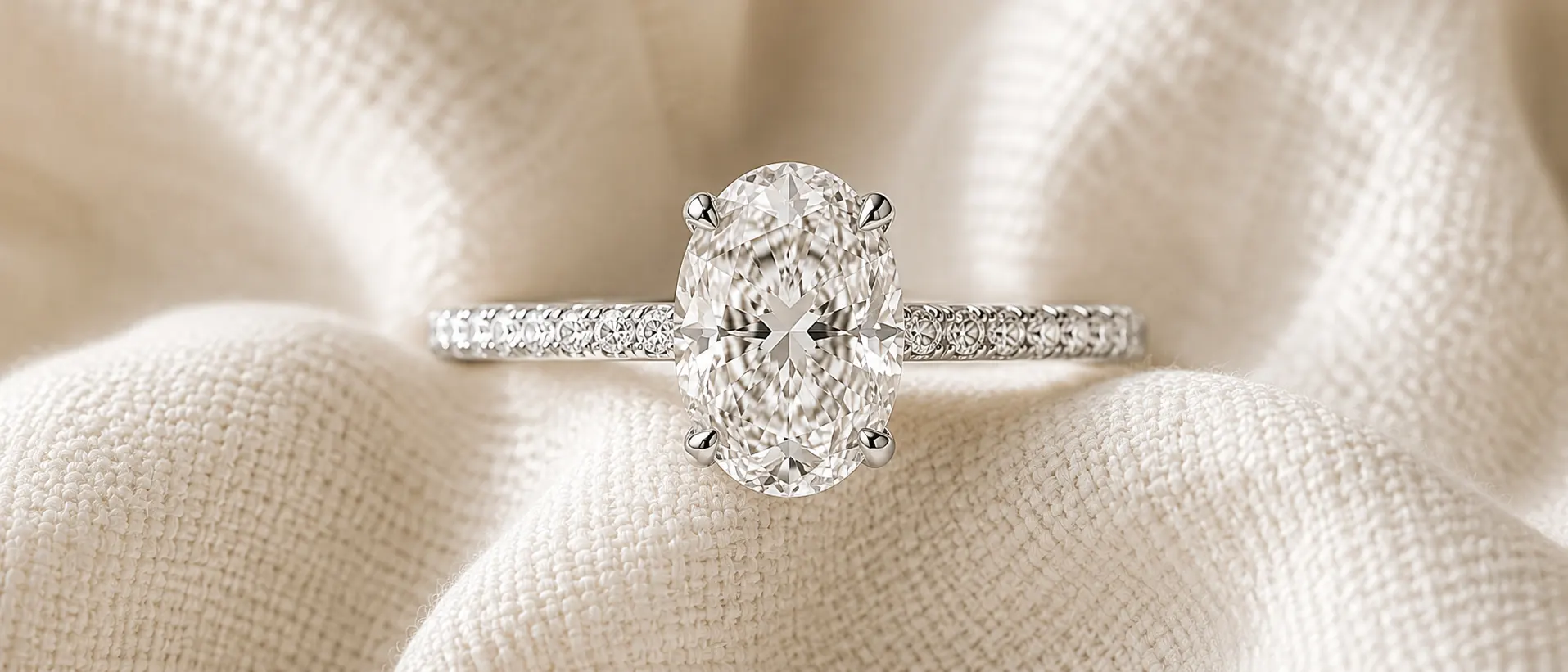
What Is an Oval Cut Diamond?
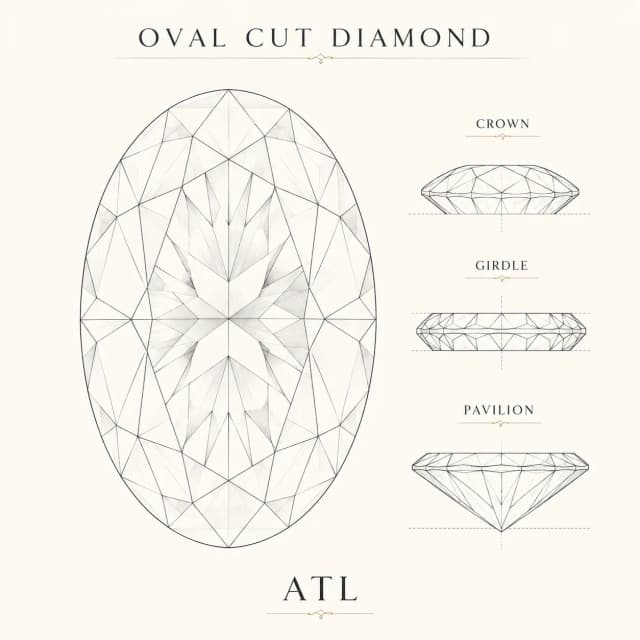
The oval cut is an elongated, elliptical diamond with 56–58 brilliant facets — essentially a stretched round brilliant, perfected in the 1950s by Lazare Kaplan to deliver round-level fire in a finger-flattering silhouette.
- Looks bigger — 10–15% larger face-up per carat than round, so a 1ct oval reads close to a 1.15ct round.
- Elongating — the silhouette makes the finger appear longer and more slender.
- Bowtie effect — a dark central band on poorly-proportioned stones; we hand-select every oval for minimal bowtie, ideal 1.30–1.50 ratio, and even brilliance.
Why ATL Luxury Jewelry for Your Oval Engagement Ring
Center stones over half a carat come with a GIA report (natural) or an IGI report (lab-grown). We source both natural and lab-grown ovals across the full color (D–J) and clarity (FL–SI2) range, and we can source a stone for you to see in person. We also custom-match wedding bands — diamond eternity bands, curved ring enhancers, and stackable sets. Every ring includes lifetime cleaning and prong-tightening.
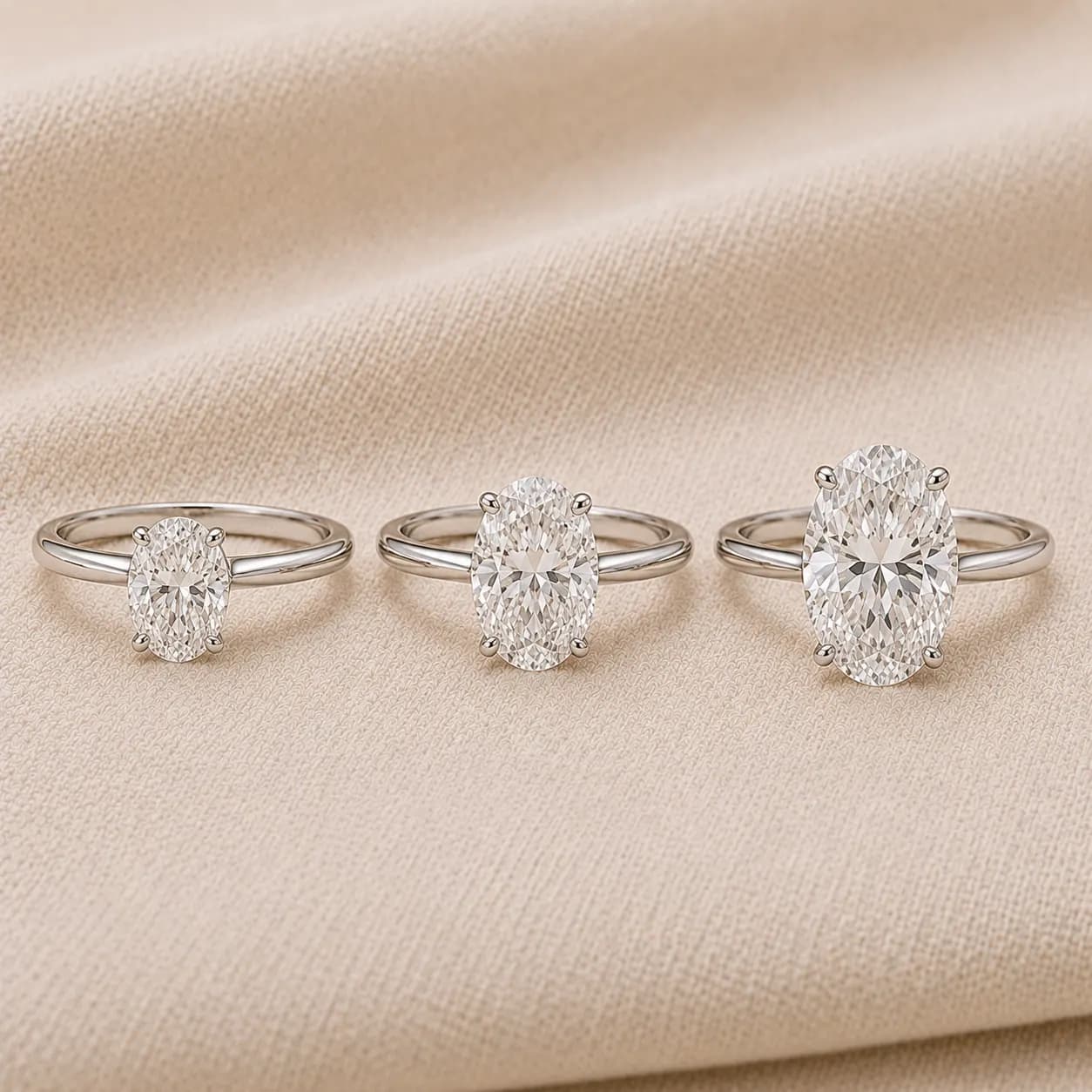
Oval Engagement Rings by Carat — 1ct, 2ct, 3ct
Oval diamonds appear visually larger than rounds of the same carat weight — an important consideration when budgeting. Common oval carat sizes:
- 1 carat — the most popular oval size; reads as a 1.15ct round equivalent face-up. $3,000–$8,500 natural ($1,500–$4,000 lab-grown) at G color / VS2 clarity.
- 2 carat — statement size, reads as ~2.3ct round equivalent. $9,000–$28,000 natural ($4,500–$12,000 lab-grown). Bowtie management becomes more important at 2ct+.
- 3 carat — milestone size with dramatic finger presence. $18,000–$55,000 natural ($7,500–$22,000 lab-grown). At 3ct+, hand-selecting the stone for minimal bowtie is essential.
Smaller (0.7–0.9ct) reads delicate; 4–5ct is anniversary/milestone size, popular among celebrities (Blake Lively’s oval is ~12ct). We model carat proportions against your hand at the showroom — oval’s elongated silhouette changes proportional perception more than round.
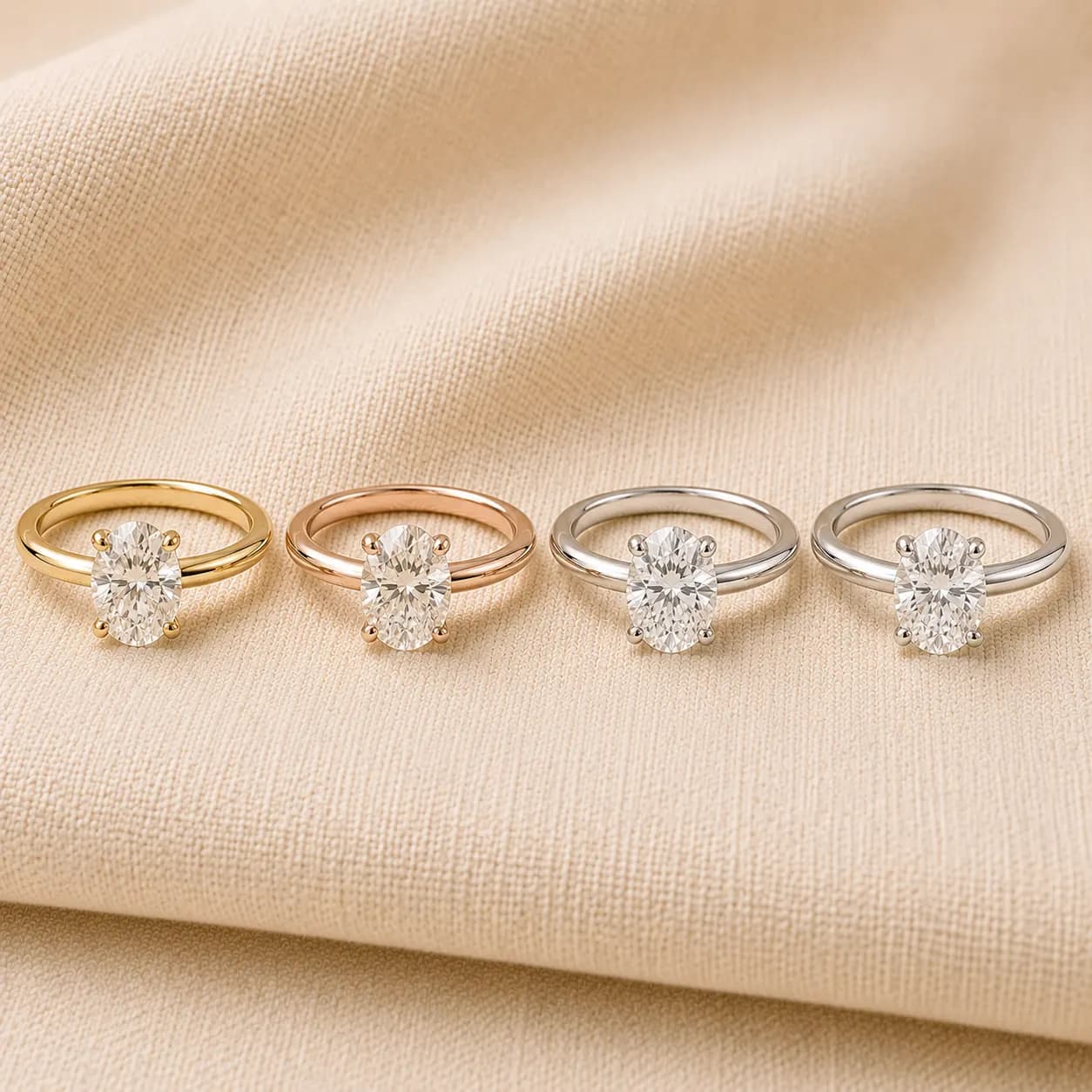
Oval Engagement Rings by Metal
Ovals work beautifully in every metal — the elongated shape is particularly flattering with warm-toned metals.
- Platinum — structural rigidity holds the oval’s prongs over decades (the pointed ends are vulnerable to prong wear); cool white shows the fire brightest. See platinum wedding bands.
- 14K / 18K white gold — very similar to platinum at 30–50% the cost; the most-purchased oval metal in the US.
- Rose gold — a defining trend of the last decade; the warm pink tone enhances the oval’s romantic, contemporary character.
- Yellow gold — the warmest choice, working especially well with vintage-inspired settings. See gold and rose gold wedding bands.
Lab-Grown vs Natural Oval Diamond
Both lab-grown and natural ovals are real diamonds — visually, chemically, and optically identical (same Mohs hardness, same brilliance, same potential for bowtie). The differences:
- Lab-grown — 40–60% less per carat. A 1.5ct natural oval at $8,000 runs $3,500–$4,500 lab; a 3ct natural at $30,000 runs $11,000–$14,000 lab. Especially meaningful here, since oval cut quality (bowtie) matters more than color/clarity at larger sizes — the savings let you size up or upgrade cut precision.
- Natural — stronger long-term resale (lab-grown ovals have declined faster than rounds), geologic rarity, and heirloom potential.
Choosing Your Oval Diamond
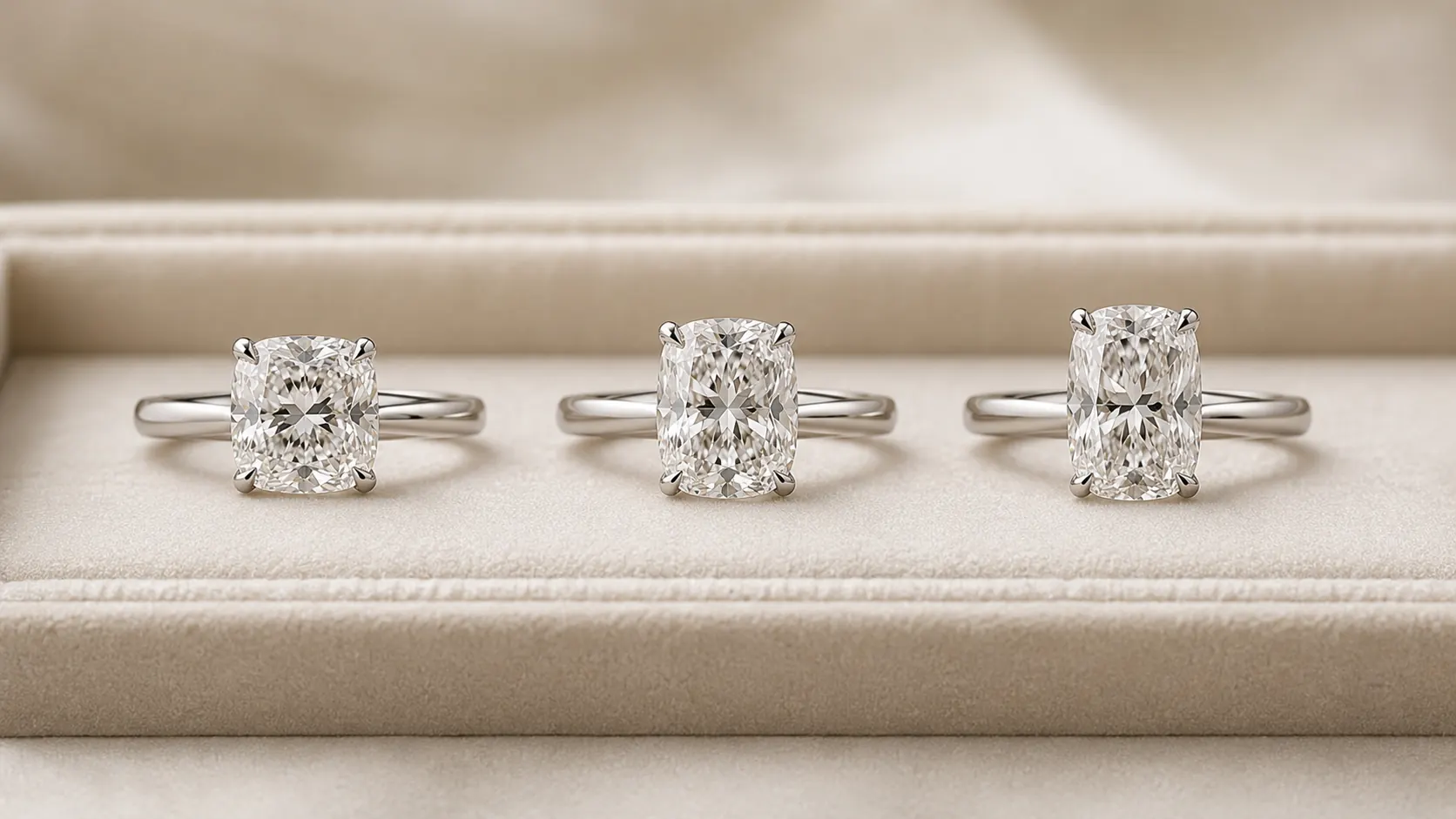
Three characteristics matter most when selecting an oval — we discuss all three candidly during every consultation:
- Bowtie visibility — the single most important factor; well-cut ovals minimize or eliminate the dark central band.
- Length-to-width ratio — 1.40 is generally ideal; 1.30–1.50 is the broadly flattering range.
- Symmetry — the two pointed ends should mirror each other exactly along the center axis.
Oval diamond pricing typically runs 10–20% lower than round brilliants of equivalent quality, while delivering 10–15% more face-up surface area per carat. This combination of value and visual size is the strongest reason oval has become one of the most-requested engagement shapes globally.
Oval Setting Styles
Oval diamonds work beautifully across nearly every setting style. The five most enduring options are:
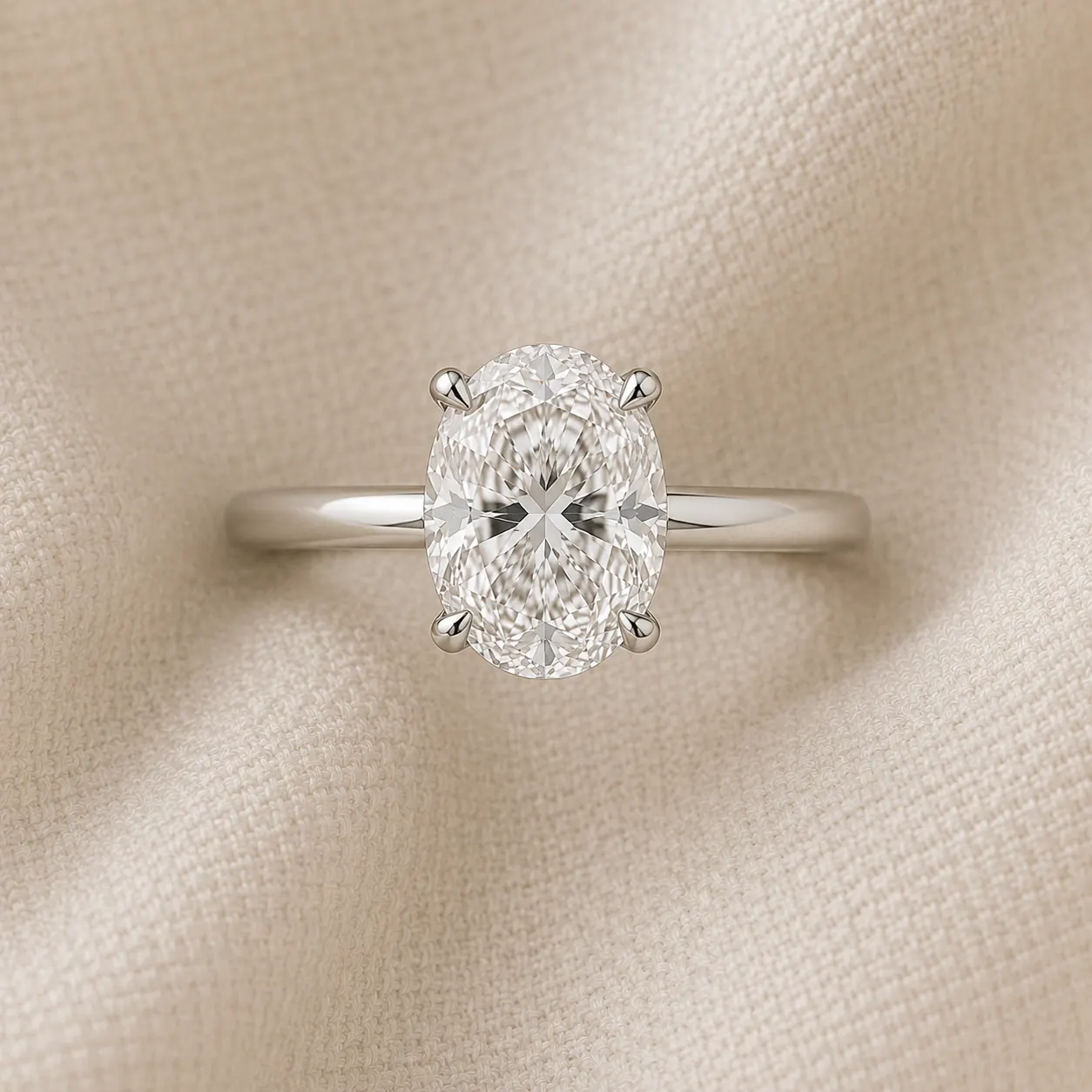
Solitaire
A classic four-prong setting that lets the oval’s elongated silhouette and brilliance take center stage.
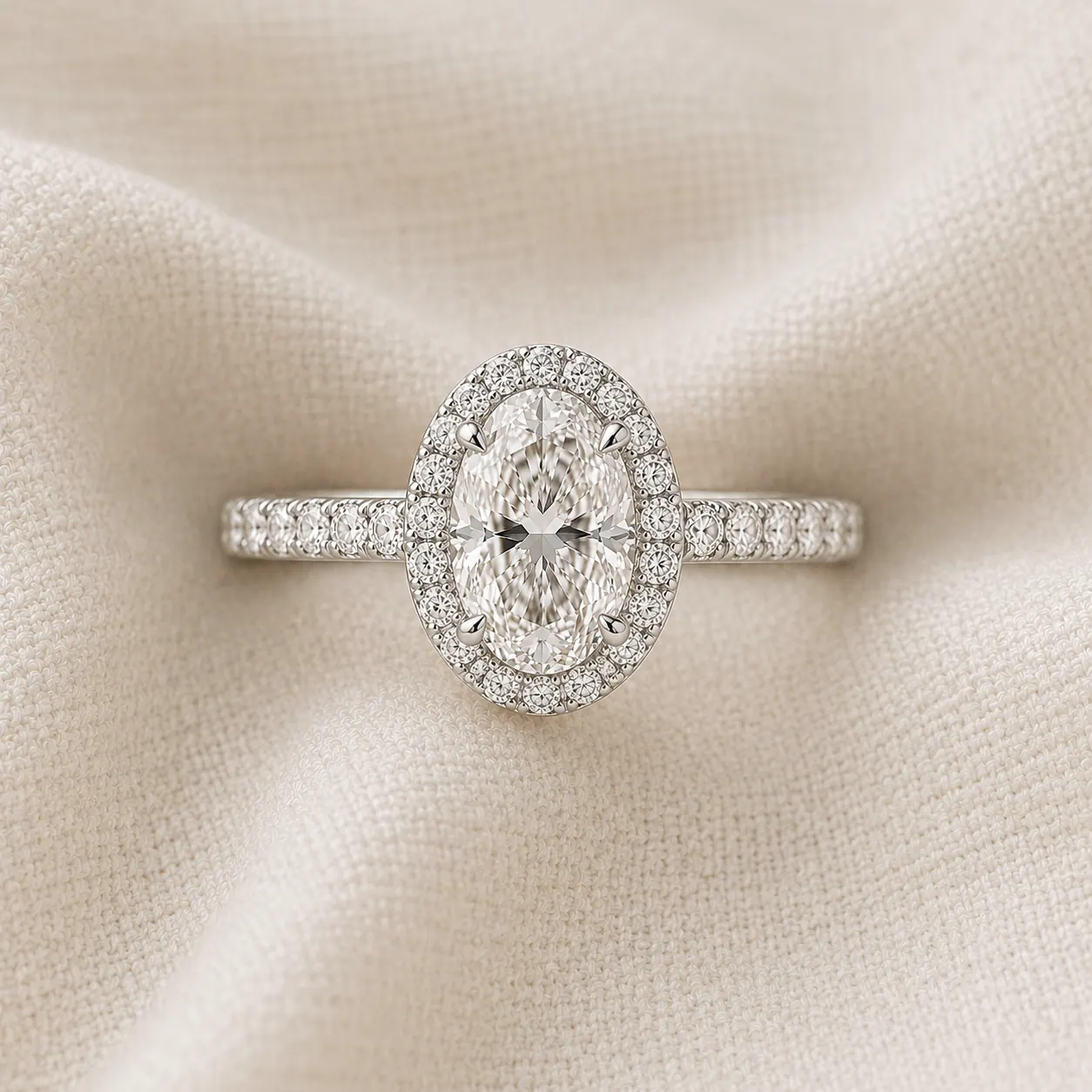
Halo
A ring of pavé diamonds frames the oval, dramatically amplifying visual size and sparkle.
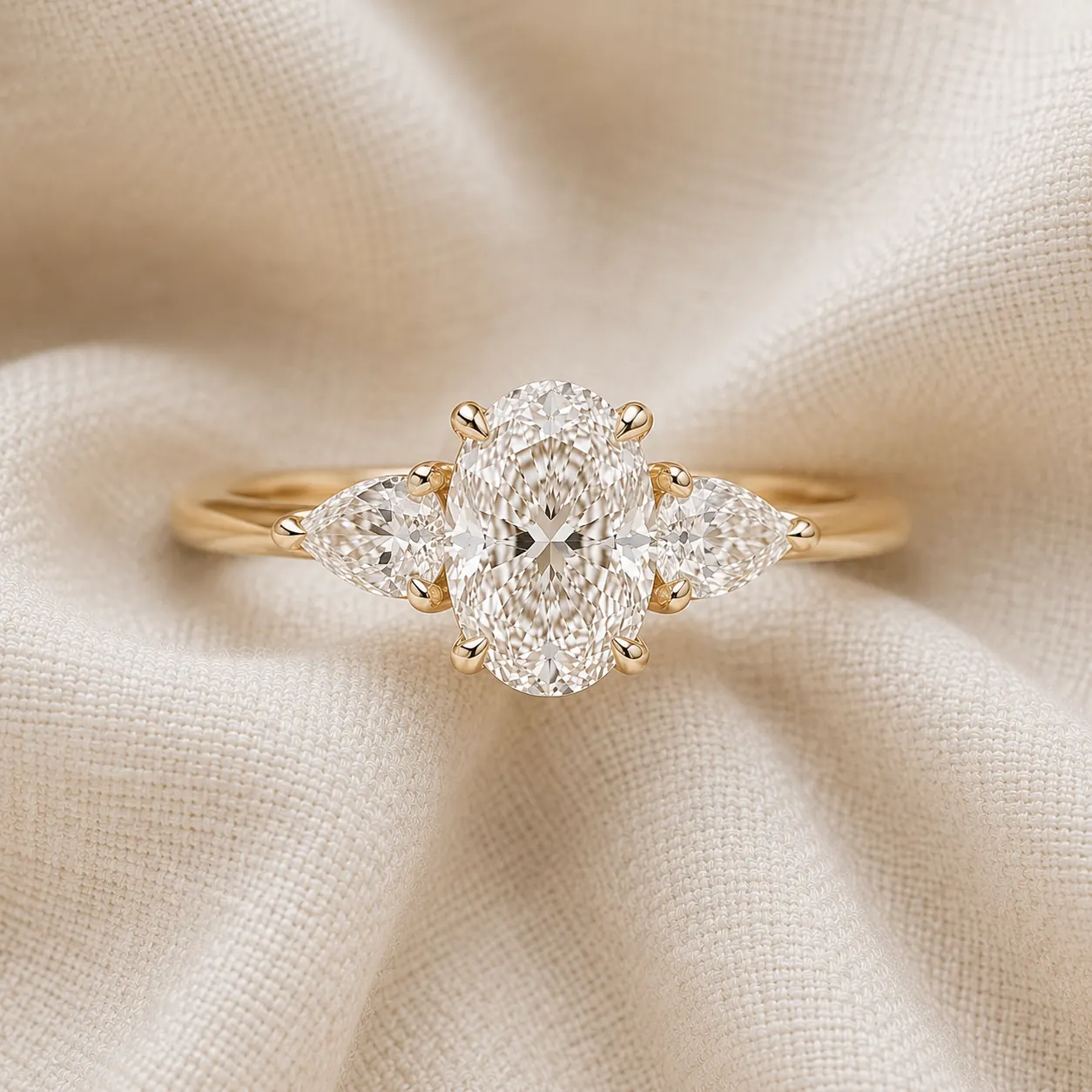
Three-Stone
Pear or trillion side stones flank the oval center — a celebrity-favorite design popularized by Meghan Markle’s ring. Browse three stone rings.
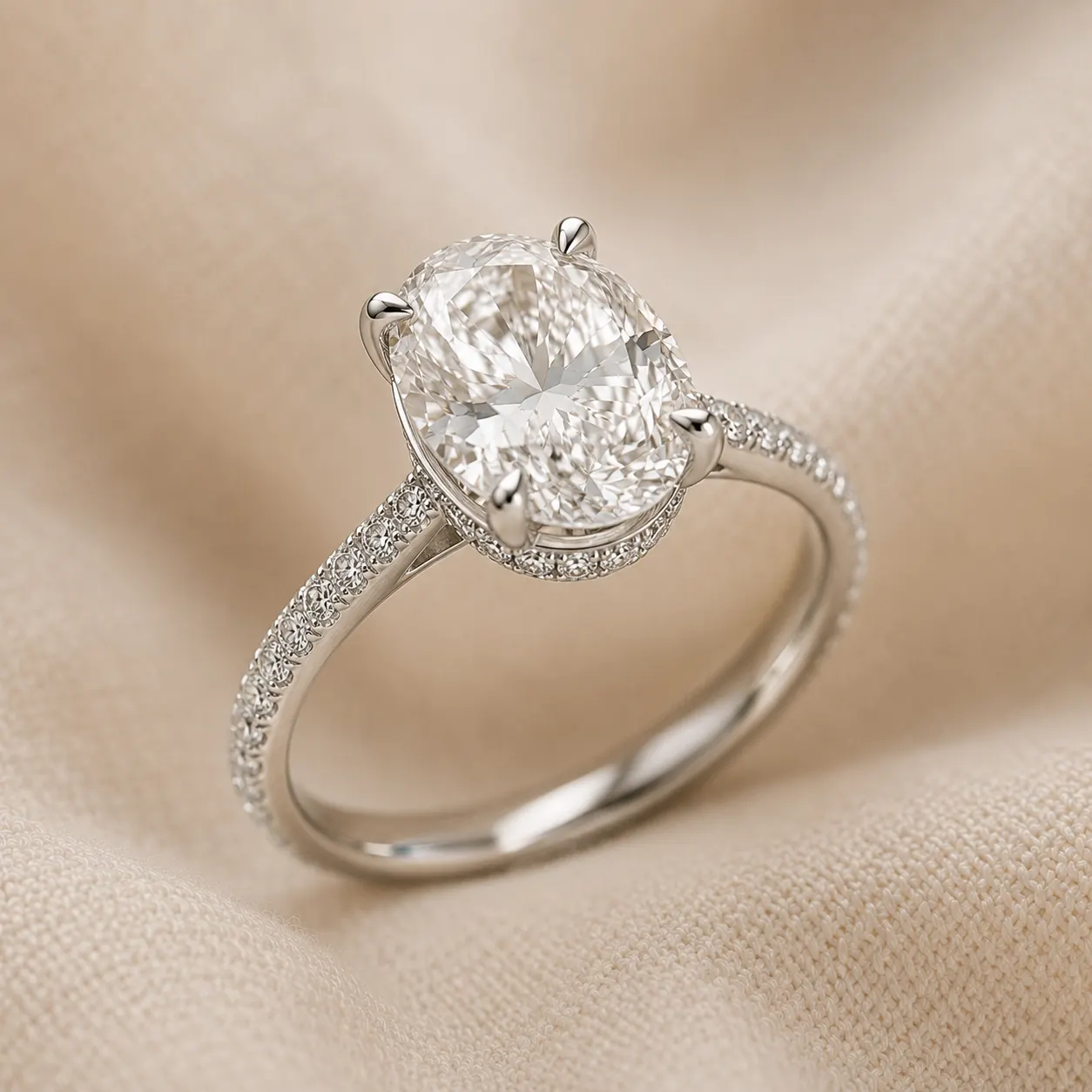
Hidden Halo
A halo of small diamonds tucked under the oval — invisible head-on but sparkling from the side. A signature modern oval design.
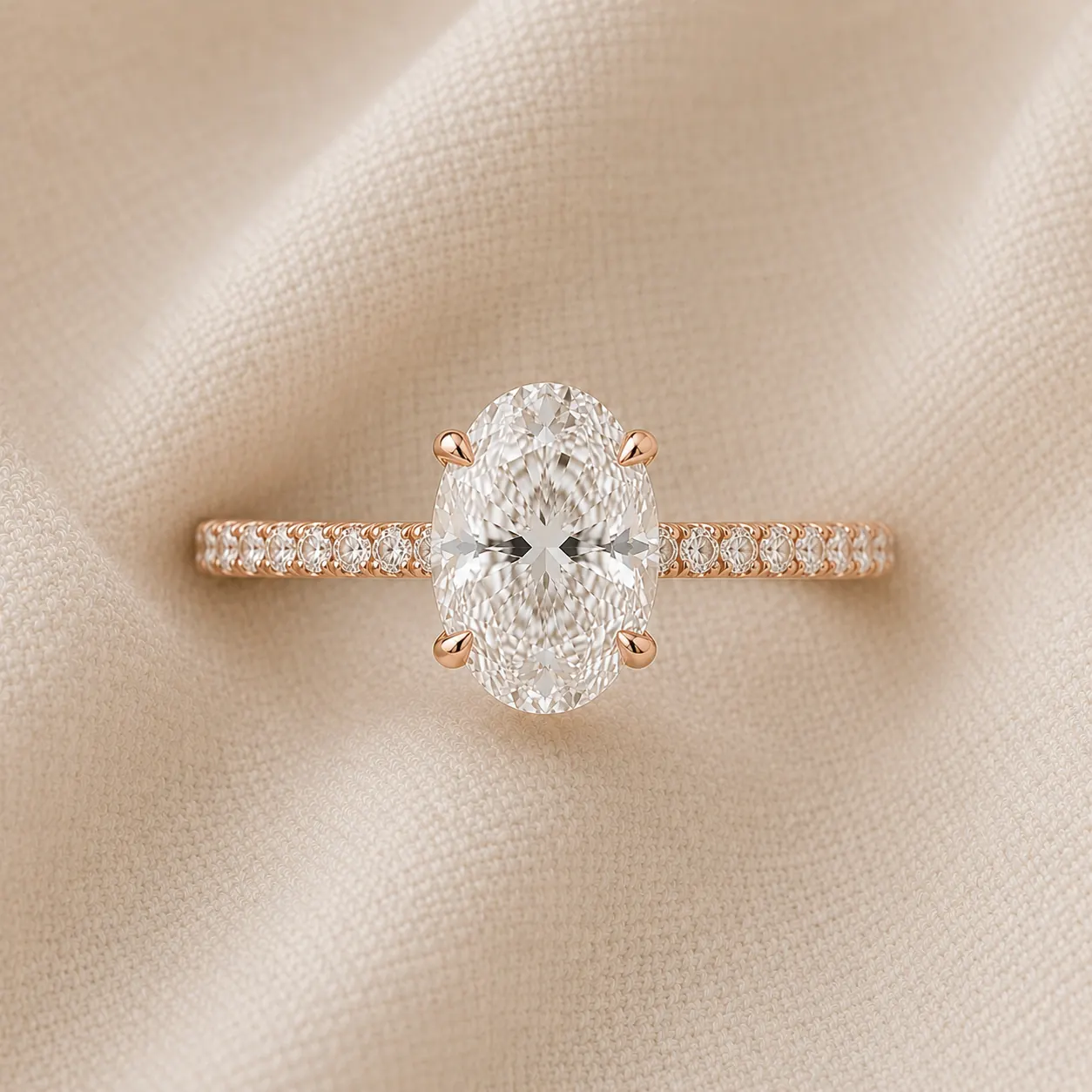
Pavé Band
Tiny diamonds along the shank — especially striking in rose gold, which has become the defining oval-cut metal of the last decade.
Wedding Band Pairings for Oval Engagement Rings
Wedding band pairing is one of the most common questions clients ask about oval engagement rings — and one we love answering. The oval’s symmetrical, elongated profile opens up more pairing options than almost any other shape:
- Straight diamond eternity band: A clean, modern complement that adds continuous sparkle. The most popular pairing for solitaire and pavé-band ovals.
- Curved (contoured) band: Custom-shaped to hug the base of the oval, creating a seamless silhouette when worn together. Ideal for low-profile settings and halo designs.
- Thin plain band: A simple gold or platinum band that lets the oval engagement ring stand alone. Often chosen by clients who plan to add anniversary bands later.
- Stacked bands: Two bands worn together — typically one curved and one straight, or two straight bands of different metals (mixed yellow and white gold is increasingly popular).
- Hidden enhancers: Bands designed to fit beneath the engagement ring rather than alongside it — adding sparkle without crowding the oval’s silhouette. See our ring enhancer collection.
Our master jewelers can custom-design any wedding band to fit your oval engagement ring exactly — including curved bands milled to the precise contour of your specific oval center stone. Most clients book a separate consultation for the wedding band 6–12 months before the wedding date. Browse our diamond wedding bands.
Related Collections
Round Engagement Rings
The classic — round brilliants share the oval’s facet pattern but with geometric symmetry.
Pear Engagement Rings
A teardrop variation that combines oval and marquise — similarly elongating.
Marquise Engagement Rings
A more pointed elongated shape — maximum finger coverage per carat.
Diamond Wedding Bands
Curved, straight, and eternity bands designed to pair with oval engagement rings.
Halo Engagement Rings
Halo and hidden-halo settings are the most popular configuration for oval diamonds.
Custom Design Process
Commission a one-of-a-kind oval engagement ring and matching band in Atlanta.
Frequently Asked Questions
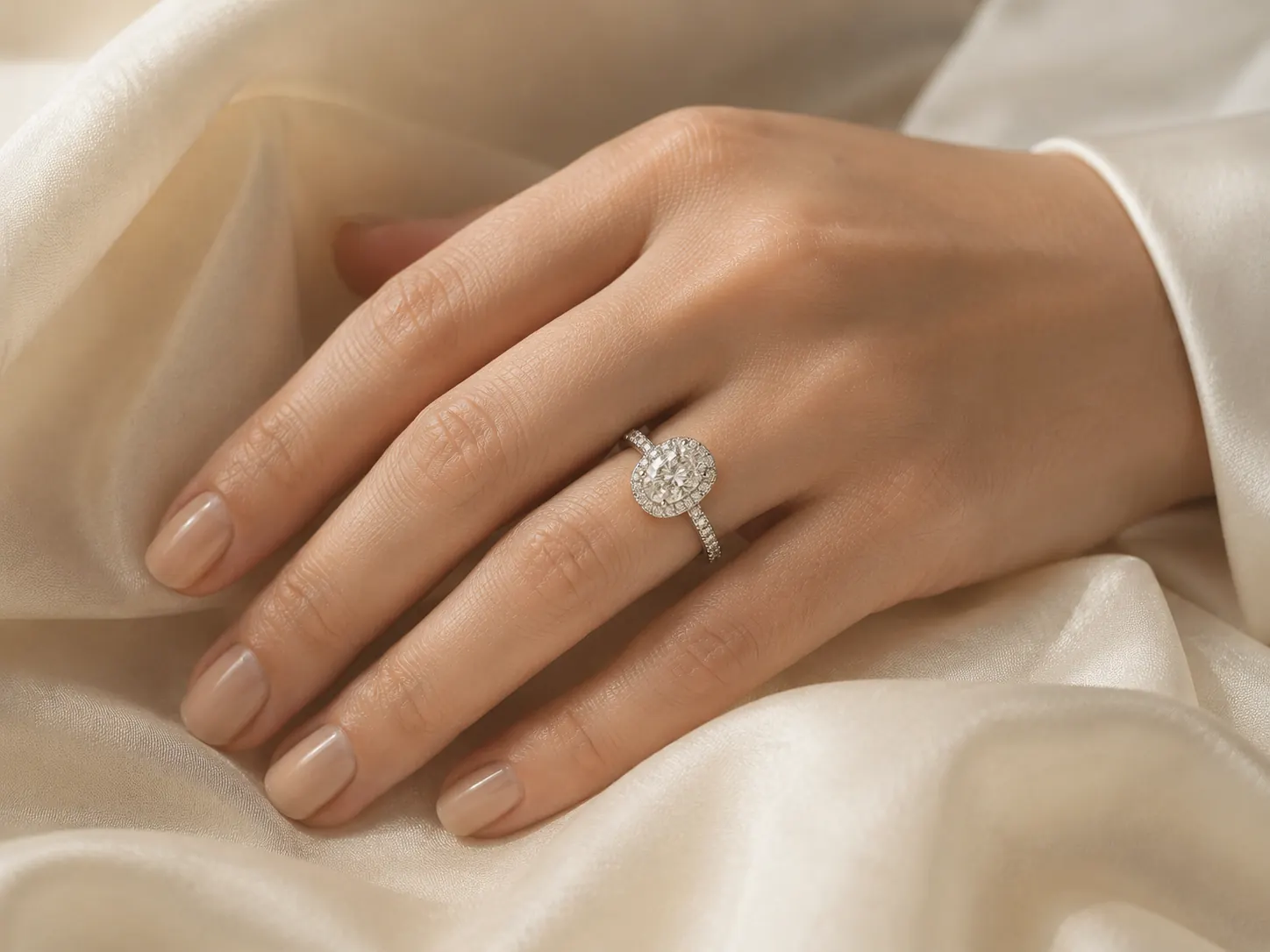
Visit Our Atlanta Showroom
See Oval Engagement Rings in Person
Our Snellville showroom — minutes from Atlanta, Lawrenceville, and Stone Mountain — carries a curated selection of oval center stones and finished engagement rings, with matching wedding bands available in every metal. Book a private consultation, or call us to source a specific oval diamond for in-person viewing.
1905 Scenic Hwy N Ste 230, Snellville, GA 30078 · (704) 684-7530