Buying Guide · Updated September 2026
Diamond Clarity Chart and Color Scale
Every diamond grading report prints the same letters for clarity and color. This guide sets out the diamond clarity chart from FL to I3 and the diamond color scale from D to Z, then explains what a report says about GIA certified diamonds. It also covers cut, carat weight and shape, so you can read a report and decide which grades are worth paying for.
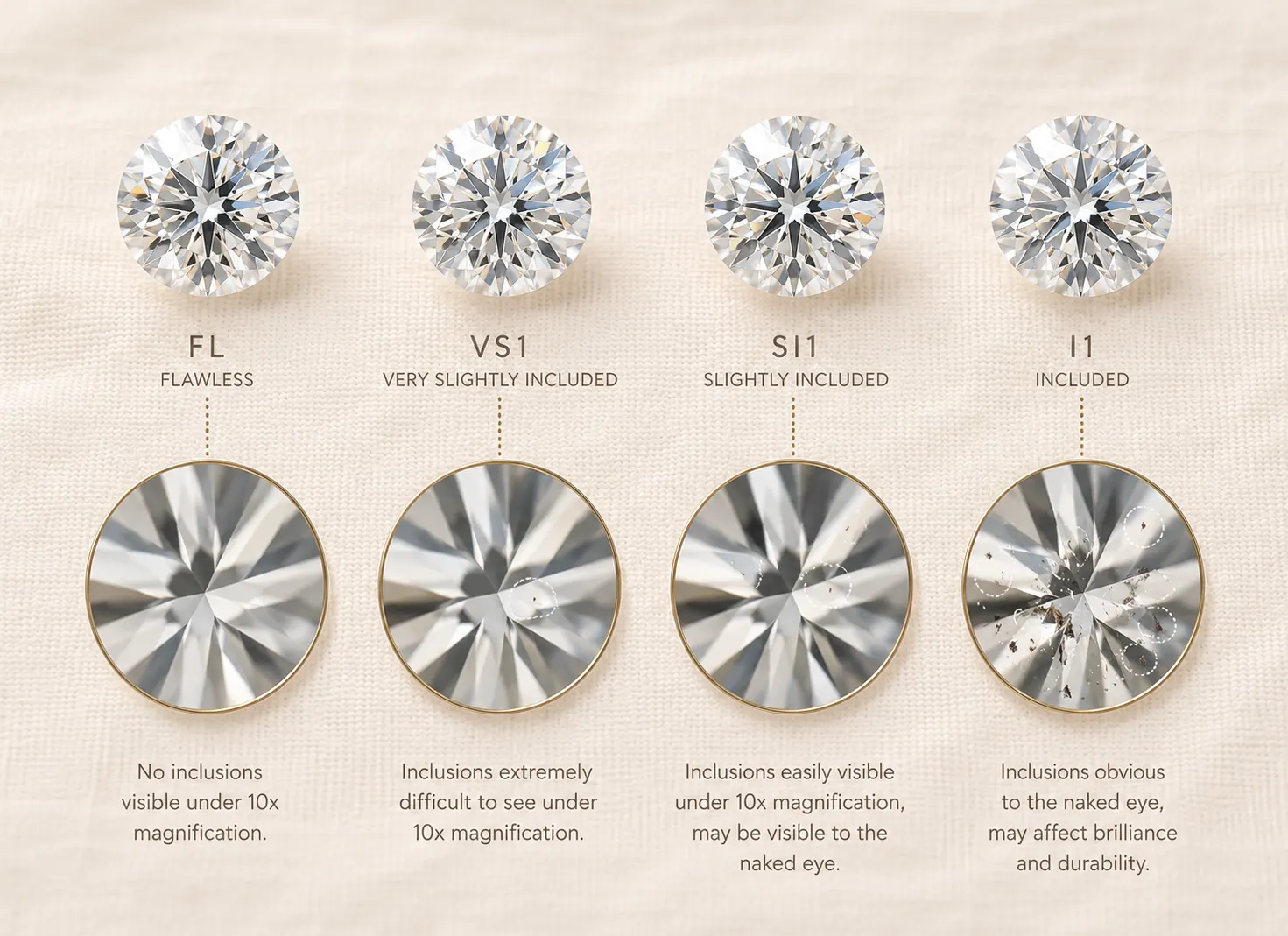
Diamond clarity chart, FL to I3
Clarity grades the inclusions inside a diamond and the blemishes on its surface, judged at 10× magnification. The GIA scale has eleven grades, listed in the table below from best to worst. The question that matters to a buyer is whether the stone looks clean to the eye at normal viewing distance, because most of the grades near the top describe features that only a loupe shows.
VS2 is reliably eye-clean across shapes, which makes it a sound target. SI1 is often the value sweet spot, but each stone has to be verified on a high-resolution video or in person. Emerald and asscher shapes have wide open facets that show inclusions readily, so aim for VS1 or better on those. FL, IF, VVS1 and VVS2 carry a large premium for inclusions that neither the eye nor most jewelers can see without magnification.
| Grade | Name | What it means |
|---|---|---|
| FL | Flawless | No inclusions and no blemishes at 10× magnification. |
| IF | Internally Flawless | No inclusions, with minor surface blemishes only. |
| VVS1 | Very, Very Slightly Included 1 | Inclusions are extremely difficult to see. |
| VVS2 | Very, Very Slightly Included 2 | Inclusions are very difficult to see. |
| VS1 | Very Slightly Included 1 | Minor inclusions that are difficult to see. |
| VS2 | Very Slightly Included 2 | Minor inclusions that are somewhat easy to see under magnification. |
| SI1 | Slightly Included 1 | Noticeable under magnification and often not visible to the unaided eye. |
| SI2 | Slightly Included 2 | Easy to see under magnification and sometimes visible to the unaided eye. |
| I1 | Included 1 | Obvious inclusions that can affect transparency and brilliance. |
| I2 | Included 2 | More obvious inclusions that are often visible face-up. |
| I3 | Included 3 | Obvious inclusions that can affect both brilliance and durability. |
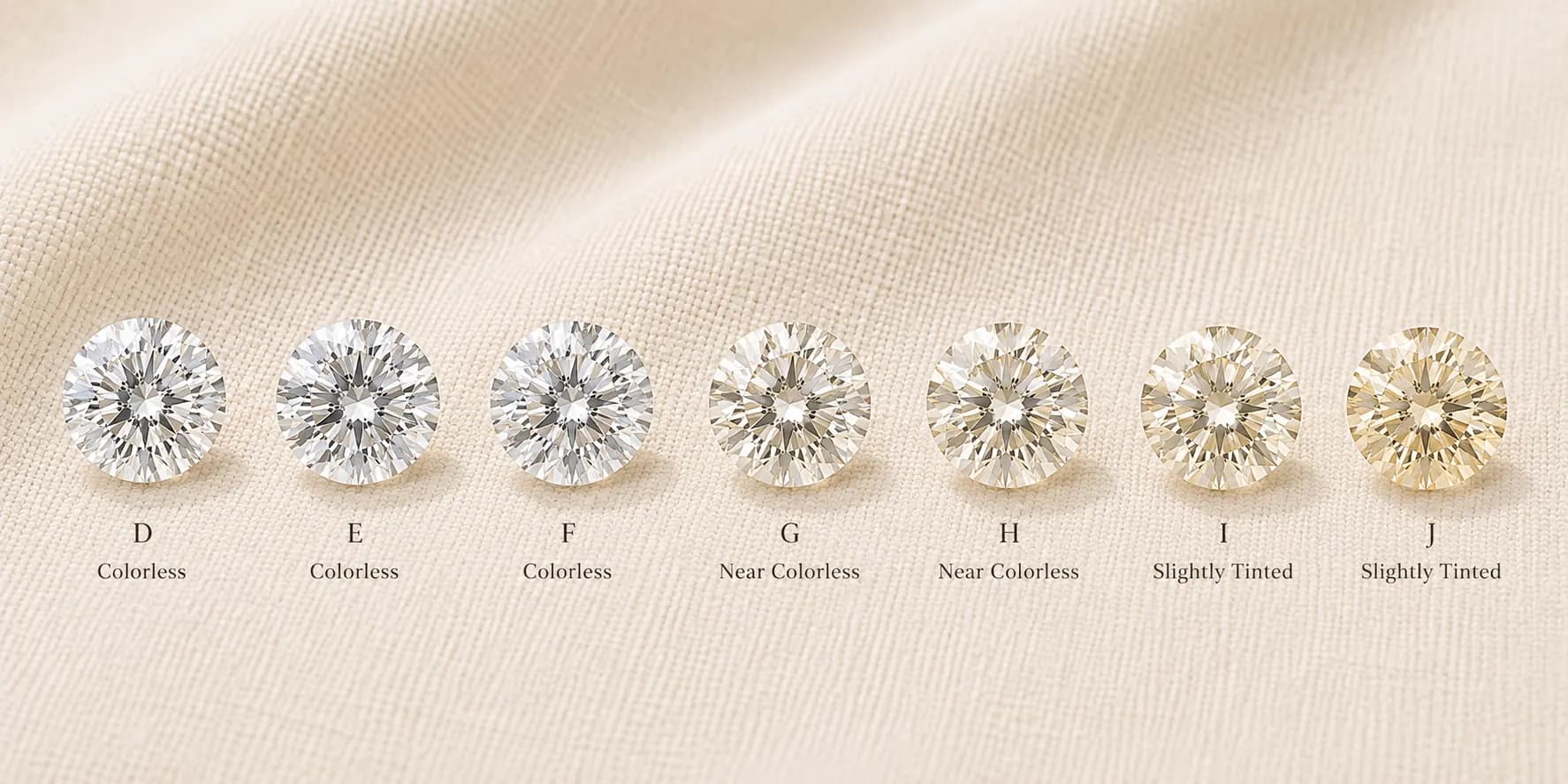
Diamond color scale, D to Z
Color grades the amount of body color in a white diamond, from D, which is completely colorless, down to Z, which is light yellow. The GIA color scale compares each stone against master stones under controlled lighting. Most of the scale is invisible in a finished piece, and the metal around the stone decides how much color grade you need.
In platinum or white gold, G or H looks colorless to the unassisted eye. In yellow or rose gold, I or J is perfectly fine, because the warm metal absorbs faint body color. Paying for D to F in yellow gold buys a difference the setting hides. Each step up the scale raises the price, and on a single stone the gap between D and G is usually larger than anything you can see.
| Grade | Name | What it means |
|---|---|---|
| D | Colorless | The highest grade, with no body color. |
| E | Colorless | Minute traces of color that only an expert can detect. |
| F | Colorless | Slight color that only an expert can detect. |
| G | Near colorless | Colorless face-up in most settings. |
| H | Near colorless | Colorless face-up, with color showing only beside a higher grade. |
| I | Near colorless | Slight warmth beside a higher grade. |
| J | Near colorless | Slight warmth that yellow or rose gold softens. |
| K to M | Faint | Warmth that shows in a white metal setting. |
| N to R | Very light | A yellow tint that is visible to the eye. |
| S to Z | Light | A clear yellow or brown color. |
Cut
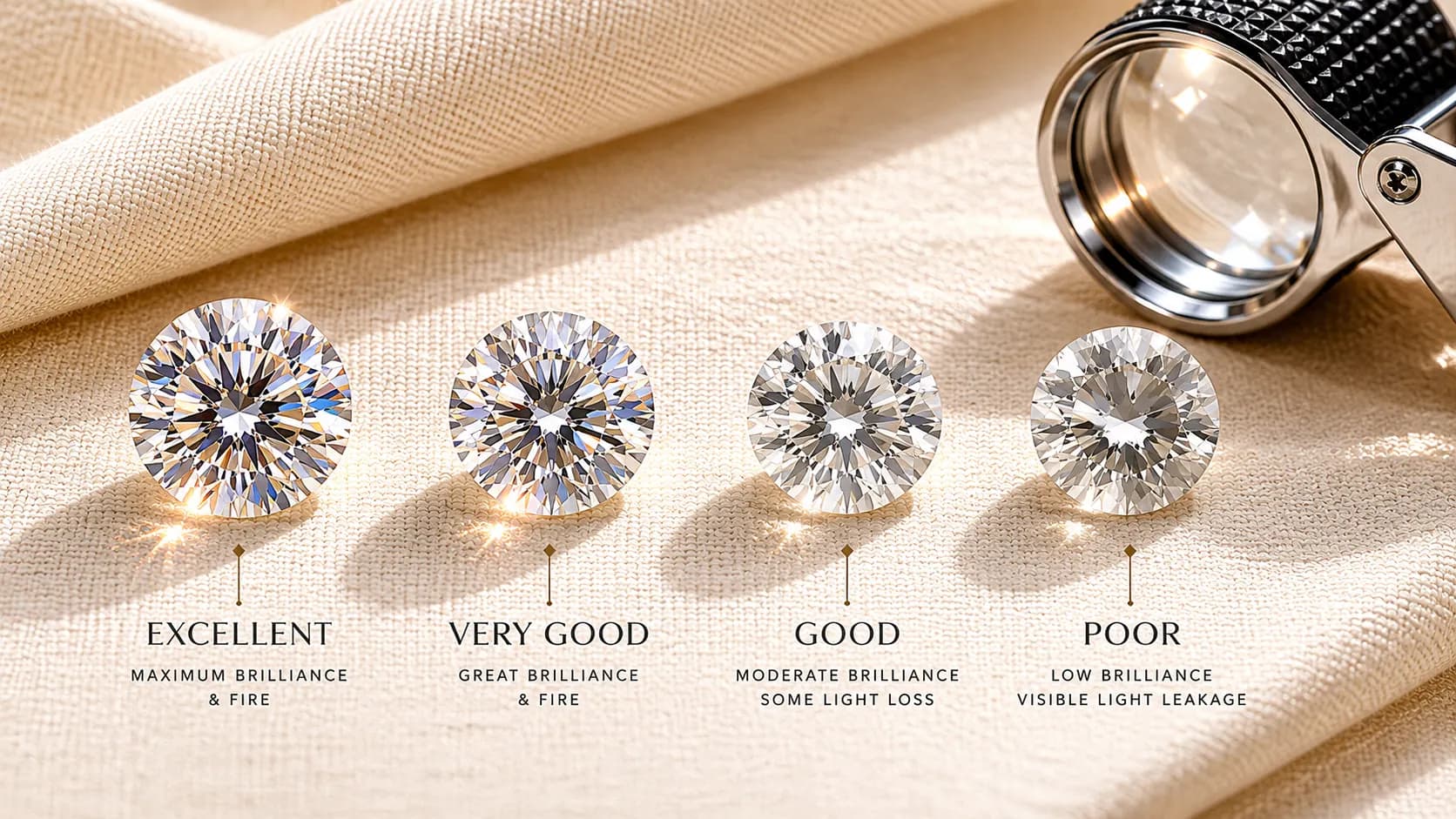
Cut is the C that makes a diamond look like a diamond. It governs brilliance, the white light a stone returns, fire, the rainbow flashes it throws, and scintillation, the sparkle as it moves. No other C makes up for a poor cut. A flawless D stone with a Fair cut looks dull, and a well-cut SI1 stone in an H color looks alive.
GIA grades the cut of round brilliants from Excellent to Poor, and Excellent is the right target. Below Very Good, a round shows windowing, dead zones or a fish-eye look. Super-Ideal and Hearts & Arrows branding add a premium for differences most buyers cannot see without a scope. Fancy shapes such as oval and cushion receive no overall GIA cut grade, so look for Excellent polish and symmetry and review the stone visually for problems specific to its shape.
Carat weight
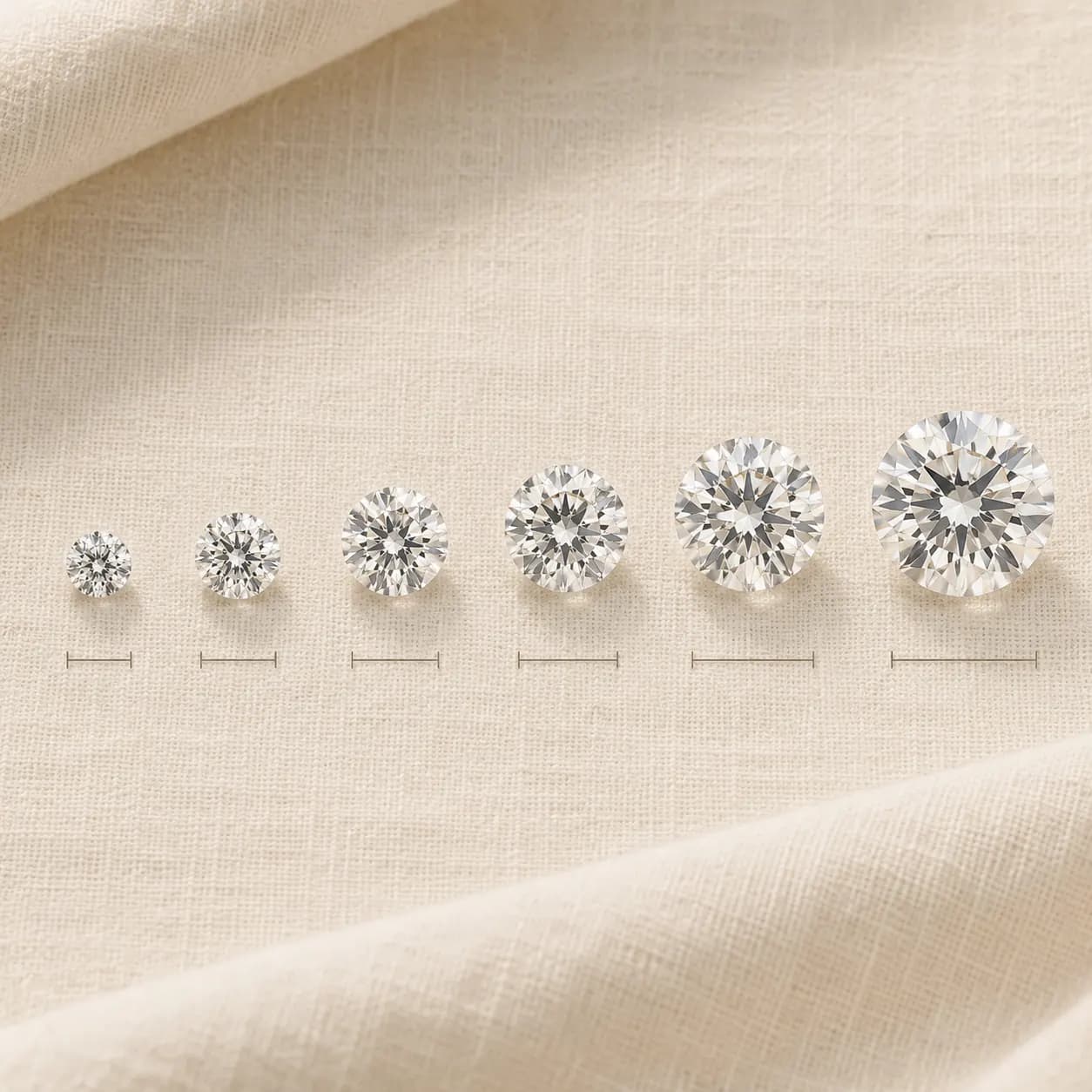
A carat is a unit of weight and says little about size. Two 1.00ct stones can look meaningfully different face-up depending on cut depth, table size and shape. The market also prices in steps at half-carat and whole-carat thresholds, at 0.50, 0.70, 1.00, 1.50 and 2.00.
A 0.90ct round measures about 6.2mm across and a 1.00ct round measures about 6.5mm, a visual difference of roughly 5%. The price per carat steps up sharply at the 1.00 mark. A 0.90 to 0.95ct round gives nearly the same look on the hand for less, and the same applies just under 1.50 and 2.00 carats. If it does not matter to you that the report reads exactly 1.00, that is where to save.
Elongated shapes spread wider for the same weight. A well-cut 1.00ct oval measures roughly 7.5 × 5.5mm and looks larger face-up than a round of the same weight.
Shapes
Round brilliant is the most popular shape because its facet pattern returns more light than any other. It also wastes the most rough stone in cutting, so it usually costs more per carat than a fancy shape with the same grades. Fancy shapes generally cost less per carat, and most look larger face-up. Each has its own trade-offs.
- Oval, pear and marquise are elongated brilliants that can show a bow-tie, a dark band across the center. Marquise is most susceptible and oval least. Review a 360° video before buying.
- Cushion has a soft pillow shape, minimal bow-tie and forgiving color and clarity.
- Emerald and asscher are step cuts. Open facets show inclusions, so target VS1 or better.
- Princess has sharp corners that are vulnerable to chipping and need a corner-protective setting.
- Radiant combines brilliance with a step-cut outline and hides inclusions well.
- Heart and trillion are niche shapes that depend on precise symmetry.
For the same weight, face-up size runs roughly from largest to smallest as marquise, oval, pear, emerald and radiant, cushion, princess, round and asscher.
GIA certified diamonds and other grading reports
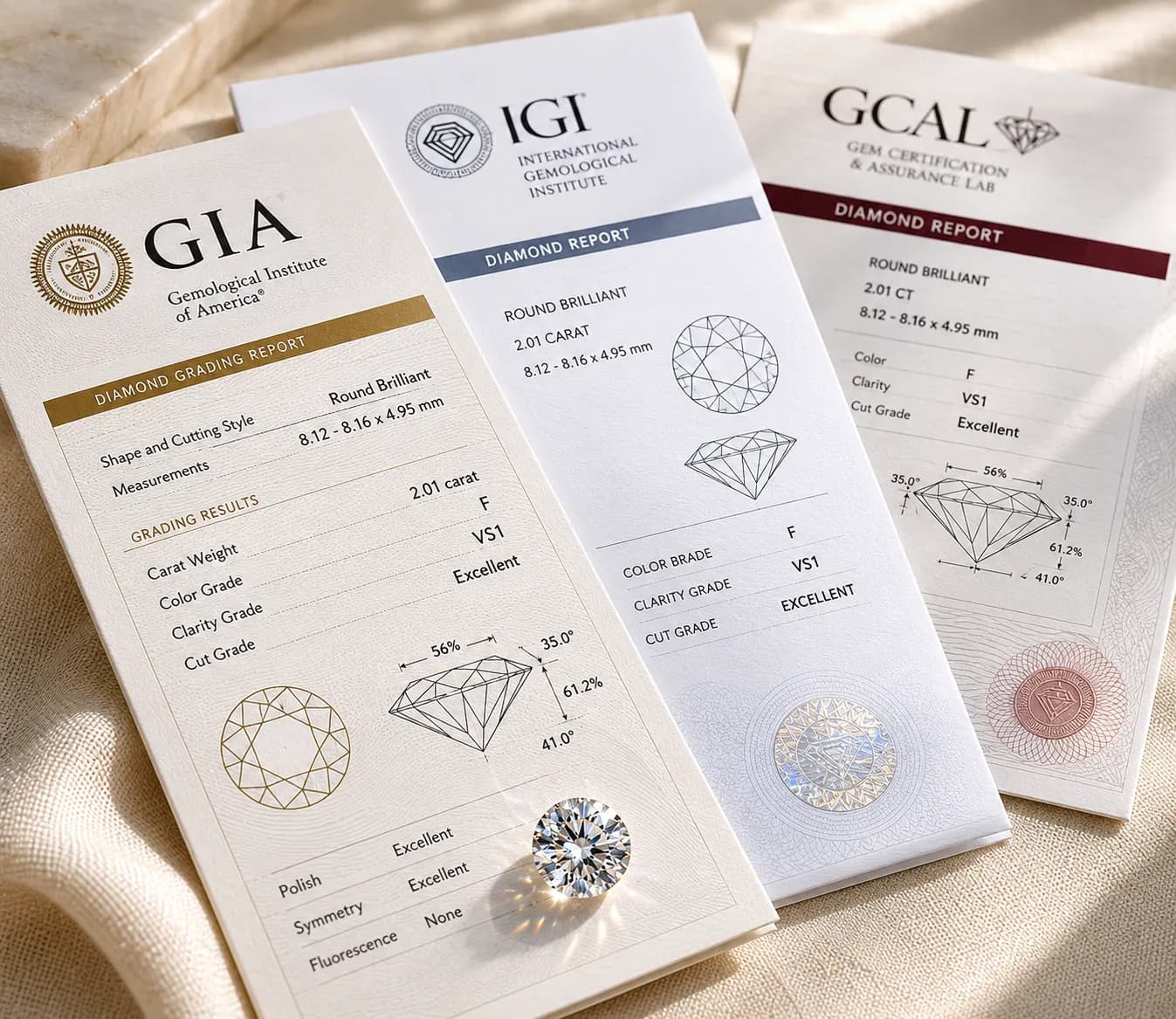
A GIA certified diamond is one that the Gemological Institute of America has graded and issued a report for. The report lists the stone’s carat weight, color grade, clarity grade, measurements and proportions, a plot of its inclusions and, on rounds, the cut grade. It is what makes the 4Cs checkable, because an independent lab assigned the grades and the seller did not. It is a grading document and does not state a price or an insurance value.
A stone is GIA certified only if it comes with that report. Several other labs issue reports too, and they differ in how strictly they grade.
- GIA is the reference lab. Its grading is the strictest and most consistent, and its reports are the ones buyers and insurers expect.
- IGI is the most widely used lab for lab-grown diamonds. Its reports are reliable and high volume, and it is often slightly more generous than GIA on color and clarity.
- GCAL is a grading lab that offers a grading guarantee and a light-performance video, which gives measurable cut quality data.
- HRD is based in Antwerp and common in European supply chains. It is reliable for what it grades, with a mixed reputation next to GIA.
- AGS was acquired by GIA in 2022. Older AGS Ideal cut reports are still highly respected, and no new reports are issued.
- EGL and in-house reports deserve caution. EGL grades tend to run generous, and an in-house report has no independent verification. If the only paper on a stone comes from the seller, ask for an independent report.
Natural and lab-grown stones on one scale
The clarity chart and color scale above apply to both. A lab-grown diamond is a real diamond, chemically and optically identical to a mined one, a definition the U.S. FTC Jewelry Guides formally recognize. Nobody can tell the two apart by eye or with standard jewelry-store equipment, and the grading report is what states the origin.
Lab-grown stones are made by CVD or HPHT growth, and both methods produce diamonds graded on the same scales. The practical difference is price and resale, not appearance. Lab-grown stones cost far less at the same grades, and they resell for far less than natural ones. Read are lab-grown diamonds worth it and do lab-grown diamonds hold value for that side of the choice, or browse lab-grown diamond jewelry.
Fluorescence
Roughly 30% of natural diamonds show some fluorescence under UV light. The report grades it as None, Faint, Medium, Strong or Very Strong. Buyers tend to fear it more than they should.
- None or Faint is invisible and carries little or no price impact.
- Medium is usually invisible and can subtly warm an I or J stone, which is a positive.
- Strong is sometimes visible and carries a milky risk on D to F color.
- Very Strong often gives a hazy or oily look in D to F color stones.
Faint or Medium fluorescence on a G to J stone often earns a discount with no visual downside. Avoid Strong or Very Strong on D, E or F unless you have seen the stone in sunlight and confirmed it looks clear.
Where to spend and where to save
Spend first on cut, because it drives how a stone looks. Then choose color by metal, G or H for white metals and I or J for yellow or rose gold. Choose clarity to the eye-clean standard, which means VS2 or an SI1 you have checked. Carat weight is where to save, by staying just under a whole or half-carat mark.
On a smaller budget, a lab-grown stone gives more size and better grades for the same spend. On a larger one, natural stones hold their resale value better. Book a design consultation at our showroom in Snellville to talk through your budget.
Common pitfalls
- Overpaying for color above G in a white-gold setting, or above J in yellow gold. The metal hides what you cannot see anyway.
- Chasing VVS clarity when VS2 and a verified SI1 look identical at arm’s length.
- Buying a full carat instead of 0.90 to 0.95ct. The face-up appearance is nearly the same and the price per carat is lower.
- Compromising on cut to chase carat weight. A 1.5ct Fair cut looks smaller and duller than a 1.2ct Excellent.
- Trusting in-house or EGL reports. Independent reports from GIA, IGI, GCAL, HRD and legacy AGS are the ones worth relying on.
- Buying oval, pear or marquise online without a 360° video. The bow-tie is not on the report.
- Treating a lab-grown stone as an investment. It depreciates soon after purchase.
- Obsessing over depth and table percentages. If the cut grade is Excellent, they are already accounted for.
Recent industry shifts
The G7 banned imports of Russian-origin natural diamonds effective March 1, 2024, and expanded the ban on September 1, 2024 to cover stones of 0.5ct and above even if cut or polished in a third country. Alrosa controlled roughly 31% of global rough diamond supply before the sanctions. G7 traceability requirements, including blockchain “digital twin” tracking, are rolling out through 2026.
Lab-grown prices fell sharply between 2020 and 2025 as Indian and Chinese CVD production scaled up. The wholesale floor is now approaching production cost, and analysts are split on whether prices stabilize in 2026 or drop again.
De Beers shut its Lightbox lab-grown brand in 2024 and 2025 to refocus on natural diamonds, and Anglo American is mid-process on divesting its De Beers stake.
Frequently Asked Questions
Ready to see stones?
Browse Loose Diamonds
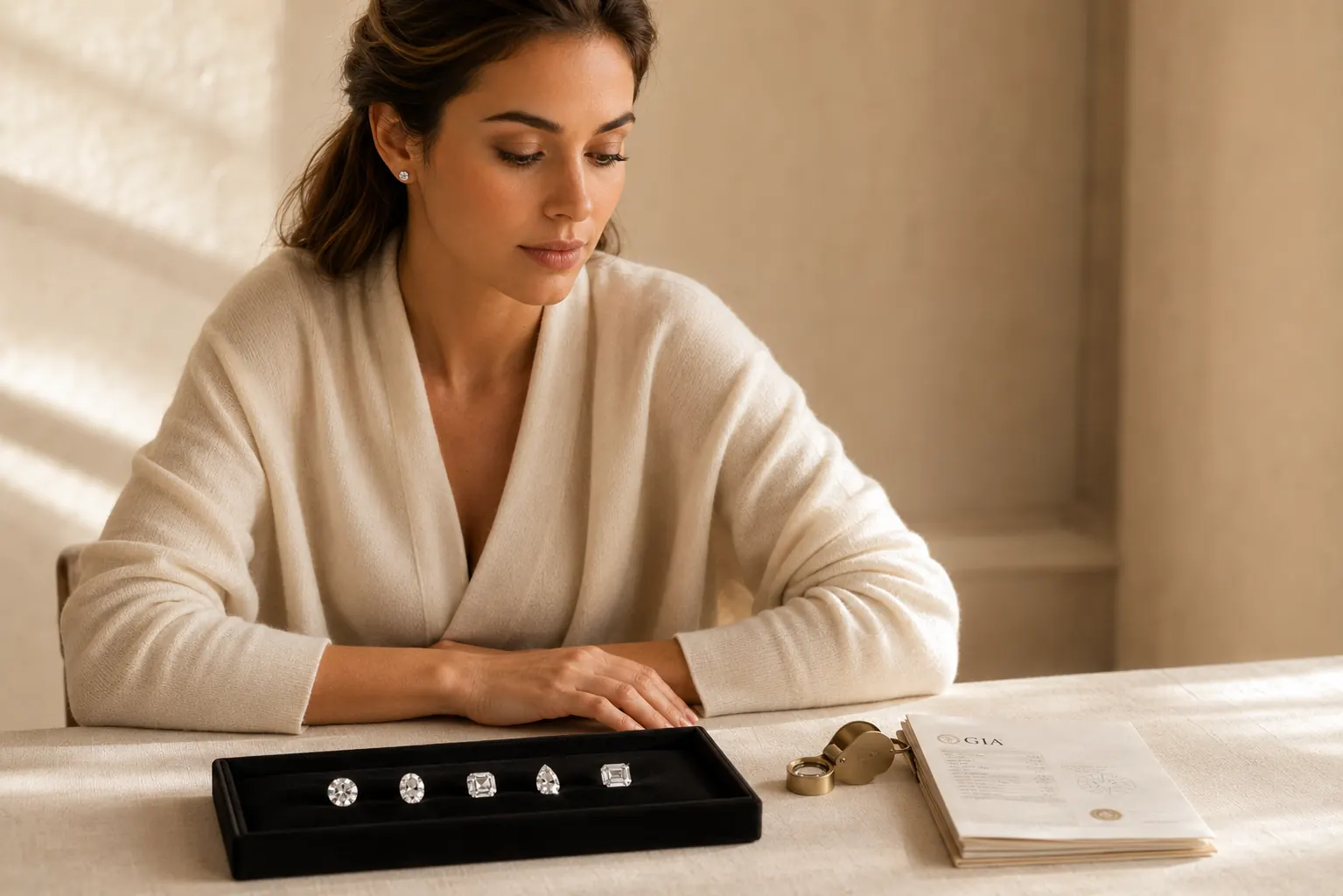
Browse the natural and lab-grown loose diamonds on the site, or book a design consultation at our showroom in Snellville.