Repair Guide · Published · Updated September 2026
When Your Ring Spins or Slips Off
A ring that spins around your finger or slides off in the shower almost always has one cause: the band is a fraction too large for where it sits, and the weight of the stone pulls the lightest side of it around as your hand moves.
Three routes fix it. A ring guard or adjuster wraps extra material inside the shank as a stopgap. Sizing beads solder two small bumps inside the band to hold it in place without cutting anything. A proper resize closes the gap at the bench for good — and it’s the only one of the three that survives being worn every day.
Why a ring spins in the first place
A ring’s stone and setting sit above the knuckle, and that extra weight is what pulls the band around. The heaviest point of the ring wants to hang at the bottom, so whenever your hand tips or swings, the lightest side — the plain back of the shank — rotates up and over to take its place. A flat band with no stone rarely spins for this reason; a solitaire or a heavier setting almost always will, once there’s any play left to move in.
Some of that play is built in on purpose. A ring is fitted to slide over the widest part of your finger — the knuckle — and the base it needs to rest on, just below the knuckle, is almost always narrower. A band comfortable enough to get past the knuckle will always have a little room at the base, which is exactly where a loose fit starts.
Fingers also change size through the day and through the year. Heat and activity cause mild swelling; cold mornings and dehydration do the opposite. Salt and alcohol hold water in the hands; a long walk or a hot shower does too. Beyond the daily swing, most hands also change gradually over the years with weight change, age, or pregnancy. A ring that fit snugly in July can have noticeable play by January, with nothing wrong with the ring itself.
A useful way to tell a genuinely loose ring from a temporary one is to watch it over a week rather than a single day. A ring that only spins on the hottest afternoons or after a salty meal is reacting to a swing that will reverse itself. A ring that spins every morning, every evening, in every season, has settled into being loose — the finger underneath it has changed for good, or the ring was never quite right for it, and that’s the case worth acting on rather than watching.
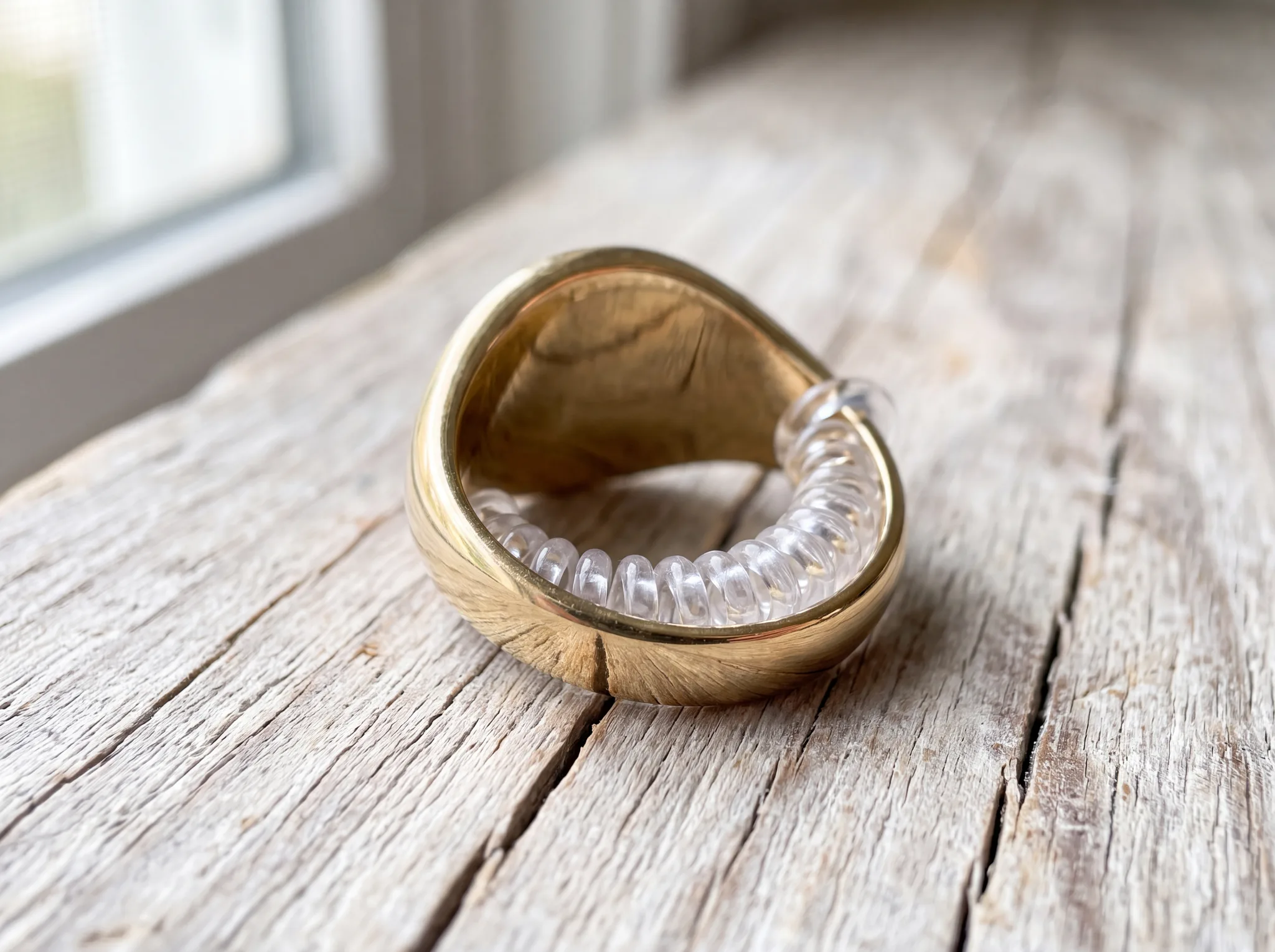
Ring guards and adjusters
A ring guard is a small clip or coil that fastens onto the outside of the shank, usually at the back of the ring, and takes up the gap from outside. A ring size adjuster is more often a strip of clear silicone, foam, or a soft metal coil pressed inside the band instead, so it sits directly against your finger. Either way, nothing about the ring itself changes — the insert is doing the work of filling the space your finger no longer does.
Both genuinely help in specific situations: a ring you’re only wearing occasionally, one you’re still deciding on a size for, or something borrowed or inherited that you’re not ready to alter yet. As a short-term measure to stop a ring spinning before a trip or an event, either one does the job.
Left on a ring worn every day for a year, though, both wear in ways worth knowing about. Silicone compresses and breaks down with repeated removal and re-fitting, so it stops gripping as firmly over time. Metal coils can leave a faint groove or a dulled patch on the inside of the shank where they press against it. And an insert against the skin all day traps moisture, soap film, and oil in a spot that doesn’t get the airflow or rinsing the rest of the finger does — noticeable as irritation or a build-up under the insert on rings that rarely come off.
If you’re weighing guards and adjusters against each other online right now, the honest answer is that most of what’s sold as either one does roughly the same job: fill the gap, hold reasonably well for a while, wear out. What differs between products is mostly the material and how it’s sized to your particular band — a loose adjuster slides and defeats the purpose, and a tight one is uncomfortable within a day. There’s no single insert that’s right for every ring, which is exactly why it’s worth treating any of them as a bridge rather than an answer.
Sizing beads
Between a stopgap insert and a full resize sits an option most people have never heard of: sizing beads. A jeweler solders two small beads of matching metal onto the inside of the shank, opposite each other near the base of the ring. The beads narrow the effective opening by roughly a quarter size — enough to stop a loose ring rotating and catching on things, without cutting the band or changing its actual size.
The advantage over a guard or adjuster is that beads are soldered in rather than held by friction, so they don’t compress or slip the way silicone does over months of wear. The advantage over a resize is that they’re reversible — a jeweler can remove them and smooth the band back to plain metal later, whether that’s because the fit has changed again or because the ring is being passed on to someone else. Beads work best for a ring that’s only slightly loose; they’re not a solution for a ring that has genuinely changed size by a full size or more.
They also work best on a plain section of the band. If your ring has stones set close to where the beads would sit — the same area a jeweler checks before any resize, since it’s roughly opposite the center stone — there may not be enough plain metal for two beads to hold properly, and a resize becomes the more reliable option regardless of how mild the spin is.
Resizing properly
A resize is the only one of the three fixes that closes the gap permanently. The jeweler opens the shank at the back, removes or adds a small section of matching metal, and rejoins it so the ring is genuinely the size it needs to be — not held there by an insert or a pair of beads, but built to that size.
It’s a straightforward bench job relative to the value of most rings, which is why it’s the fix most people land on once a guard or adjuster has proven it’s not going to be a long-term answer. And because nothing about a proper resize depends on friction or compression, it’s the only one of the three that holds up to being worn every single day, indefinitely, without attention.
On a simple band, that work is often finished the same day it comes in. On a ring with a center stone, the setting itself is rarely touched at all — the work happens at the back of the shank, well away from the stone, which is why the stone almost always stays exactly where it was set.
For what actually happens at the bench — cutting the shank, adding or removing metal, and rejoining it — see how ring resizing works.
What your ring resizing will cost
Priced off today’s gold and silver. No email and no phone number to see it. Pricing a different piece? All seven repairs are on the repair cost estimator.
What is the ring made of?

Choosing between them
If you’re still deciding on a ring, wearing it only occasionally, or holding onto something you inherited before committing to any change, a guard or adjuster is a reasonable place to start — cheap, immediate, and easy to remove if you change your mind. Just keep an eye on the band underneath it and don’t leave it in place indefinitely.
If the ring is worn daily but the looseness is mild — a slight turn now and then rather than sliding off — sizing beads are usually the better middle step. They hold up to everyday wear far better than an insert does, and they leave the door open to a full resize later without any extra work.
If the fit has genuinely changed — your finger, the season, or the years — or the ring spins enough that you’re worried about losing it, a ring resizing is the fix that actually lasts. It’s the option that stops the problem instead of managing it, and for a ring you wear every day, that’s usually worth doing sooner rather than later.
The one case worth naming on its own is an inherited ring you’re not ready to alter. A guard or adjuster is a genuinely good fit here — it changes nothing permanent while you decide — but it’s worth checking in on the fit every few months rather than forgetting about it entirely. A ring that’s spinning enough to worry about is a ring that can slip off somewhere you won’t notice, and no insert removes that risk completely.
Frequently Asked Questions
Related guides & collections
- Jewelry repair in AtlantaAll in-house services and free estimates.
- How ring resizing worksWhat happens at the bench when a band is opened and rejoined.
- Can my ring be resized?Eternity bands, tension settings, and the metals that can't be sized.
- Ring sizing serviceGet a price range online, free exact estimate in store.
- How to measure your ring size at homeFind your size before you book, with a printable guide.
Free estimate, no obligation
Get Your Ring Fitted Right
Bring your piece to our Snellville workshop near Atlanta for a free estimate. Most resizes are ready in days, many the same day, and your ring stays in-house the whole time.
Prefer to talk? Call (704) 684-7530