Sizing Guide · Published · Updated September 2026
How to Measure Your Ring Size at Home
Wrap a strip of paper or a flexible tape around your finger. Mark where it overlaps. Measure that length in millimeters. Then match it to a US ring size.
You can also trace the inside of a ring you already own. Compare that circle to a size chart.
Both ways get you close enough to order with confidence. This guide shows you how to do each one. It also gives you the millimeter-to-size chart.
It covers the small things that can throw a measurement off by half a size. Last, it covers when it’s worth having a jeweler check it for you.

Ring size basics
US ring sizes run from about 3 to 13. They go up in half sizes. Each number is a small step up in size around the band.
A gold ring for women usually runs 5.5–7.5. Most men fall between 9 and 11. Both ranges are just averages, not hard limits.
A gold ring is made to order in your exact size. So are the gold rings in our fashion ring collection. Getting your number right the first time saves you a trip back to the store.
- Measure your finger. Wrap a strip of paper or a flexible tape around the base of your finger.
- Measure a ring you already own. Trace the inside of a ring that fits well.
- Between two sizes? Size up. A loose ring still slides on, and you can tighten it later. A tight ring may not pass your knuckle at all.
Both ways give you the same US size. Neither one needs anything you don’t already have at home.
A ring size is really about the distance around your finger. It is not about how wide your finger looks. That is why a snug strip of paper gives such a reliable size. You also can’t guess a size by looking at a ring on someone else’s hand.
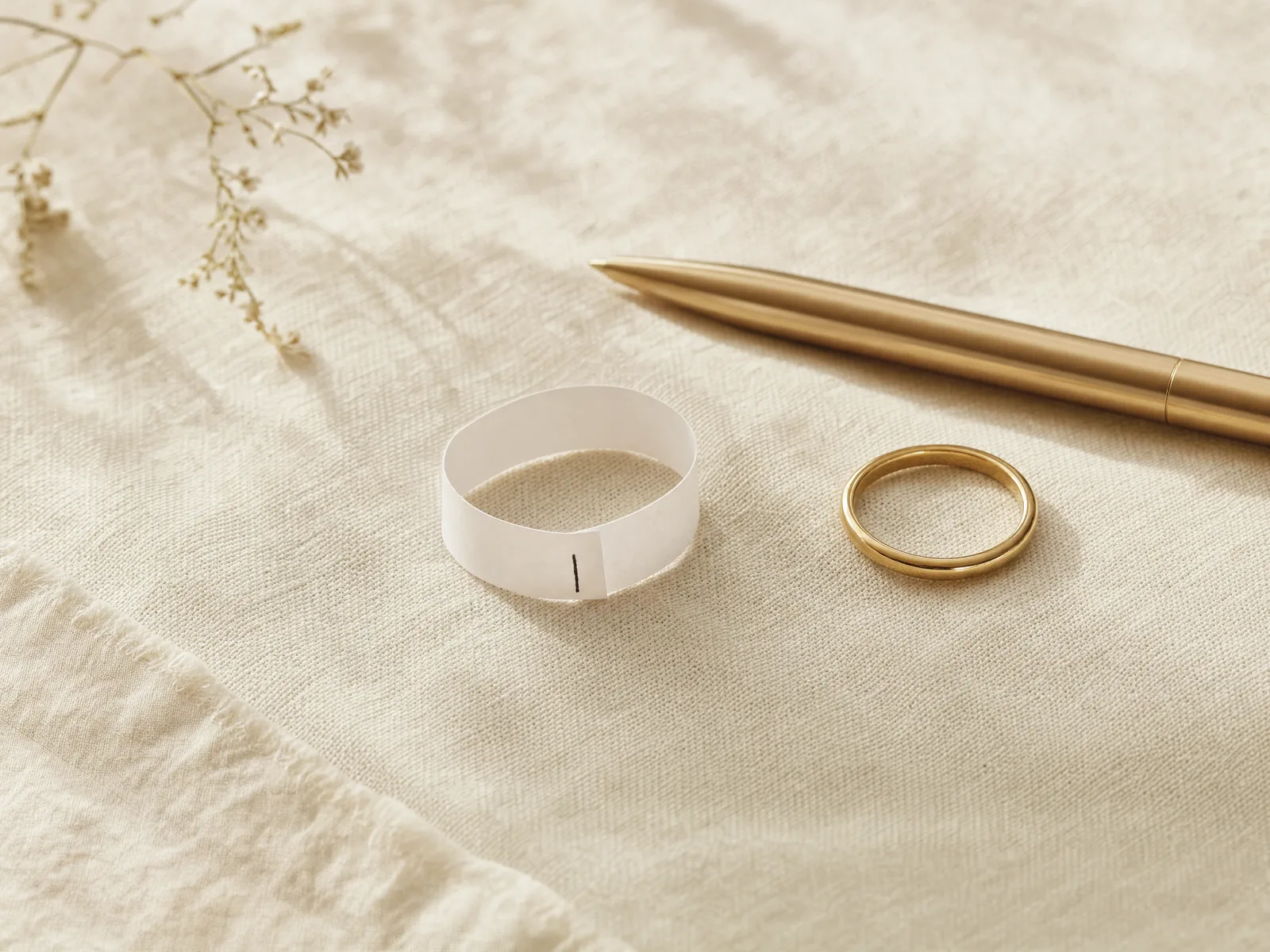
Measure with string or paper
Wrap a flexible tape or a thin strip of paper around the base of your finger. Mark where it overlaps. Measure that length in millimeters. A few small things make a big difference:
- Measure at the base of your finger, below the knuckle. That is where the ring sits once it’s on.
- Snug, not tight. The strip should touch the skin but not press into it. Too tight, and your size reads too small.
- Mark the overlap with a pen before you take the strip off. Then lay the strip flat and measure it against a ruler. Don’t try to read a curved strip.
- Paper works better than string for most people. String can stretch a little when pulled tight, which makes your size read too big. A strip of printer paper does not stretch.
Once you have your length in millimeters, match it to a US ring size in the chart below.

Millimeter-to-US ring size chart
Match your millimeter measurement to the closest US size below. These are the same conversions we use in our store:
- 47mm — US size 4.
- 49.3mm — US size 5.
- 51.9mm — US size 6.
- 54.4mm — US size 7.
- 56.9mm — US size 8.
- 59.5mm — US size 9.
- 62.0mm — US size 10.
If your number falls between two rows, round to the closer one. If you plan to buy a wide ring, size up instead. A wide band fits snugger than a thin one at the same size. That’s because more metal touches your finger at once.
A 2mm stacking band and an 8mm statement band can feel very different at the same size number. Say you measured with a thin strip of paper but you’re ordering a wide ring. Sizing up half a size is the safer choice.

Measure with a ring you already own
Trace the inside of a ring that fits well. Compare it to a ring size chart. This only works with a ring worn on the same finger you want to size. A well-fitting right-hand ring won’t tell you your left-hand size.
That’s true for any ring gold rings included. Try it with a ring you already own. Or pick a new one from our fashion ring collection. Fingers are rarely the same size, even on the same hand.
- Set the ring down flat.
- Trace the inside edge onto a piece of paper.
- Measure the traced circle. Compare it to a printed ring size chart.
This is a good double-check for your string or paper measurement. Both methods should land within half a size of each other.
Pick a ring with a plain, even inner edge. An eternity band or a heavily domed ring can throw off your trace. A stretchy costume ring won’t hold a true size either.
If a well-fitting ring is all you have, this method is the easier of the two. There’s no strip tension to second-guess.

Tips for an accurate measurement
Measure in the evening. Your fingers are closest to their normal size then. Fingers swell a little during the day. They shrink in cold mornings.
A measurement taken first thing can read half a size small. A few other details matter for certain kinds of rings:
- Pinky rings usually run 1 to 1.5 sizes smaller than a ring finger. Measure the pinky itself. Don’t just guess down from your usual size.
- Stackable bands should all be the same size. That way they sit flush, without overlapping or gapping.
- Full eternity bands have diamonds set all the way around. They cannot be resized later. Measure with extra care before you order one. Half-eternity bands have stones across the front only. They can be resized.
- Skip measuring right after exercise or a hot shower. Heat and effort cause your fingers to swell for a while. Wait until you’ve cooled off and been at a normal temperature.
The same steps work whether you’re sizing a fashion ring, a wedding band, or an engagement ring. Your finger doesn’t know what the ring is for.
What changes with an engagement ring is often who gets measured. Say you’re sizing in secret. Borrowing a ring your partner already wears is often easier to pull off.
Tracing it stays unnoticed. Asking them to sit still with a strip of paper does not.

Getting a professional measurement
A home measurement gets you close. A jeweler’s metal ring sizer gets you exact.
Visiting a jeweler is the most accurate way to size a ring. It’s free at our Atlanta showroom. A set of graduated metal rings removes the guesswork a paper strip or a string can add.
It takes only a couple of minutes. That goes for rings jewelry gold buyers already own. Or a new pick from our fashion ring collection.
- Worth doing before a purchase you can’t easily return. It matters even more before a full eternity band, which can’t be resized once it’s made.
- No purchase required. Book a sizing appointment at our Snellville showroom, or call ahead and stop by. Either way, you’ll walk out with a confirmed US size you can use anywhere, not just with us.
- Already own a ring that’s the wrong size? That’s a different question from measuring. Our guide to ring resizing cost and turnaround covers what’s involved in getting it adjusted.
Frequently Asked Questions
Related guides & collections
Skip the guesswork
Get Sized in Person, Free
A string or paper measurement gets you close. A jeweler's ring sizer is the most accurate method there is. We offer free ring sizing at our Snellville showroom near Atlanta.
Prefer to talk? Call (704) 684-7530