Metal Guide · Published · Updated August 2026
Yellow vs White vs Rose Gold
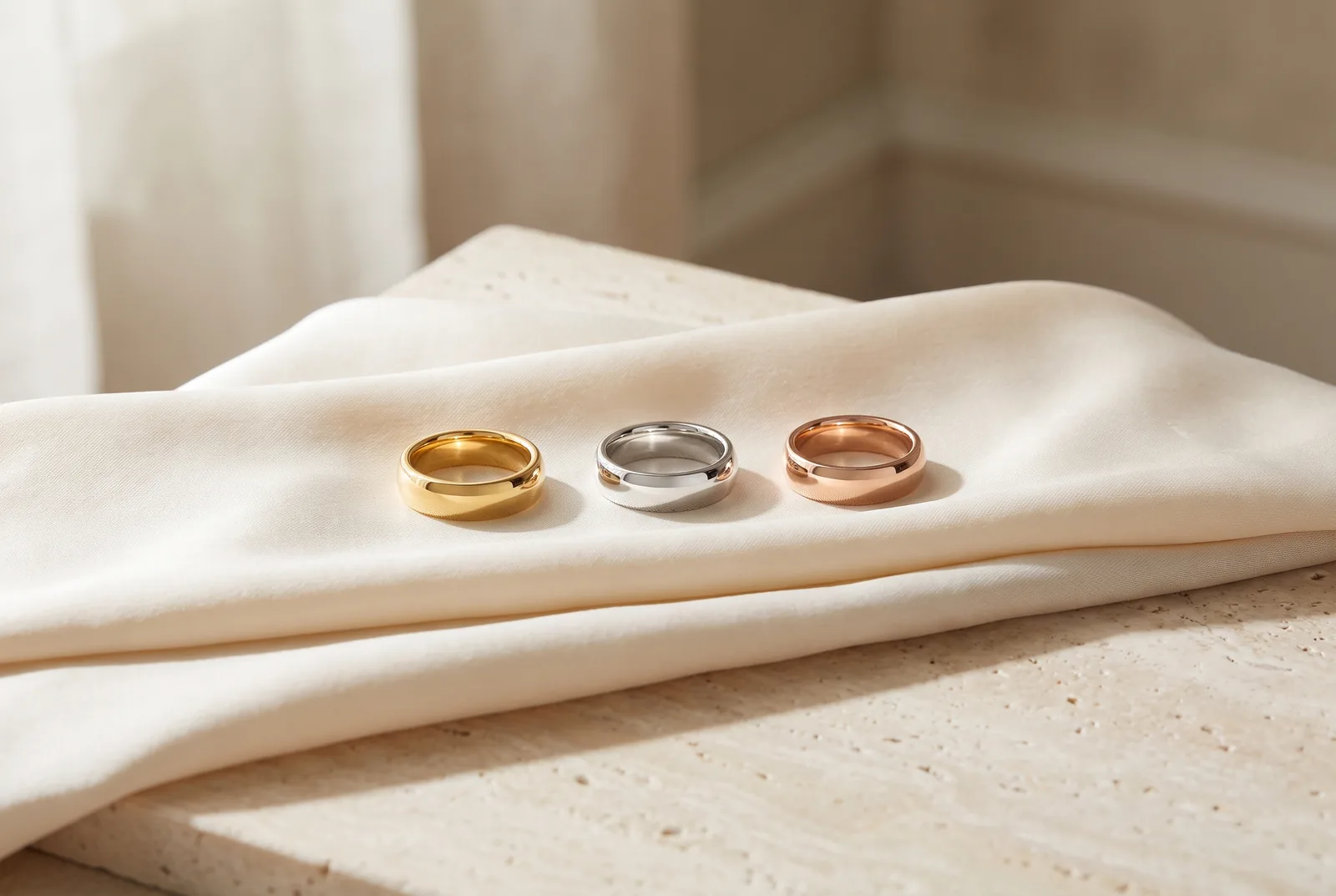
Yellow gold, white gold and rose gold are all real gold, and at a given karat every one of them holds exactly the same amount of it. The color is not a grade and not a coating: it comes entirely from the other metals melted in alongside the gold. Copper and silver keep gold yellow; white metals such as palladium and silver take the yellow out of it; a heavier hand with copper turns it pink.
So choosing between the three is, for the most part, a choice about color — with one practical consequence attached, because white gold is the only one of the three with a re-plating cycle to keep up. This guide covers what each one actually is, why a 14K piece is 14K in all three, and how people usually decide.
The short answer
One metal, three alloy recipes. Pure gold is too soft to wear, so every piece of gold jewelry is an alloy: gold plus a measured quantity of other metals. Change which metals go into that quantity and you change the color of the finished metal — and nothing else about it that matters.
Karat is untouched by any of this. 14K is 58.3% pure gold whether the piece is yellow, white or rose; 18K is 75% in all three. Two pieces of the same karat and the same weight hold the same gold and are worth the same as metal, whatever color they happen to be.
- Yellow gold — gold with copper and silver. Gold’s own color, hardened and steadied.
- White gold — gold with white metals such as palladium, silver and zinc, then usually plated. The yellow is taken out.
- Rose gold — gold with a larger share of copper. The copper pulls it pink.
Everything below follows from those three lines.

What is yellow gold?
Yellow gold is gold in its own color: pure gold alloyed with copper and silver so it is hard enough to wear. Nothing is added to make it yellow.
The U.S. Geological Survey describes pure gold as sun yellow in its metallic form, and notes that it is mixtures with other metals that produce the range of hues jewelry uses. Yellow is the starting point; the other two colors are departures from it.
Is yellow gold real gold? Yes — it is the most literal version of it. A 14K yellow gold chain is 58.3% pure gold by weight and stamped 14K or 585; an 18K piece is 75%, stamped 18K or 750. The alloy makes up the balance, and it is there for hardness: 24K gold is soft enough to mark with a fingernail, which is why very little jewelry is made from it.
What is in yellow gold, specifically? Gold, copper and silver — in proportions the karat fixes and the maker chooses. Copper adds hardness and warmth; silver lightens the tone back toward a clean yellow. A bench leaning on copper produces a richer, deeper yellow and one leaning on silver a paler one, which is why two 14K yellow pieces from different makers can read slightly differently side by side.
And “gold” versus “yellow gold”? In jewelry they are the same thing. When a hallmark, a price list or a jeweler says simply “gold” with no color named, yellow is what is meant — the other two are always specified, because they are the ones that need explaining. For the pieces themselves, see our yellow gold jewelry collection.

What makes white gold white
White gold is the same gold, alloyed instead with white metals — palladium, silver, nickel and zinc — which cancel the yellow rather than keep it. Most pieces are then finished with a microns-thin rhodium plating, which is what supplies the bright, cool white you see on the shelf. That plating is the one real difference in how the three colors are looked after, and our guide to what white gold is made of covers the alloy systems, the re-plating cycle and the care routine in full.

What makes rose gold pink
Rose gold is gold and copper — the same copper already present in yellow gold, in a larger share. There is no pink metal in it and no pink coating on it. Copper is a red metal, and past a certain proportion its color begins to show through the gold’s.
How pink depends on how much copper, which is why “rose gold” describes a spectrum rather than one shade. GIA puts it plainly: the proportion of copper to gold sets the intensity of the pink, from barely there to unmistakable. Karat sets the ceiling: an 18K rose piece is three-quarters gold, so it can only ever read softly warm, while 14K leaves room for more copper and comes out distinctly pinker. Some alloys keep a little silver in the mix, which cools the blush slightly — the names rose, pink and red gold mark points along that line rather than three fixed formulas.
The copper also makes it marginally harder. Copper is a harder metal than either gold or silver, so a rose alloy tends to resist scratching and bending slightly better than a yellow one at the same karat — a small difference, not a category difference, and not a reason to choose it on its own. The more useful consequence is that the color is a property of the whole body of the metal, so there is nothing on a rose gold piece that can wear off. See our rose gold jewelry for how it reads across necklaces, rings and bracelets.
Is white gold the same as yellow gold?
It is the same gold in a different alloy. The question comes up constantly because the two look nothing alike, and the honest answer is that the part which makes gold valuable is identical in both. 14K white and 14K yellow are each 58.3% pure gold by weight and carry the same 14K stamp. What differs is the other 41.7% — copper and silver in one, white metals in the other — plus the plating over the top of the white piece.
They are also worth the same. Intrinsic value is karat multiplied by weight, valued at the day’s gold market; color is not a term in that calculation, and the plating is far too thin to register in it. A jeweler valuing either piece weighs it and reads its stamp — nobody looks at the color.
Three practical differences do survive that. White gold reads cooler beside a near-colourless diamond and makes the stone look whiter; yellow and rose carry their color in the metal itself, so neither ever needs renewing; and only white gold has a plating cycle to think about. If those are the pieces you are after, our white gold jewelry collection is the place to start.
Karat and color are two separate choices
Karat measures gold content; color describes the alloy around it. 10K, 14K and 18K each exist in all three colors, and neither decision constrains the other. Karat is a fraction out of 24, and the arithmetic is the same in all three:
- 18K — 75% pure gold, stamped 18K or 750. The richest color in yellow, and the softest of the three.
- 14K — 58.3% pure gold, stamped 14K or 585. The US fine-jewelry standard, and harder than 18K.
- 10K — 41.7% pure gold, stamped 10K or 417. The hardest of the three, and the palest in every color.
- 24K — 99.9% gold, and therefore always yellow. There is no 24K white or rose gold: making gold any color other than yellow requires alloying it with something else.
What karat changes is how the piece behaves. More alloy means a harder, more knock-resistant metal; GIA’s guidance on choosing a ring metal for everyday wear is that 14K and 18K sit in the useful range for daily wear while 24K is too soft for it. Less alloy means more gold — and in yellow gold a deeper color, in rose gold less room for copper and so a gentler pink.
What color mostly changes is how it looks. It does not change what a piece is worth, how it is hallmarked, or what it can be made into. The one thing it does change is upkeep — white gold has a re-plating cycle that yellow and rose do not, and a rose alloy is marginally harder than a yellow one at the same karat.
Decide karat on how the piece will be worn; decide color on taste, with that plating cycle as the one practical footnote. They are two questions, not one.
Which color should you choose?
There is no correct answer here, and no rule you can break. What follows is how people usually decide, not a standard to meet.
- Skin tone is a starting point, not a verdict. Warm undertones — skin that reads golden or olive, veins that look green — tend to sit comfortably with yellow and rose. Cooler undertones, with veins reading blue, often make white gold look crisp. Plenty of people suit all three, and the quickest way to find out is to hold a piece of each against the back of your hand in daylight.
- Match the jewelry you already wear, not the outfit. A wardrobe changes; the watch, the wedding band and the everyday chain do not. If nearly everything you own is one color, a new piece in that color will simply get worn more.
- Think about what it will sit next to. A cool white metal reads cleaner around a colorless diamond. Yellow flatters warm stones — citrine, garnet, yellow sapphire, pearls. Rose is the kindest of the three to morganite and to warm-toned diamonds, because the blush and the stone pull in the same direction.
- Mixing colors is a style choice, not a mistake. Stacked rings and layered chains in two or three colors are long established in fine jewelry, and two-tone pieces exist to do it deliberately. If you want a guideline, let one color carry the look and use the others as accents — then ignore that too if the stack looks right to you.
One case deserves its own thinking: a ring worn every day for decades, where weight, prong security and maintenance count for more than they do on a pendant or a pair of earrings. Our guide to choosing an engagement ring metal works that comparison through in ring terms, platinum included.
Frequently Asked Questions
Related guides & collections
Color is the one thing a screen gets wrong
Compare the Three Golds Side by Side
Photographs and screens shift all three colors, which is why yellow, white and rose so often look different in person than they did online. We keep metal samples in every metal and karat, so you can hold the three against your own hand under the same light — and see our own custom work — at our Snellville showroom near Atlanta.
Prefer to talk? Call (704) 684-7530