Metal Guide · Published · Updated August 2026
Platinum vs Silver
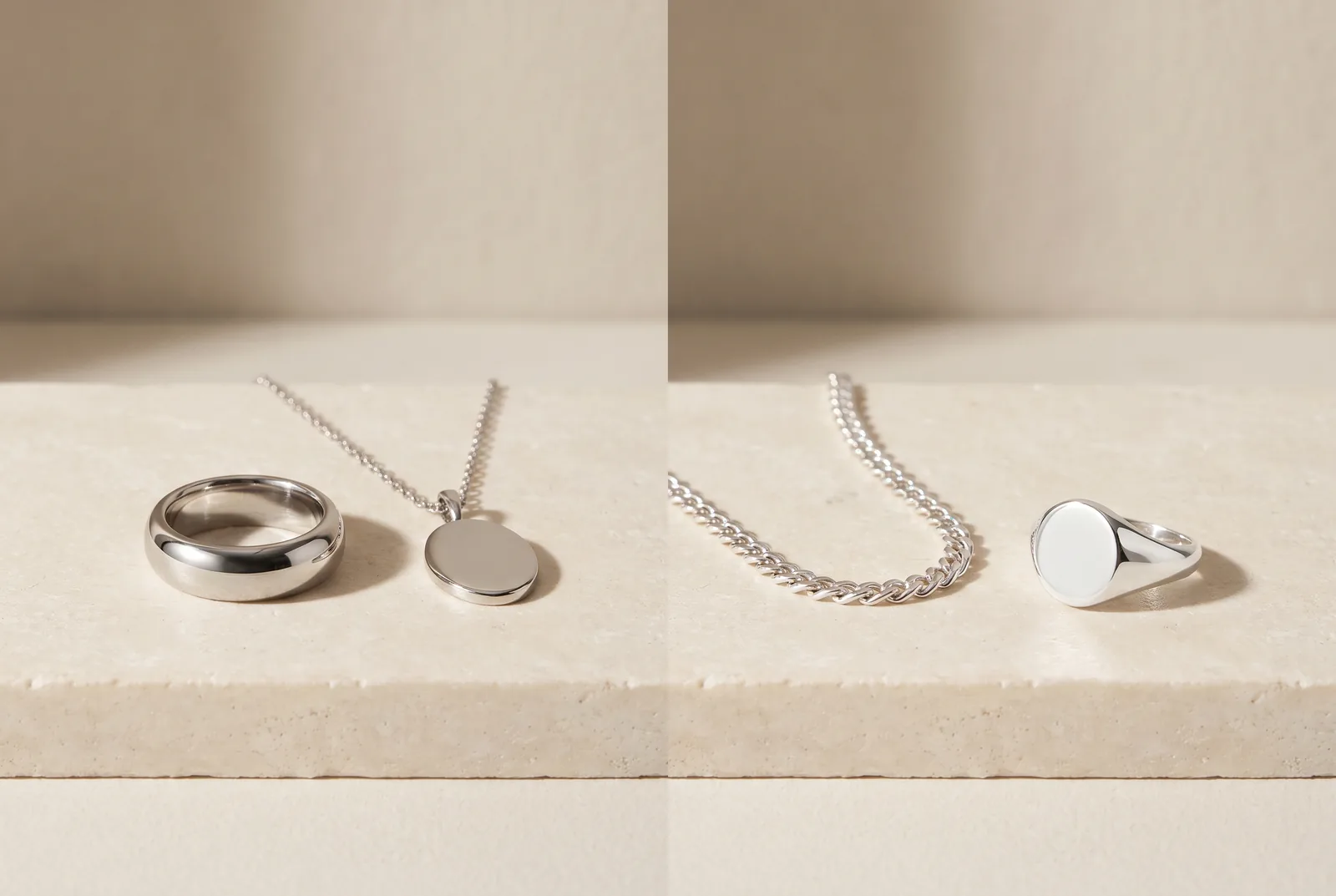
Platinum and silver are not two shades of the same metal — they are different elements entirely. Platinum is rarer, roughly twice as dense and does not tarnish. Sterling silver is brighter, much softer and costs a small fraction as much, and it tarnishes in ordinary air. They look alike in a photograph and almost nothing else about them matches.
That single fact settles most of what people actually want to know — which one weighs more, which one darkens, why one costs many times the other, and which one belongs on a ring you intend to wear every day for the next forty years.
Platinum vs silver: the short answer
Platinum is a rare, dense, naturally white metal that does not tarnish. Sterling silver is a common, light, very bright metal that does. They are separate chemical elements — platinum is element 78, silver is element 47 — and everything that follows on this page comes out of that one distinction.
The four differences that actually change a buying decision:
- Weight. Platinum is about twice as dense, so an identical design in platinum weighs roughly twice as much — the most reliable tell without a hallmark.
- Tarnish. Sterling silver darkens in ordinary air and needs polishing. Platinum does not tarnish at all.
- Durability. Both are soft as metals go, but platinum wears far better, and a scratch pushes the metal aside rather than removing it.
- Price. Platinum costs many times what silver does per gram, and because a piece needs about twice the mass, the finished-piece gap is wider still.
If you already know which way you are leaning, our platinum jewelry collection is the place to start.

What each metal actually is
Platinum jewelry is normally 95% pure platinum; sterling silver is 92.5% silver. Both numbers are stamped on the piece, and both mean something quite specific.
- Platinum, marked 950 or PLAT. Ninety-five parts platinum in a thousand, with the remaining five percent chosen to make the metal workable — usually another platinum-group metal such as iridium or ruthenium, or cobalt, which is not a platinum-group metal but alloys with platinum well and casts cleanly. 900 and 850 alloys exist as well, and each is marked with its own number.
- Sterling silver, marked 925 or STERLING. Nine hundred and twenty-five parts silver in a thousand, with the balance usually copper. Pure silver is far too soft to hold a shape, and the copper is what makes it wearable — it is also what makes it tarnish more readily than pure silver would.
The purity numbers are not the interesting comparison, though. Ninety-five percent against ninety-two and a half is a small gap, and it explains almost none of the price difference. What does explain it is scarcity: the Royal Society of Chemistry puts silver’s abundance in the Earth’s crust at 0.055 parts per million, against 0.000037 parts per million for platinum — more than a thousand times the difference.
One consequence worth carrying forward: platinum pieces are close to pure and contain no nickel, which is why platinum is the standard recommendation for reactive skin. For the silver pieces themselves, see our sterling silver jewelry collection.
Can you tell them apart?
By eye alone, often not. By weight, almost always — and the hallmark settles it. This is the honest answer to “is platinum silver?”, which is one of the most common ways people search for this comparison: the two are genuinely hard to separate in a photograph, and genuinely easy to separate in the hand.
Four tells, in order of how much you can trust them:
- The stamp. Look inside a ring shank, on a clasp, or on a pendant bail. 950, PLAT or PT950 is platinum; 925 or STERLING is sterling silver. This is the only test that is conclusive on its own.
- The weight. Pick the piece up. Platinum has a dense, solid heft that surprises people the first time; silver of the same size feels light and almost hollow by comparison. If you can hold both at once, you will not confuse them again.
- The color. Platinum is a cooler, slightly greyer white; freshly polished sterling silver is brighter. Side by side in daylight this is visible; on its own it is not much help.
- The tarnish. An older piece that has darkened or gone near-black in its crevices is silver. Platinum simply does not do that.
One warning about the tests you will read about elsewhere: a magnet tells you very little here, because neither metal is meaningfully magnetic and a null result is consistent with both. If a hallmark is missing or illegible, a jeweler can identify the metal non-destructively in a few minutes with an XRF analyser rather than guessing.

Durability and everyday wear
Platinum wears better than silver in almost every way that matters, and the gap is widest on a ring worn daily. Neither is hard the way steel is; the difference is what happens to each over years of contact with the world.
Platinum displaces rather than sheds. This is the property that makes jewelers reach for it. When gold or silver is scratched, a little metal is scraped off and lost for good; when platinum is scratched, the metal is pushed to the side of the groove and stays on the piece.
The accumulated result is a patina — a soft satin surface that many people prefer to a mirror, and that a polish removes if they do not. It is also why platinum prongs are the traditional choice for holding a valuable stone: they thin far more slowly than gold prongs do.
Silver tarnishes, and tarnish is not damage. Silver reacts with sulfur-bearing compounds in ordinary air to form a thin, dark surface film — a faint dulling at first, near-black in the recesses of a design eventually. A polishing cloth takes it straight off, and a piece worn often tarnishes more slowly than one left in a drawer, because skin contact keeps burnishing it.
Where each one ends up after ten years. A platinum band worn daily looks softened rather than worn: same weight, same shape, satin instead of mirror. A sterling silver band worn just as hard shows more scratching, can distort out of round on a working hand, and needs periodic polishing. Earrings and pendants change the calculation entirely — they barely touch anything, so silver holds up indefinitely in those forms.
Skin sensitivity follows the same pattern. Platinum at 950 contains no nickel and is about as inert as jewelry metal gets, which is why it is the standard recommendation for reactive skin. Sterling silver is generally well tolerated too, though its copper can react with sweat and leave a green mark — cosmetic, temporary and more common in humid weather.
Price and long-term value
Platinum costs a large multiple of silver, and three separate factors compound to produce that gap. Both are traded commodities whose prices move daily, so the comparison is best held as a ratio and a set of reasons rather than a pair of numbers.
- Rarity. Platinum is one of the scarcest metals put to commercial use. The U.S. Geological Survey tracks it in its platinum-group metals statistics, where annual world production is measured in tonnes — against tens of thousands of tonnes for silver.
- Density. Because platinum is about twice as dense, the same ring in platinum needs roughly twice the mass of metal. The price gap per gram is therefore not the price gap per finished piece; the finished gap is larger.
- Fabrication. Platinum melts at a far higher temperature than silver and behaves differently under the torch. It calls for dedicated tools, dedicated solders and more bench hours, and that labour is a real part of what a platinum piece costs.
Resale is a different question from durability, and worth separating. Silver’s low price is exactly what makes it accessible, and the flip side is that there is not much melt value in a silver chain. Platinum carries far more intrinsic metal value per piece, but as with any jewelry, what a piece resells for sits below what it retailed for — a retail price also covers design, fabrication, setting and stones, none of which a metal buyer pays for.
Cost of ownership is the more useful frame. A platinum ring asks for an occasional polish across a lifetime; a silver ring costs far less at the counter and asks for regular attention. Neither is wrong — they are different purchases.
Which should you choose?
Choose platinum for pieces that must survive decades of daily wear, and silver for pieces meant to be enjoyed, rotated and replaced. The question is rarely which metal is better in the abstract, but which suits the piece you have in mind.
Platinum makes sense when:
- The piece will be worn every day — an engagement ring, a wedding band, a signet worn for years without coming off.
- It holds a stone you care about. Platinum prongs thin more slowly and hold a setting securely for longer.
- It is meant to be handed on. Platinum arrives at the next generation looking like itself.
- Skin sensitivity is a concern, or a piece has caused irritation before.
Sterling silver makes sense when:
- You want several pieces rather than one — stacking rings, layered chains, a different pair of earrings for every mood.
- The design is trend-led and you expect to wear it for a season or two rather than a lifetime.
- The piece is an earring, a pendant or a necklace, where wear is minimal and silver holds up indefinitely.
- Budget is the binding constraint and you would rather have more of the look.
And there is a middle path worth knowing about. White gold is gold alloyed with white metals and plated with rhodium: harder than sterling silver, considerably less expensive than platinum, and visually very close to both. The trade is a plating cycle — the bright white is a surface, and it needs renewing every few years on a ring worn daily. Our guide to what white gold is made of covers that in full.
If the piece is specifically an engagement ring, the weighting changes again — prong security, weight on the hand and the plating cycle all count for more. Our guide to choosing an engagement ring metal works through that comparison in ring terms.
Frequently Asked Questions
Related guides & collections
Weight is the difference a photograph cannot show
See Platinum and Silver in Person
The color difference between these two metals is subtle and the weight difference is not — you have to hold both to understand which one you want. We keep metal samples in every metal and karat, so you can compare platinum, sterling silver and white gold under the same light, and see our own custom work, at our Snellville showroom near Atlanta.
Prefer to talk? Call (704) 684-7530