Ear Piercing Guide · Published
Newborn Ear Piercing: When Can Babies Get Their Ears Pierced?
Newborn ear piercing is something the American Academy of Pediatrics suggests putting off. Its main recommendation is to wait until a child is mature enough to care for the piercing herself. This guide walks through that advice, what parents weigh at each stage and what to look for if you go ahead.
Is there a right age?
Parents often start with the question of timing, and the honest answer is that the medical advice leans toward waiting. As the Johns Hopkins Medicine write-up of the American Academy of Pediatrics guidance puts it, the main recommendation is to postpone piercing until a child is mature enough to care for the site herself.
That is the pediatricians' position, and it is why ear piercing at our showroom does not come with an age attached. We do not name one, because the decision belongs to you and your child's pediatrician, not to a jeweler.
The same guidance covers parents who decide to go ahead anyway. The Academy advises having it done by a trained professional under sanitary conditions, and it suggests gold posts to reduce the chance of a reaction. Those two points are worth asking about wherever you book.
It helps to be clear about what that advice does and does not say. It does not hand parents a number of months or years, and neither do we. It points to a question you can answer for your own child: is she able to look after the site herself, and if not, are you ready to do it for her? Your pediatrician knows your child and can help you answer it, which is a better starting point than any rule of thumb from a stranger online.
Whichever way you lean, you are making a choice for a child who cannot yet have an opinion of her own, so it deserves the same care as any other decision about her health.
Newborns, infants and toddlers
The question of when you can pierce a baby's ears usually comes down to the same few things, and they change as a child grows. The first is who will look after the piercing. Aftercare, which we cover below, means clean hands, careful cleaning and watching the site for signs of trouble, and all of that falls to a parent when the child is a baby.
The second is how a child behaves with her own ears. An infant who grabs at everything within reach, or a toddler who pulls at a new stud, makes caring for a piercing harder for the adult doing it.
Many families also find that a pediatrician visit is a natural moment to raise the question. Checkups and vaccinations already put you in front of someone who knows your child's health, and they can tell you what they would advise for her. We make no medical claims beyond what the Academy says, and your pediatrician is the right person to ask.
Each stage hands you a different job. With a newborn the job is almost entirely yours. With a toddler it is shared, because she now has opinions about her own ears and the hands to act on them. Thinking through who will do the daily work, and what happens on a day when she will not hold still for it, tells you more about whether the time is right than any milestone does.
Ear studs for infants
If you do go ahead, the studs matter as much as the timing. The Academy's own suggestion is gold posts, and Sutter Health lists 14K or 18K gold among the metals piercers recommend, alongside implant-grade surgical steel, palladium white gold, niobium and titanium.
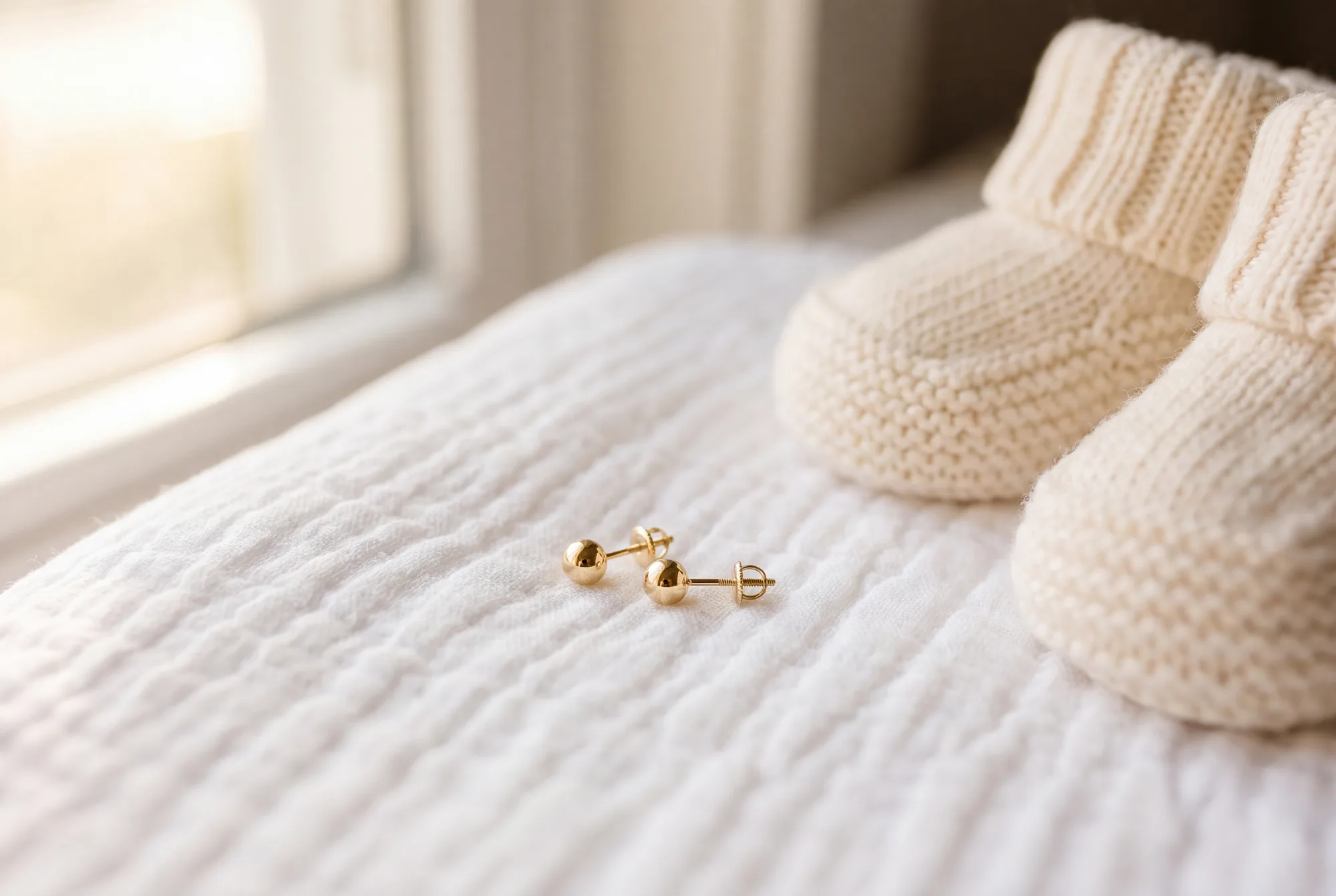
You may see the word hypoallergenic on earring packaging, but no metal is guaranteed to suit everyone, and a stud that works for one child can still bother another. If your family has a history of sensitive ears, our guide to earrings for sensitive ears explains the metals in more detail.
Shape comes next. A small stud with a flat or round front is less likely to snag on a blanket, a car seat strap or a sleeve than anything with points or dangling parts. The back should hold firmly, so that a stud is not easily pulled loose by small hands. You can see the full range on our stud earrings page.
Caring for a baby's new piercing
The Association of Professional Piercers publishes aftercare advice that applies to any new piercing. It starts with clean hands. Wash them before you touch the area, then clean the piercing with a sterile saline wound wash whose only ingredient is 0.9 percent sodium chloride, and pat the area dry with disposable gauze.
The same association says to avoid alcohol, hydrogen peroxide, harsh soaps, ointments and benzalkonium chloride "ear care" solutions. It also cautions against over-cleaning, and it no longer suggests homemade salt mixes. Older advice told parents to rotate the earring, but the association now says not to twist or rotate the jewelry during healing. Advice changes, so follow the instructions you are given at your appointment and your doctor's advice. Our ear piercing aftercare guide covers the routine in more detail.
Sutter Health lists the signs that mean you should see a provider: pain that lasts beyond a day or two, heat at the site, red lines spreading from it or pus. With a baby, call your pediatrician. The association also says that if you suspect an infection you should seek medical attention, and we cannot diagnose or treat one.
It is worth reading these lists once now, before an appointment, rather than for the first time when you are worried. Knowing that the cleaning wash is plain saline, that the jewelry is left alone and that a pediatrician is the first call for anything that looks wrong makes the early days calmer. The sources are named here so that you can read them yourself: the Johns Hopkins Medicine article on the risks of infant ear piercing, the Association of Professional Piercers aftercare page and the Sutter Health body piercing page.
What the appointment is like here
We pierce ear lobes only, and always by appointment. A parent or guardian comes with the child, and you can book through our booking page. We state no age, so tell us when you book and ask us anything you want to know about how the visit works.
Your child picks the stud from our case. Many parents like to look over the options with her, since ear piercing for babies is as much about what she will wear every day as about the appointment itself.
In short, we pierce ear lobes by appointment, you choose the stud from our case, and we are glad to answer questions before you book.
Frequently Asked Questions
Related guides & collections
By appointment
Questions Before You Book?
We pierce ear lobes by appointment, and your child picks the stud from our case. Call us with any question first.
Prefer to talk? Call (704) 684-7530