Ear Piercing Guide · Published
Ear Piercing Aftercare: How to Care for a New Lobe Piercing
Ear piercing aftercare is mostly a short routine and a lot of leaving the lobe alone. The Association of Professional Piercers, known as the APP, recommends clean hands, a sterile saline wound wash and gentle drying with disposable gauze. This guide walks through that routine, what to skip, and when a sore lobe is a reason to call a doctor.
The routine: saline, clean hands and gauze
If you have just had your ear piercing done, the first thing to know is that the routine is short. Most of the work of healing happens when you are not touching the lobe at all.
Start with clean hands. The APP says to wash your hands thoroughly before cleaning or touching the piercing for any reason, and to leave the piercing alone except when you are cleaning it. That one habit matters more than any product.
Next comes the wash. The APP strongly encourages a sterile saline labeled for use as a wound wash, and it says the ingredients should list 0.9% sodium chloride as the only ingredient, though purified water is sometimes listed too. You spray the piercing while it heals. Additives such as moisturizers and antibacterials should be avoided, and so should similar sounding products.
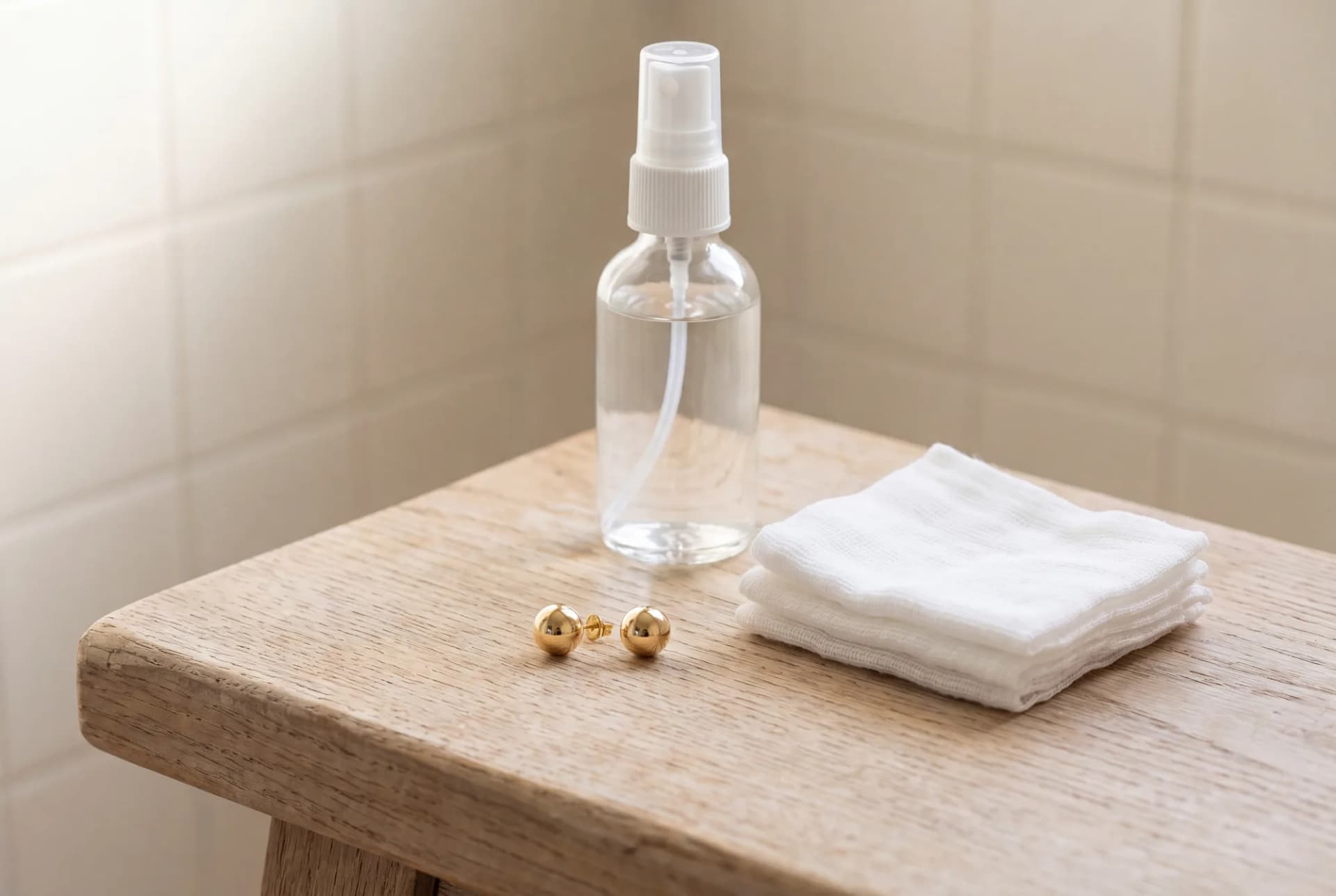
To dry the lobe, the APP recommends clean, disposable products such as gauze or cotton swabs. You use them to gently remove any crusty debris or build up. Patting is the idea here, not rubbing, and you throw the gauze away afterward so you never reuse it.
That is the whole of earring care after piercing at its simplest: wash your hands, spray with saline, pat dry with fresh gauze and leave it alone. The APP also says not to mix your own sea salt solution, because homemade salt mixes are no longer a suggested practice. We do not sell aftercare products, so we will not name any here. Look for the ingredient list the APP describes.
Your own appointment instructions come first. Different piercers and doctors can have their own preferences, and if the paper you were handed disagrees with something you read online, follow the paper and ask us or your doctor about the difference.
What to skip while it heals
The APP is just as specific about what stays off the lobe. It says to avoid cleaning with alcohol, hydrogen peroxide, antibacterial soaps, iodine or any harsh products. It also says to avoid ointments, because they prevent necessary air circulation.
Pierced ear care solutions are on the list too. The APP says to avoid pierced ear care solutions, along with anything containing benzalkonium chloride, often shortened to BZK. If a bottle is sold as an ear care solution, check the label for that ingredient before you use it.
Then there is the question of twisting. You may have been told to rotate your earring every day, and that was common advice for years. It has changed. The APP now says that during healing you should not twist, spin or rotate your jewelry, and that moving it is not necessary while cleaning or rinsing and may actually irritate the piercing.
Cleaning more than you need to does not help either. Do the routine as your instructions describe, then leave the piercing alone. If your doctor or pediatrician has given you different directions, follow theirs.
Sleeping, hair, phones and makeup
Some of this part is plain practicality rather than medical guidance. A fresh lobe does not like pressure, so think about what presses on it. A phone held to the ear, a tight hat or headband and a hard pillow can all lean on the stud and the back. Switching ears on calls and sleeping on your other side for a while are easy ways to give it room.
Hair is worth a thought as well. Long hair that catches on a stud can tug the piercing, so tying it back for the first days can help. This is general, not medical, advice.
Products are where the health sources do speak up. The APP says to avoid all beauty and personal care products on or around the piercing, including cosmetics, lotions and sprays. Sutter Health says to avoid makeup and powders in the area during healing, and if you use hairspray, to cover the pierced area with a tissue.
For a child, the same ideas apply, and a parent or guardian will usually be the one doing the cleaning. Small hands that touch and tug are a good reason to keep the routine simple and to wash your own hands before every cleaning.
Swimming after ear piercing
People ask this more than almost anything else: can you swim after getting ears pierced? The APP page does not give a date. What it says is to avoid submerging the piercing in bodies of water such as lakes, pools, oceans and hot tubs. It also says that you can protect the piercing with a waterproof transparent film dressing.
Plenty of people also ask how long after ear piercing they can swim, and swimming after ear piercing is a fair thing to plan around if a vacation or a pool party is coming up. Because the APP ties its advice to healing and gives no number of days, we will not invent one. Sutter Health lists 6 to 8 weeks as the average healing time for an earlobe, but healing differs from person to person, and nobody can promise you a date.
Bathing comes up in the same place. The APP says showers tend to be better than baths, because bathtubs can harbor bacteria, and that if you do bathe in a tub you should clean it well before each use and rinse your piercing when you get out. If you have a trip on the calendar, ask us about it before your appointment, and ask your doctor if you have a health question.
Ear piercing infection: when to see a doctor
A new piercing can be tender, and that alone is not unusual. What deserves a call is a short list. Sutter Health says to see your healthcare provider for pain that does not go away within a day or two, an area that feels hot to the touch, red lines starting from the piercing, or oozing, bleeding or pus from the piercing site.
The APP says that if you suspect an infection you should seek medical attention. We are jewelers, not clinicians, so we cannot tell you what is happening in a lobe or treat it. A doctor can, and for a child, a pediatrician is the right call.
Sutter Health also advises not to remove your jewelry before you see your healthcare provider, because taking it out can let the hole close and trap the problem inside. Leave the earring where it is until a provider tells you otherwise.
If something seems off but you are not sure it is on that list, it is always fine to ask. Your doctor, your pediatrician or the piercer who did the work can all tell you whether to wait or come in.
Before you book
We pierce ear lobes by appointment, and you choose the stud from our case. We are glad to answer questions about aftercare before you book, so ask whatever is on your mind when you call or walk in.
Frequently Asked Questions
Related guides & collections
By appointment
Book an Ear Piercing
We pierce ear lobes by appointment and you choose the stud from our case. Call during showroom hours (Monday – Saturday 11:00 AM – 7:00 PM and Sunday 12:00 PM – 6:00 PM) or book online. 300+ 5-star reviews on Google.
Prefer to talk? Call (704) 684-7530